
In 2026, agentic AI and causal measurement have become the two operational priorities for marketing analytics, replacing last-click dashboards and static reports. The practical shift is measurement first: Gartner expects agentic workflows to require AI-ready data governance, while platforms like GA4 and Google’s Gemini integrations push teams toward incrementality testing over platform-reported ROAS. The immediate move for any agency is to fix first-party data and start testing lift, not buying another dashboard.
TL;DR:
- Most organizations now have AI analytics actively running in production, with teams using incrementality tests to detect true lift rather than relying on inflated platform-reported ROAS.
- Data quality remains the biggest obstacle; implementing first-party data architecture, schema monitoring, and privacy-safe signals is essential to ensure AI models produce trustworthy results.
- AI-driven automation speeds up reporting, anomaly detection, and predictive modeling, but requires strong governance to prevent noise and overreliance on plausible yet incorrect insights.
- Incrementality testing methods like geo-holdouts, ghost ads, and synthetic controls are now the primary way to measure true marketing impact, often combined with marketing mix modeling for comprehensive insights.
- Success in AI-driven marketing analytics depends on clearly defined decision boundaries, organizational governance, and validated pilot results, with a focus on impact, feasibility, and trust risk.
Table of Contents
- What Is Driving AI in Marketing Analytics in 2026?
- Why Is Attribution Breaking Down, and What Replaces It?
- What Can AI Analytics Actually Do for Marketers Right Now?
- Why Data Governance Determines Whether AI Analytics Works
- How Agentic AI Is Changing Marketing Teams
- What Are the Real Risks of AI-Driven Marketing Analytics?
- How Should Agencies Prioritize AI Analytics Pilots?
- An Agency Perspective on AI in Marketing Analytics
- Getting Started: Gleanit for Agencies Running This Playbook
- Sources
- FAQ
What Is Driving AI in Marketing Analytics in 2026?
Agentic AI is the headline shift. Instead of a model that generates a report on request, agentic systems run continuous loops: testing creative variants, reallocating budget across campaigns, and flagging underperformance without a human triggering each step. A retail brand running Meta and TikTok campaigns might now have an agent that shifts spend between ad sets hourly based on predicted CAC, then logs the reasoning for a human to review the next morning.
The second shift is answer engine optimization (AEO). As more searches resolve inside AI chat interfaces rather than traditional results pages, brand visibility depends less on ranking a page and more on how consistently a brand’s facts appear across authoritative third-party sources. That is the “zero-click paradox”: marketers now manage entity hygiene, meaning consistent naming, structured data, and citations across the web, rather than optimizing a single landing page.
Adoption numbers back up the scale of this shift. Industry benchmarking found that 56% of organizations had AI analytics running in production by 2026, and teams using AI-driven forecasting reported significantly better forecast accuracy than teams relying on manual models.
Fast facts on 2026 AI adoption:
- 56% of marketing organizations now run AI analytics in production, not pilot mode.
- Teams pairing AI models with governance report 28 to 35% better forecast accuracy.
- Generative AI speeds up reporting and narrative generation but contributes a comparatively small direct share of measurable commerce revenue, since its main value so far is analyst time saved, not incremental sales.
By the numbers: Organizations with mature AI analytics report meaningfully better forecasting than those without it, according to Improvado’s 2026 trends analysis. The gap is governance, not access to models.
Generative AI’s biggest 2026 contribution isn’t new revenue. It’s speed. Report drafting, anomaly summaries, and creative variant generation that used to take an analyst half a day now take minutes. That’s real value, but it’s an efficiency gain, not a growth lever on its own.
Why Is Attribution Breaking Down, and What Replaces It?
Platform-reported ROAS has been inflated for years, and by 2026 most performance marketers know it. App Tracking Transparency, cookie deprecation, and the walled-garden nature of Meta and TikTok’s own reporting mean each platform tends to claim credit for conversions it merely touched, not caused. AD-Times reporting on incrementality testing documents how attribution inflation routinely overstates real lift, sometimes badly enough that unified-measurement rollouts get reversed when the gap between claimed and actual lift exceeds roughly 40%, according to Improvado’s analytics trend coverage.
Three incrementality methods now do the heavy lifting:
- Geo-holdout tests. Split matched markets, run the campaign in one, hold the other out, and compare outcomes. These need a minimum four-week window for mid-market brands and a willingness to leave some revenue on the table in the control cell.
- Ghost ads (PSA tests). The platform serves a public-service ad instead of your creative to a held-out audience, letting you measure true incremental conversions without a separate geography.
- Synthetic controls. Statistical modeling builds a “what would have happened anyway” baseline from historical and comparable-market data, useful when you can’t cleanly split geography or audience.
Marketing mix modeling (MMM) ties these results together at a higher level, estimating channel contribution across weeks or months using aggregate spend and outcome data rather than user-level tracking. Google’s 2026 measurement updates, including Meridian and tighter Data Manager integration, were built specifically to help advertisers feed first-party data into causal experiments instead of relying on platform pixels alone. The most defensible posture triangulates all three: incrementality tests validate MMM’s channel coefficients, and MMM fills the gaps between discrete tests.
Pro Tip: Before running any incrementality test, confirm your weekly spend on the tested channel is large enough to produce a detectable lift within the test window. A $500-a-week campaign rarely generates a statistically readable signal in four weeks.
A quick pre-flight checklist for a valid test: matched-market pairs with similar seasonality, a spend threshold high enough to move the metric you’re testing, a window of at least four weeks, and a pre-registered success threshold so you’re not rationalizing the result after the fact.
What Can AI Analytics Actually Do for Marketers Right Now?
Strip away the vendor pitch decks, and AI analytics in 2026 delivers value in four concrete areas.
- Anomaly detection. Automated alerts catch budget overspend, CAC spikes, or sudden drop-off in a funnel stage faster than a human scanning dashboards. A well-tuned system flags a 20% CAC jump within hours instead of at the end of a reporting week.
- Predictive modeling. Churn, lifetime value, and purchase-propensity models now run continuously rather than as quarterly exercises, though accuracy still depends heavily on data volume and event quality, not just model sophistication.
- Agentic optimization loops. These differ from older rule-based automations (if CPA exceeds $X, pause the ad) by continuously adjusting multiple variables at once. That power requires real governance, since an unsupervised agent can just as easily amplify a mistake as fix one.
- Conversational analytics. Natural-language query tools let an analyst ask “why did conversion rate drop in the Northeast last week” and get a plain-language answer pulled from the underlying data, cutting time-to-insight substantially compared to building a custom report.
Improvado’s benchmark data shows teams pairing AI automation with strong data governance see up to 64% faster time-to-insight. The keyword there is “with governance.” Without it, agentic systems and predictive models produce plausible-looking noise.
Why Data Governance Determines Whether AI Analytics Works
None of this functions without clean data underneath it. Epsilon’s 2026 benchmark study found that 91% of marketers consider AI valuable, but data quality remains the single biggest obstacle to actually capturing that value. Plenty of teams overestimate how mature their data setup is until an AI model starts producing answers nobody trusts.
Four fixes matter more than any AI feature purchase:
- First-party data architecture. A clean event taxonomy, consistent naming across platforms, and a single source of truth for customer identity beat any amount of modeling sophistication layered on top of messy inputs.
- Schema governance and monitoring. Someone needs to own the event schema, catch breaking changes before they hit production, and run regular data-quality diagnostics, not just when a report looks obviously wrong.
- Privacy-safe signal strategy. Server-side tagging, Meta’s Conversions API, and consent-first data collection now matter more than any single tracking pixel, since browser and app-level restrictions have made client-side tracking alone unreliable.
- Operational discipline. Data contracts between teams, version control for models and dashboards, and monitoring SLAs that define who gets alerted when a data feed breaks. Building reliable attribution after cookie deprecation starts here, not with a new tool.
Pro Tip: Run a data-quality audit before you run an AI pilot, not after. Teams that fix event tracking first consistently get better model output than teams that patch tracking issues mid-pilot.
How Agentic AI Is Changing Marketing Teams
Agentic AI doesn’t replace analysts. It changes what they spend time on. The roles gaining the most weight in 2026 are AI supervisors who audit agent decisions, data stewards who own the taxonomy powering those decisions, and experiment designers who build the incrementality tests that validate whether the agent’s actions actually worked.
Hiring priorities have shifted accordingly. Causal inference and basic statistical literacy now matter as much as channel expertise, because someone on the team has to be able to tell the difference between a model that’s genuinely improving performance and one that’s drifting into confidently wrong territory. Gartner’s 2026 marketing guidance frames this as a direct organizational design problem, not just a hiring one.
Decision rights need clear boundaries before an agent goes live. Define what an autonomous system can do without approval (reallocate budget within a set range), what needs a human sign-off (pause an entire campaign), and what escalates immediately (spend anomalies above a defined threshold). A workable governance rhythm is a weekly review of agent decisions and a monthly deeper audit against core KPIs like iROAS and forecast accuracy. Teams that dedicate 15 to 20% of their AI tool budget to training and oversight report higher-quality insights and fewer misapplied outputs than teams that spend everything on licenses. The organizational shift toward AI-augmented collaboration is as much about redefining who reviews what as it is about the tools themselves.

What Are the Real Risks of AI-Driven Marketing Analytics?
AI models still hallucinate, and a confidently wrong revenue forecast is more dangerous than an obviously broken one. Guardrails need to be built in, not bolted on afterward.
- Verify before you act. Any AI-generated insight tied to a budget decision needs a human spot-check against the raw data, especially for numbers that will move real spend.
- Audit for bias. Predictive models trained on historical conversion data can quietly encode which customer segments got targeted well in the past, skewing propensity scores toward audiences that were already prioritized.
- Protect consumer trust. Disclose AI-generated content and creator collaborations clearly, and keep a visible layer of human oversight on anything customer-facing.
- Watch privacy exposure. Server-side data pipelines and third-party AI tools both widen the surface area for compliance risk, so know exactly where customer data flows before connecting a new model to it.
How Should Agencies Prioritize AI Analytics Pilots?
Score potential pilots on three axes: impact (does this move a KPI leadership cares about), feasibility (do you have the data to support it now), and trust risk (how bad is it if the model gets it wrong). A churn-prediction pilot on clean CRM data scores high on all three. An agentic budget-reallocation pilot on a client with messy tracking scores high on impact but low on feasibility, meaning it needs data work first.
- Confirm data readiness: event tracking, taxonomy consistency, and at least a few months of clean historical data.
- Define success thresholds before launch: target lift percentage, forecast accuracy improvement, or time-to-insight reduction.
- Run a bounded test, whether that’s a geo-holdout, a predictive model on one client segment, or an agentic loop with hard spend caps.
- Compare results against iROAS, measured lift, and forecast accuracy, not platform-reported ROAS.
- Scale only after the pilot clears its pre-defined threshold, then train the wider team on what made it work.
Pro Tip: Fund the scaled rollout from the pilot’s proven savings, not from a separate budget request. It’s an easier internal sell and keeps the team honest about whether the pilot actually worked.
An Agency Perspective on AI in Marketing Analytics
Clients don’t want a lecture on Bayesian methods. They want a straight answer to “did this work,” and in 2026 that answer has to come from incrementality data, not a platform’s self-reported ROAS. The agencies getting this right present a lift number alongside a confidence range, then let the client decide how much risk they’re comfortable with. Pilot one causal test this quarter, build the governance habit around it, and the AI tooling conversation gets a lot easier to have honestly.
— Ovannes
Getting Started: Gleanit for Agencies Running This Playbook
Gleanit is built for exactly the workflow this playbook describes. It runs automated monitoring across Meta, TikTok, and Google so agencies aren’t manually pulling platform reports to spot the funnel gaps that incrementality testing is designed to catch. Instead of a generic dashboard, it flags where a client’s funnel is leaking and prioritizes fixes by expected ROI, which is the same impact-versus-feasibility thinking this article recommends for pilot selection.
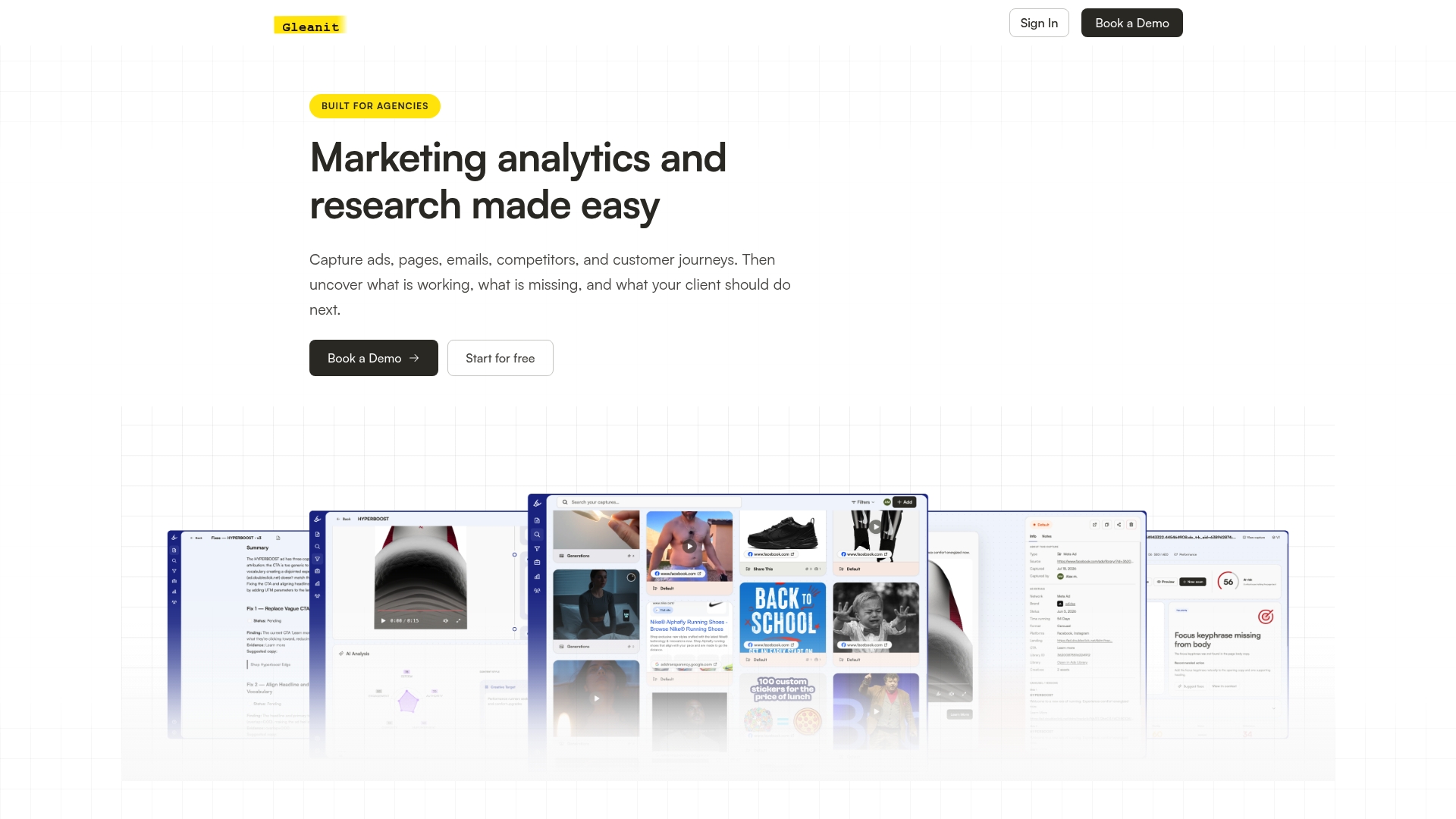
Before committing budget to a pilot, get a read on where the gaps actually are. Gleanit offers a free marketing audit, a free competitor analysis, and a free ad audit that surface funnel and creative gaps without any commitment. Run one of those first, use the findings to scope a targeted pilot, then check the Agency plan once you’re ready to move client reporting and monitoring onto a connected workspace instead of a stack of spreadsheets and platform exports.
Sources
- Gartner: The future of marketing
- 7 AI Marketing Trends Reshaping Strategy in 2026 — Improvado
- Incrementality Testing Is Quietly Becoming Performance Marketing’s New North Star — AD-Times
- Drive growth with your new measurement playbook — Google blog
- 2026 benchmark study: Marketing’s AI inflection point — Epsilon
FAQ
What Does AI in Marketing Analytics Mean in 2026?
It means pairing agentic AI systems, which run continuous optimization loops, with causal measurement methods like incrementality testing and MMM instead of relying on platform-reported attribution. The goal is trustworthy answers about what actually drove results, not just faster dashboards.
Is Platform-Reported ROAS Still Reliable?
No. Attribution inflation from Meta and TikTok’s own reporting routinely overstates real lift, which is why incrementality testing has become mainstream as a corrective measure. Treat platform ROAS as a directional signal, not a final number.
How Long Does a Geo-Holdout Test Need to Run?
A minimum of four weeks for a mid-market brand, with matched control and test markets that share similar seasonality and spend levels. Shorter windows rarely produce a statistically readable lift signal.
What Does Gleanit Cost for Agencies?
Gleanit offers a Solo plan at $99 per month and an Agency plan at $459 per month, with additional users or workspaces at $20 per month each, according to Gleanit’s pricing page. Agencies can also start with a free marketing, competitor, ad, email, or landing page audit before committing to a plan.
What Skills Do Marketing Teams Need for AI Analytics in 2026?
Causal inference and basic statistical literacy now matter as much as traditional channel expertise, since someone has to validate whether an AI model’s output is genuinely accurate. Gartner’s 2026 guidance frames this as an organizational design shift, not just a training exercise.
Recommended
- Media Mix Modeling: A Practitioner’s Guide for 2026
- Build Reliable Post Cookie Attribution in 90 Days for Agencies
- Multi-Touch Attribution Models: A Practitioner’s Guide
- Automate Marketing Reports for Agencies: Start With Data Governance
Corrections: ovannes@hearye.co or our editorial policy.