
A campaign post mortem is a short, structured, blameless review that converts campaign results into prioritized, trackable fixes you can implement in the next 30–60 days. According to a 2024 HubSpot survey, as reported by Influencers Time, teams running regular post-mortems saw a notable median improvement in campaign ROI within a year. That is not a small number for an agency billing on performance.
Start now: book a 60–90 minute, timeboxed meeting for 7–14 days after the campaign ends. Have these three things ready before anyone walks in:
- Final brief with original objectives, hypotheses, and KPI targets
- Single source-of-truth dataset with normalized spend, delivery, and conversion data
- Decision log listing every mid-campaign change and the reasoning behind it
Pro Tip: Send a short pre-read to all attendees 24 hours before the meeting. A single source of truth prevents the meeting from derailing and cuts the time needed to reach decisions by half.
Key Takeaways
A campaign post mortem produces three decisions — repeat, kill, or test — and those decisions only stick when they are assigned to owners, tracked in a PM tool, and validated at 30 and 60 days.
| Point | Details |
|---|---|
| Timing matters | Run the review 7–14 days after campaign end to let conversions and pipeline data stabilize. |
| Data pack first | Pull from GA4, ad platforms, and CRM before the meeting; agree on attribution window and conversion definitions upfront. |
| Decisions over discussion | Every post-mortem must end with a repeat/kill/test decision, an owner, and a due date for each action. |
| Validate the fixes | Design a success-criteria threshold and a holdout or A/B test before the next campaign launches. |
| Gleanit automates the pack | Gleanit assembles normalized data across Meta, TikTok, Google, and LinkedIn automatically, cutting prep time and keeping decision logs current. |
Table of Contents
- When should you run a campaign post mortem?
- Who should attend and what should they prepare?
- What data should you pull before the meeting?
- How to run a 60–90 minute post-mortem meeting
- Which KPIs and qualitative signals actually matter?
- How to find the real root cause
- How to prioritize fixes so the right things get done first
- What deliverables should come out of the meeting?
- How do you know if the fixes actually worked?
- Paste-ready templates you can use today
- How to automate and scale post-mortems across clients
- How Gleanit supports repeatable post-mortems for agencies
- The part most agencies get wrong about post-mortems
- Gleanit cuts your post-mortem prep from hours to minutes
- Sources
When should you run a campaign post mortem?
Wait 7–14 days after a campaign ends before running the review. That window lets view-through conversions settle, CRM pipelines update, and attribution models stabilize. Running it on day two means you are reviewing incomplete data.
Run a full post mortem after:
- Any campaign that missed its primary KPI by more than 10%
- Any campaign that dramatically exceeded its goal (understanding why a win happened is just as valuable)
- Every high-budget or high-stakes client campaign, regardless of outcome
For cadence, match the review depth to the work:
- Per-campaign reviews for high-value or high-complexity campaigns
- Biweekly rolling checks for fast-running paid experiments where you need quick iteration signals
- Quarterly cross-campaign audits to surface systemic issues — recurring creative fatigue, approval bottlenecks, or audience overlap problems that single-campaign reviews never catch
Who should attend and what should they prepare?
Keep the room small. A post-mortem produces decisions, not a report — and decisions happen faster with five people than fifteen.
Core attendees and their focus areas:
- Campaign owner — overall performance narrative and objective alignment
- Media lead — channel delivery, pacing, bid strategy, and placement data
- Analytics or RevOps — attribution, funnel metrics, CRM pipeline numbers
- Creative lead — asset performance, fatigue signals, copy and format decisions
- Client or sales rep — pipeline quality, revenue impact, and client context
For regulated categories, add a legal or compliance reviewer. For larger organizations, a neutral facilitator keeps the conversation on process rather than people.
Pro Tip: Ask each attendee to submit one “what surprised me” note before the meeting. Anonymous inputs surface candid observations that people hesitate to say aloud, and they give the facilitator a ready-made agenda for the root-cause segment.
What data should you pull before the meeting?
Revisit campaign objectives first, then collect data from GA4, ad platforms, email systems, and your CRM. Pick 3–5 key metrics tied to the original brief. Vanity metrics — impressions, raw clicks, follower counts — belong in an appendix, not the main scorecard.
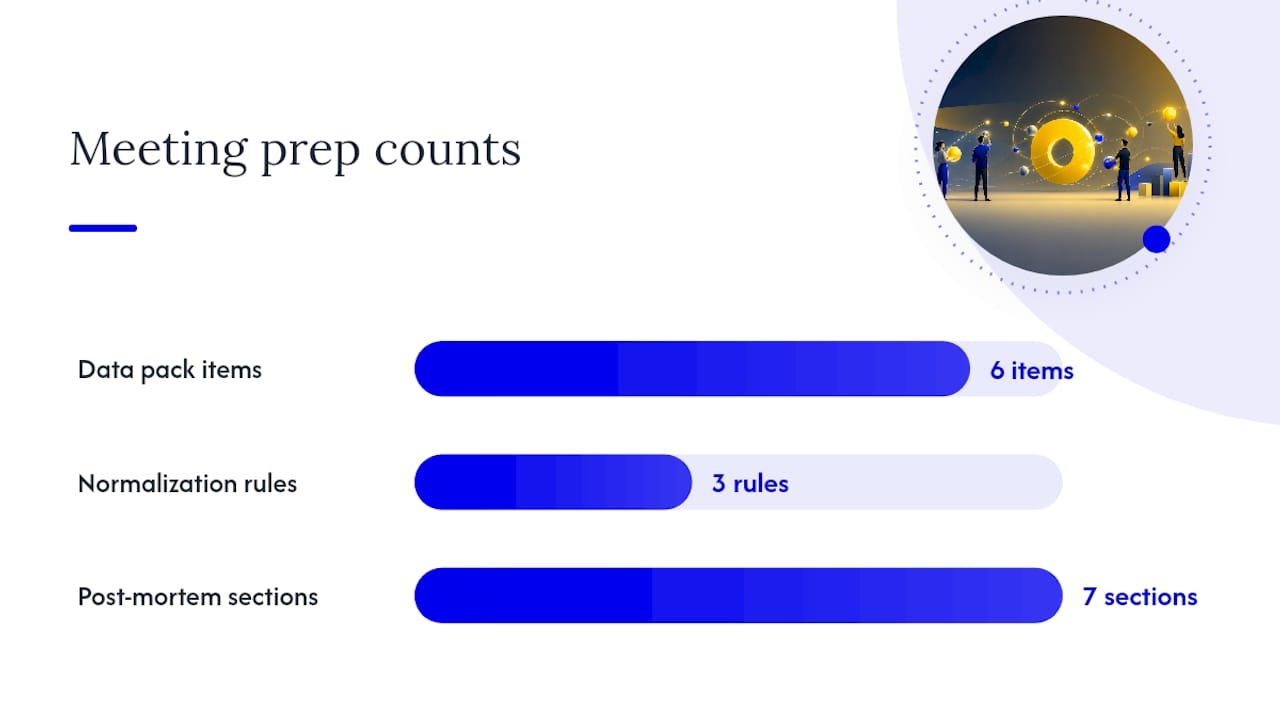
Build your data pack in this order:
- Export the final brief with original targets
- Pull total spend and delivery by channel and placement
- Export attribution snapshots from your primary analytics source (GA4 or equivalent)
- Pull CRM pipeline and revenue numbers tied to campaign-sourced leads
- Compile the creative asset list with per-asset performance data
- Attach experiment logs and any mid-campaign changes from the decision log
Before the meeting, agree on three normalization rules: the attribution window, the conversion definition (form fill vs. qualified lead vs. closed revenue), and how UTM parameters and platform IDs reconcile across sources. One mismatched definition can send a 90-minute meeting in the wrong direction.
A high-quality post-mortem covers objectives, final results vs. targets, funnel diagnostics, creative analysis, audience checks, tracking integrity, and a prioritized action plan. That list is your data pack checklist.
How to run a 60–90 minute post-mortem meeting
Structure the meeting so decisions come before discussion, not after it. A structured, blameless meeting uses data, customer feedback, and team experience to identify what to repeat, what to improve, and what to test next.
Timeboxed agenda:
- Verdict (5 min) — campaign owner states the one-line outcome: hit, miss, or surprise
- Evidence and scorecard (20–30 min) — analytics lead walks the data pack; no editorializing yet
- Root-cause diagnostics (15–20 min) — team works through causes using Five Whys or fishbone
- Decisions: repeat, kill, or test (15–20 min) — assign an owner and due date to every decision
- Wrap and next steps (5 min) — confirm the decision log is complete and schedule the 30-day check-in
Meeting rules: blameless framing only, one source of truth, facilitator enforces timeboxes, pre-read required.
Pro Tip: Open the decisions segment with the question “What would we do differently if this campaign launched tomorrow?” It reframes the conversation from retrospective blame to forward-looking process design.
Which KPIs and qualitative signals actually matter?
Match metrics to the campaign’s original objective. Reviewing ROAS for an awareness campaign, or reach for a direct-response campaign, produces noise.
By objective:
- E-commerce / direct response: ROAS, CAC, ROMI, conversion rate by funnel stage
- Lead generation: CPL, MQL-to-SQO ratio, pipeline value, win rate
- Awareness / brand: reach, frequency, brand lift (where measured), share of voice
Beyond outcome KPIs, review efficiency signals: cost per qualified lead, CAC trend over the campaign window, and landing page conversion rate by traffic source. These tell you where the funnel broke, not just that it broke.
Qualitative signals are equally important and often skipped. Capture customer feedback from support tickets and sales calls, social sentiment shifts, creative fatigue notes from the media lead, and any brand lift data available. Segment everything by channel × audience × creative × placement before drawing conclusions. A campaign that “missed” overall may have hit hard on one channel and failed on another.
How to find the real root cause
Surface-level causes (“the creative underperformed”) rarely produce fixes that stick. Use structured methods to get one level deeper.
Recommended methods:
- Five Whys — ask “why” five times from the symptom to reach the systemic cause
- Fishbone (Ishikawa) — map causes across six categories: people, process, data, creative, external, and tools
- Timeline reconstruction — plot every campaign event and change against the performance curve to find inflection points
- Hypothesis testing — convert each suspected cause into a testable statement with evidence required to confirm it
Use this hypothesis template during the meeting:
Pro Tip: Assign one person to play devil’s advocate for each hypothesis. Confirmation bias is the most common reason post-mortems produce the same fixes campaign after campaign.
How to prioritize fixes so the right things get done first
Not every fix deserves equal urgency. Score each candidate action on two axes: expected impact on the primary KPI, and effort to implement.
Impact × effort scoring:
- High impact, low effort — fix immediately (tracking errors, broken UTMs, mismatched audiences)
- High impact, high effort — schedule with a named owner and a deadline (landing page rebuild, creative system overhaul)
- Low impact, low effort — batch into a sprint (copy tweaks, minor bid adjustments)
- Low impact, high effort — deprioritize or drop
For agencies that prefer a scoring formula, RICE (Reach × Impact × Confidence ÷ Effort) and ICE (Impact × Confidence × Ease) both work. The specific framework matters less than applying it consistently across every action so you can rank them.
Prioritize fixes using an impact × effort rubric, then operationalize the top items immediately by turning them into PM tasks with owners and due dates. A ranked backlog with three columns — action, owner, due date — is all you need to leave the meeting with momentum.
What deliverables should come out of the meeting?
Minimum output from every post-mortem:
- One-line verdict — hit, miss, or surprise, with the primary reason
- Evidence summary — two to three paragraphs covering what the data showed
- Prioritized action list — owner, due date, and expected impact for each item
- Measurement plan — how each fix will be validated and by when
- Links to raw data and assets — so anyone can audit the conclusions later
A decision-first one-page report works best: open with the verdict, explain why, list cost and return, and end with clear next actions and owners; supporting charts go in an appendix.
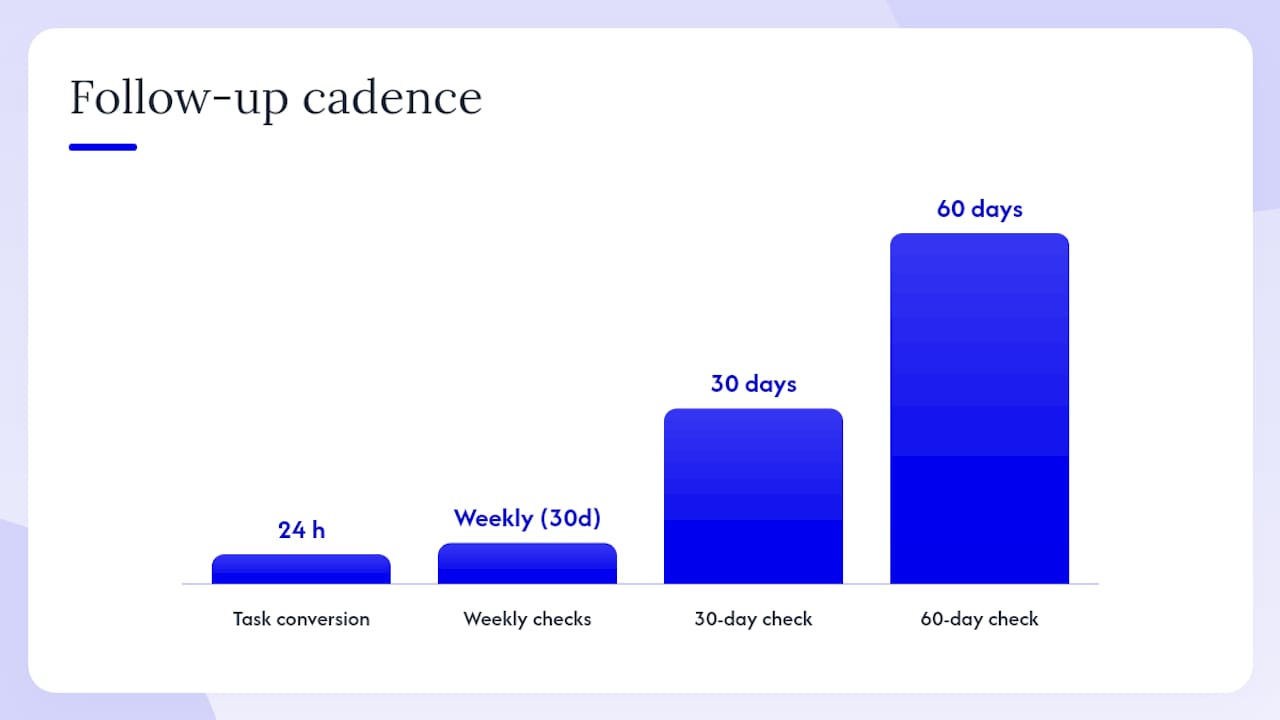
Follow-up cadence:
- Convert every action to a task in your PM tool within 24 hours of the meeting
- Weekly check-ins on high-impact fixes for the first 30 days
- 30-day validation checkpoint: are the fixes live and measurable?
- 60-day checkpoint: do the numbers confirm the expected impact?
Assign owners, set deadlines, integrate tasks into project software, and store decisions in a centralized repository for cross-project learning. Tag every decision with campaign type, channel, and issue category so you can search across clients and quarters.
Pro Tip: Feed validated fixes back into your brief templates immediately. If a landing page structure consistently underperforms for a specific audience type, that note belongs in the next brief’s creative requirements, not just in the decision log.
How do you know if the fixes actually worked?
Design a validation plan before the next campaign launches, not after.
- Define success criteria upfront: a specific KPI threshold, a confidence level (80% minimum for most marketing decisions), and a time window
- Use a control or holdout group where possible — even a 10–20% holdout gives you a clean comparison
- Run A/B tests for creative and landing page changes; use pre-post comparisons with stable seasonal windows for structural changes
- Check sample size before calling a result — underpowered tests produce false positives that send teams chasing phantom improvements
If a fix doesn’t validate within the agreed window, run a mini post-mortem on the fix itself. Was the hypothesis wrong, or was the implementation flawed? Persistent failures on the same issue usually signal a process problem upstream — brief quality, approval cycles, or data infrastructure.
Pro Tip: Set a “no-decision zone” for the first seven days of a new campaign. Early data is noisy. Reacting to day-three numbers with structural changes is one of the fastest ways to invalidate your own experiment.
Paste-ready templates you can use today
Calendar invite text:
60–90 minute agenda template:
- Verdict (5 min) — campaign owner
- Scorecard walkthrough (25 min) — analytics lead
- Root-cause diagnostics (20 min) — full team
- Decisions and owners (20 min) — facilitator leads
- Wrap and next steps (5 min) — confirm log and schedule 30-day check
Decision log columns: Campaign | Decision | Rationale | Owner | Due Date | Status | Validation Date
Prioritization sheet columns: Action | Impact (H/M/L) | Effort (H/M/L) | Score | Owner | Due Date | Expected KPI Lift
The post-mortem identified the root cause as audience overlap between two ad sets driving up CPM. Decision: kill the overlapping ad set, test a refined exclusion list. Owner: media lead.
Store templates in a shared drive folder versioned by quarter (e.g., /Templates/Post-Mortem/Q2-2026). For client work, maintain a separate copy per client workspace so version history stays clean.
How to automate and scale post-mortems across clients
Manual data collection is where post-mortems die. When pulling the data pack takes three hours, teams skip the meeting or run it on incomplete numbers.
Automation opportunities:
- Scheduled data exports from Meta, Google, TikTok, and LinkedIn into a central dashboard
- KPI anomaly alerts that flag underperformance during the campaign, not after
- Automatic asset capture — creative screenshots, copy variants, and landing page versions logged at launch
- Action tracking tied to your PM tool so owners get reminders without a manual follow-up
Integration checklist:
- Analytics: GA4 or equivalent as the primary source of truth
- Ad platforms: Meta Ads Manager, Google Ads, TikTok Ads, LinkedIn Campaign Manager
- CRM: Salesforce, HubSpot, or equivalent for pipeline and revenue attribution
- PM tools: Asana, ClickUp, Linear, or Notion for action tracking
- Comms: Slack, Discord, or Teams for weekly check-in nudges
For agencies managing multiple client workspaces, tagged decision logs across clients uncover organizational weaknesses — recurring creative approval delays, repeated audience targeting errors — that single-campaign reviews never surface. Aggregate tags quarterly to find the patterns.
Pro Tip: *Build a “post-mortem ready” checklist into your campaign close-out SOP.
How Gleanit supports repeatable post-mortems for agencies
Gleanit connects ad monitoring, customer journey tracking, and funnel gap diagnostics into a single dashboard across Meta, TikTok, Google, and LinkedIn. For post-mortems, that means the data pack is largely assembled before you schedule the meeting.
Features that map directly to the post-mortem workflow:
- Automated ad and journey monitoring across platforms — no manual exports
- Single-source dashboards with normalized spend, delivery, and conversion data
- Prioritized recommendations that surface high-ROI fixes before the meeting starts
- Decision log with owners, due dates, and status tracking
- Integrations with Slack, Discord, Telegram, WhatsApp, and Figma for team notifications
- AI-powered report generation to produce the one-page verdict document automatically
- Client-dedicated workspaces so each account’s data and decisions stay separate
Workflow example:
- Campaign ends — Gleanit’s automated monitoring flags KPI anomalies and assembles the data pack
- Analytics lead reviews the prioritized recommendations and adds context to the decision log
- Post-mortem meeting runs against the pre-built scorecard — no setup time
- Decisions are logged with owners and due dates; Slack notifications go out automatically
- 30-day validation checkpoint is tracked inside the same workspace
Pro Tip: Use Gleanit’s AI report generation to produce the one-page verdict document immediately after the meeting. Send it to the client the same day while the decisions are still fresh.
The part most agencies get wrong about post-mortems
Post-mortems fail not because teams lack data, but because they lack discipline about what the meeting is for. The meeting exists to produce three decisions — repeat, kill, or test — and to assign an owner to each one before anyone leaves the room. Everything else is supporting evidence.
The agencies that get the most value from retrospectives are the ones that treat the decision log as a living document, not a filing cabinet. They tag decisions, search across clients, and update brief templates within 48 hours of the meeting. That feedback loop is what turns a single campaign review into an organizational learning system.
Hard timeboxes are not optional. A 90-minute meeting that runs to two hours is a meeting where the last 30 minutes produced no decisions — just fatigue. Set the clock, enforce it, and move unresolved items to a follow-up task rather than extending the session.
Automating the data pack is the single highest-leverage change most agencies can make. When the scorecard is ready before the meeting starts, the conversation shifts from “what happened?” to “why did it happen and what do we do next?” That shift alone cuts meeting time and improves decision quality.
Gleanit cuts your post-mortem prep from hours to minutes
Most agencies spend more time building the data pack than running the actual review. Gleanit flips that ratio. The platform automatically monitors ads and customer journeys across Meta, TikTok, Google, and LinkedIn, assembles a normalized data pack, and surfaces prioritized fixes before your team sits down.
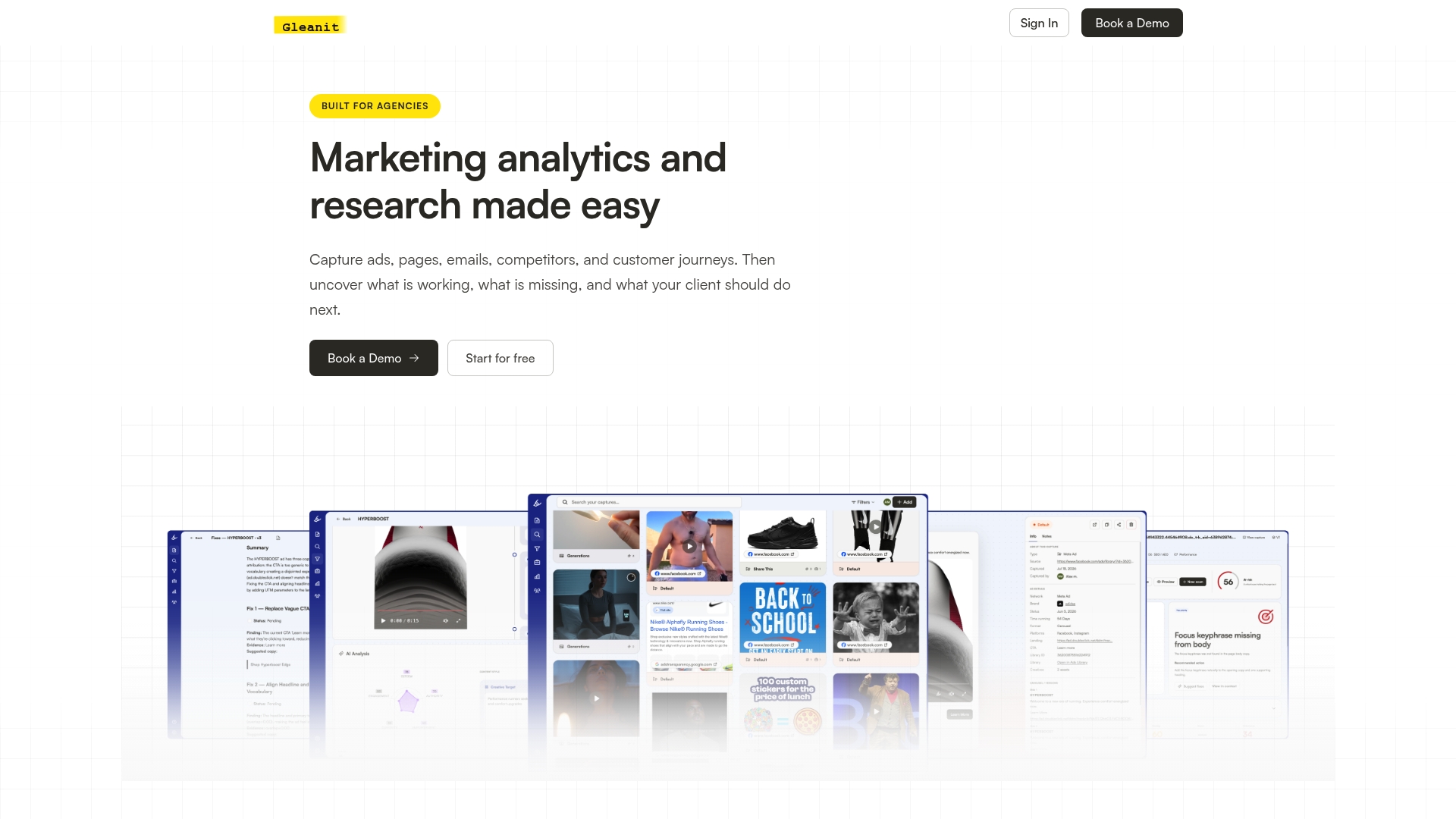
You get a single connected view of every client’s funnel, a decision log with owners and due dates, and AI-generated reports that produce the one-page verdict document automatically. Integrations with Slack, Discord, and your PM tool keep action owners accountable between meetings, so the 30-day validation checkpoint actually happens.
Start a free trial at Gleanit and run your next post-mortem with a pre-built scorecard, automated data collection, and a decision log that tracks every fix through to validation.
Sources
The templates and methods in this article draw on the following sources. Each covers a specific part of the post-mortem workflow in more depth:
- What should be included in a campaign post-mortem analysis?
- Post-Campaign Review: What to Analyse and Report
- Post-Mortem Analysis for Marketing: Learn From Failure Fast
- Marketing campaign retrospective
For platform-specific metric guidance, consult the native documentation for Meta Ads Manager, Google Ads, GA4, and your CRM. Those sources update frequently and are the authoritative reference for attribution model changes that affect post-mortem data.
Recommended
Corrections: ovannes@hearye.co or our editorial policy.