
Honor every opt-out signal immediately, update your Notice at Collection to list data categories and third parties, sync suppression lists across every ad platform and ESP, and shift measurement toward aggregated or modeled attribution instead of individual-level tracking. Gleanit’s free ad audit can flag where opt-out handling is leaking into live campaigns right now.
TL;DR:
- Maintaining current suppression lists and passing opt-out signals to all platforms prevents signal loss and minimizes impacts on ad performance.
- Using aggregate or modeled measurement methods helps preserve attribution accuracy when individual-level tracking is restricted by opt-outs.
- Building a unified suppression list sync process and logging consumer requests ensures ongoing compliance and quick response to regulatory inquiries.
- Contracts with vendors must clearly define their role as service providers or third parties to legally respect consumer opt-out rights and prevent data misuse.
- Continuous monitoring tools like Gleanit can identify funnel gaps caused by opt-out signaling issues, enabling proactive correction before performance declines.
Table of Contents
- Your 1 to 4 Week CCPA Compliance Checklist for Marketers
- CCPA and CPRA Basics Every Marketer Needs to Know
- How CCPA Opt-Outs Actually Hit Your Ad Performance
- Setting Up Your Marketing Stack to Handle Opt-Outs Correctly
- What Your Privacy Policy and Request Process Need to Cover
- How Gleanit Helps Agencies Catch CCPA Measurement Gaps
- Why Marketing Teams Need a Seat at the Privacy Table
- Managing Ad Vendors and Data Processors Without Losing Control
- Email Marketing Under CCPA: What Actually Changes
- B2B Marketers Don’t Get a CCPA Exemption Anymore
- Data Minimization: Collect Less, Store It for Less Time
- Cross-Device Tracking Gets Harder, Not Impossible
- An Editorial Take on Getting CCPA Compliance Right
- Get a Free Check on Your CCPA-Related Ad and Funnel Gaps
- Sources
- FAQ
Your 1 to 4 Week CCPA Compliance Checklist for Marketers
If you’re staring down a compliance deadline with no clear starting point, work through this order. It reflects what actually creates legal exposure fastest versus what can wait a few weeks.
- Update your Notice at Collection and privacy policy links. List the categories of personal information collected, the business purpose, whether data is sold or shared, and a working opt-out link, before you touch anything else.
- Build a suppression list and keep it current. Anyone who has opted out of sale or sharing goes on this list, and no ad platform or ESP should ever receive their identifiers again.
- Pass opt-out signals to every downstream platform. Whether it’s a Global Privacy Control signal or a manual opt-out click, that status has to travel with the user, not stop at your own server.
- Enable server-side tagging where your stack supports it. Server-side endpoints let you keep first-party signals flowing to platforms like Google and Meta without leaking data on individuals who opted out.
- Segment your test campaigns to isolate impact. Run a controlled comparison between suppressed and unsuppressed audiences so you know exactly how much reach and signal you’re losing.
- Document every step with timestamps. If a regulator or a consumer ever asks how a request was handled, you need a paper trail, not a memory.
Pro Tip: Build the suppression list sync into your weekly ad-ops routine, not a one-time project. Opt-outs happen daily, and a suppression list that’s a month stale is functionally useless.
CCPA and CPRA Basics Every Marketer Needs to Know
The California Attorney General’s CCPA guidance lays out four rights that touch marketing directly: the right to know what data a business collects, the right to delete it, the right to opt out of sale or sharing, and the right to limit use of sensitive personal information. The CPRA amendments that took effect in 2023 added the right to correct inaccurate data and created a distinct category for sensitive personal information, which includes precise geolocation and certain demographic details often used in ad targeting.
Every business collecting personal information has to serve a Notice at Collection at or before the point of collection. Under the CCPA regulations, that notice must state what categories of data you’re gathering, why, and whether it gets sold or shared, plus a clear opt-out link.
One distinction trips up more marketers than anything else: service provider versus third party. A service provider processes data only on your behalf and under contract restrictions, while a third party can use that data for its own purposes. The CCPA statute specifically bars combining opted-out consumers’ data for cross-context behavioral advertising. If your ad tech vendor operates as a third party rather than a service provider, your contract terms and your compliance obligations look very different.
How CCPA Opt-Outs Actually Hit Your Ad Performance
Opt-outs don’t just remove a few records from a database. They shrink the pool of eligible signals feeding your bidding algorithms, and that has measurable downstream effects on retargeting and cross-site measurement.
Research from the Platform Strategy Institute found that opt-outs reduce eligible audience data and weaken optimization signals across the board, which is exactly why campaigns that once performed well can quietly underperform after opt-out volume climbs, even with no other changes to creative or budget.
The instinct many teams have is to disable measurement tools outright to play it safe. That’s usually the wrong move. The same research recommends a more targeted path:
- Maintain suppression lists rather than pulling measurement tools entirely.
- Switch to aggregate or modeled measurement instead of individual-level tracking for opted-out segments.
- Lean on first-party data you collected directly, since it carries fewer downstream restrictions than third-party identifiers.
- Test server-side tagging to preserve signal quality without exposing raw personal data.
Signal loss compounds. A campaign losing even a modest share of trackable conversions doesn’t just lose those conversions in reporting. It loses the training data that keeps automated bidding sharp, which drags down performance for the audience that never opted out at all. If your funnel benchmarks look off, comparing against industry CTR and CVR data can help you separate normal variance from an opt-out-driven drop.
Setting Up Your Marketing Stack to Handle Opt-Outs Correctly
Getting the technical implementation right is where most of the actual compliance risk gets resolved or created. Here’s the sequence that works:
- Build one master suppression list and sync it everywhere. Every platform, whether it’s Meta Ads Manager, Google Ads, or your ESP, needs the same current suppression data, not a version from last quarter.
- Pass explicit opt-out signals downstream. Whether the signal comes from a Global Privacy Control header or a manual opt-out click, it has to reach every platform touching that user’s data, not just stop at your CMS.
- Prefer server-to-server connections over browser-based pixels when the platform supports it. Server-side paths give you more control over exactly what data leaves your systems and when.
- Run parallel tests between browser and server-side measurement. A short shadow test tells you whether your server-side setup is actually capturing what the browser pixel used to, before you retire the old method.
- Log every consumer request with a verification record. Date, method of verification, and resolution all need to be on file in case of an audit.
Monitoring dashboards that already track ad performance across platforms make this far less manual. A Meta Ads monitoring workflow that flags sudden reach or conversion drops can double as an early warning system for opt-out-driven signal loss.
Pro Tip: Run your shadow test for at least two full billing cycles before trusting server-side numbers completely. Ad platforms recalibrate bidding models slowly, and a one-week test will underestimate how well the new setup actually performs.
What Your Privacy Policy and Request Process Need to Cover
Your privacy policy needs the same core elements as your Notice at Collection: categories of data collected, business purposes, whether data is sold or shared, and a working opt-out mechanism. Add a clearly labeled Notice of Right to Opt-Out or Notice of Right to Limit wherever sensitive data gets collected, along with an alternative opt-out link for anyone who can’t use automated signals.
Assign a specific owner, usually someone on the privacy or legal team working with marketing, for verifying and logging consumer requests. Track the date received, verification method, and resolution date for every one.
How Gleanit Helps Agencies Catch CCPA Measurement Gaps
Gleanit’s automated monitoring across Meta, TikTok, and Google flags funnel gaps before they quietly erode client ROI, including the kind of signal loss opt-outs create. Instead of guessing where suppression isn’t syncing correctly, agencies get prioritized fixes ranked by impact. Gleanit’s blog covers deeper attribution rebuilding strategies worth bookmarking alongside your compliance workflow.
Why Marketing Teams Need a Seat at the Privacy Table
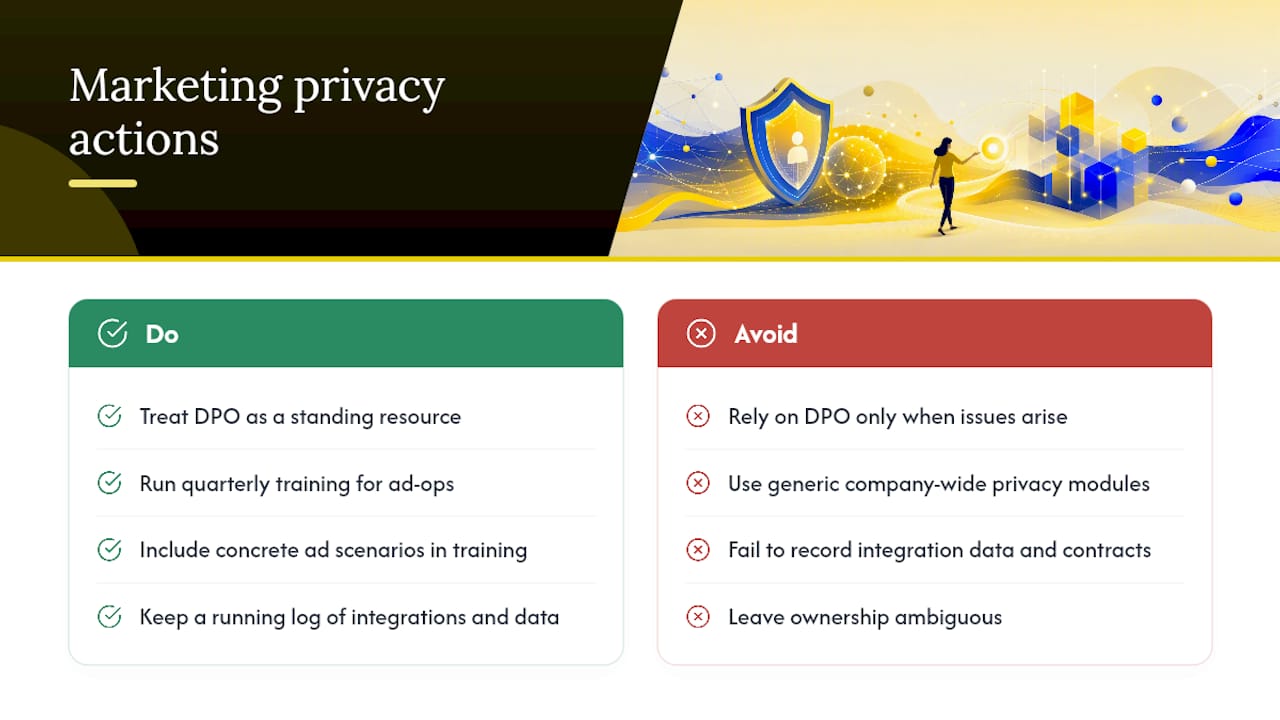
A Data Protection Officer, or whoever owns privacy operations at companies too small for that formal title, can’t be the only person who understands CCPA obligations. Marketing teams make the daily decisions that create or avoid violations: which vendors get data, how retargeting pools get built, what a landing page form discloses.
The most effective setups treat the DPO as a standing resource for marketing, not a gatekeeper brought in only when something breaks. That means quarterly training sessions specifically for ad-ops and campaign managers, not generic company-wide privacy modules that never mention advertising use cases. Training should cover concrete scenarios: what to do when a new ad platform integration requests raw email addresses, how to recognize when a vendor is acting as a third party rather than a service provider, and when a campaign needs legal sign-off before launch.
Documentation matters as much as training. Keep a running log of every marketing tool integration, what data it touches, and its contractual classification. When your DPO or legal counsel needs to answer a regulator’s question about a specific ad platform six months from now, that log is the difference between a five-minute answer and a week of digging through vendor contracts.
Smaller agencies without a dedicated privacy role should still name one person as the point of contact for marketing-related privacy questions. Ambiguity about who owns this is how gaps happen.
Managing Ad Vendors and Data Processors Without Losing Control
Every vendor touching consumer data needs a contract that specifies its role: service provider or third party. That distinction isn’t paperwork. It determines whether you can legally share data with them at all once a consumer opts out.
Service provider agreements should explicitly restrict the vendor from using your data for anything beyond the service they’re providing, and from combining it with other clients’ data. If a vendor’s standard contract is vague on this, push back before signing, because a vague contract becomes your liability, not theirs, when a request comes in.
Build a vendor inventory that lists every platform receiving marketing data, what categories they receive, and their contractual status. Review it at least twice a year, since ad tech partnerships change quietly and a platform that was a service provider last year can shift its data use terms without much notice.
For agencies managing multiple client accounts, this gets more complex fast. Each client relationship may involve different vendors with different contract terms, so a single compliance framework rarely fits every account. Standardize what you can, like a baseline vendor questionnaire, and flag exceptions client by client.
Email Marketing Under CCPA: What Actually Changes
Email marketing feels less exposed than ad targeting, but CCPA still applies fully. If you’re building segments from purchase history, browsing behavior, or third-party enrichment data, that’s personal information subject to the same opt-out and disclosure rules as any ad platform.
The practical risk is suppression list drift. A consumer who opts out through your website form needs that status reflected in your ESP within a reasonable window, not just in your ad platforms. Following documented suppression list practices for syncing opt-outs into email campaigns closes a gap a lot of teams don’t realize exists until a complaint surfaces.
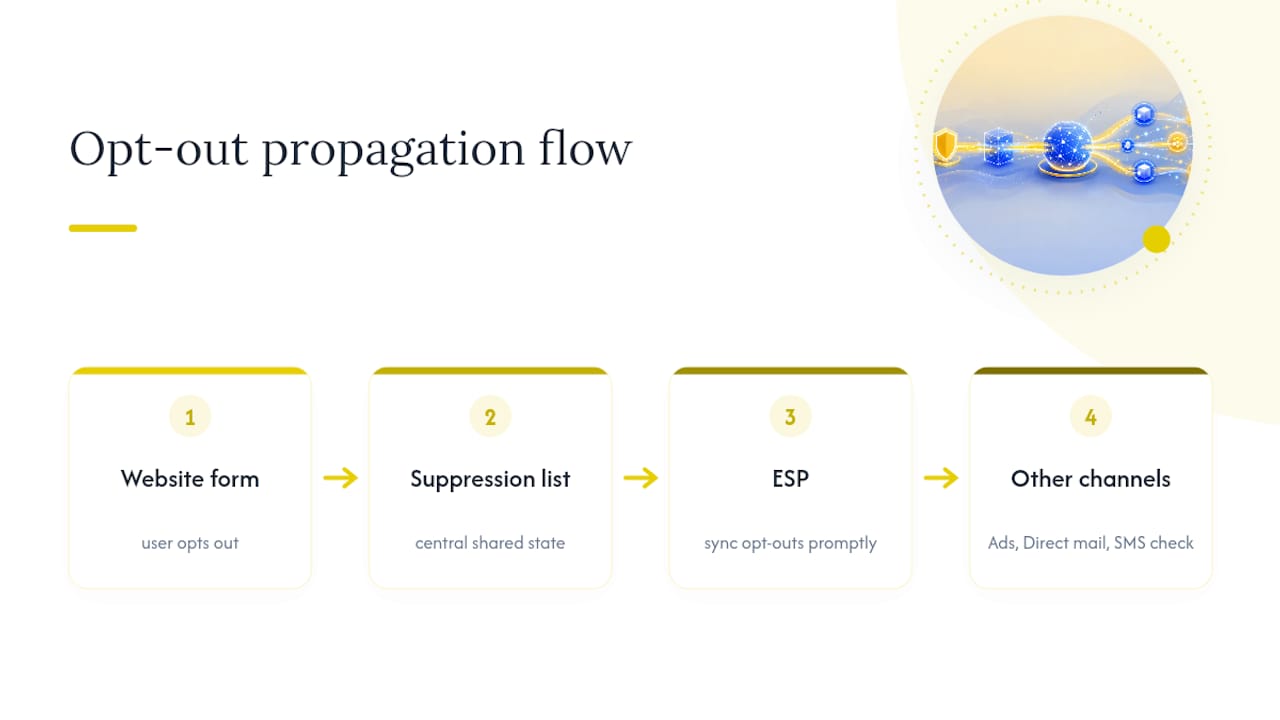
Direct mail and SMS carry the same underlying obligation, even though they’re not app-based tracking. Any channel using personal information for marketing purposes needs to check against the same suppression list before a send goes out.
B2B Marketers Don’t Get a CCPA Exemption Anymore
A common misconception is that CCPA only applies to consumer-facing brands. It doesn’t. Business contact information, like a work email or job title collected through a webinar signup, is personal information under CCPA once tied to an identifiable individual, and B2B marketers need the same Notice at Collection and opt-out handling as any B2C team.
The practical difference is scale and data type. B2C marketers typically manage larger volumes of behavioral and transactional data tied to targeting. B2B marketers more often handle smaller volumes of professional contact data collected through gated content, events, and outbound sales tools, but that data still triggers the same disclosure and deletion obligations.
One area B2B teams underestimate is data enrichment. Buying firmographic or contact data from a third-party provider to fill out a lead record still counts as collecting personal information, and your Notice at Collection needs to account for that, even if the consumer never directly gave you the data themselves.
Data Minimization: Collect Less, Store It for Less Time
The CCPA regulations push businesses toward collecting only what’s necessary for the stated purpose. For marketing teams, that means auditing every form field, every pixel, and every data enrichment call against a simple question: does this specific field serve a purpose you can name?
Retention policies matter just as much. Data sitting in a CRM three years past its useful life isn’t generating value, it’s generating exposure. Set retention windows tied to actual business need, not “just in case,” and build automated deletion into your CRM and ESP workflows rather than relying on manual cleanup that never happens.
Cross-Device Tracking Gets Harder, Not Impossible
Stitching a user’s behavior across phone, laptop, and tablet has always depended on identifiers that CCPA opt-outs directly restrict. When a consumer opts out of sale or sharing, cross-device graphs built on third-party identifiers lose that person’s data across every device, not just the one where they clicked opt-out.
The workaround isn’t more aggressive tracking, it’s shifting toward identifiers you control directly. First-party login data, when a consumer creates an account or signs into a loyalty program, gives you a legitimate cross-device link that doesn’t depend on third-party cookies or device graphs vulnerable to opt-out attrition. It’s a smaller pool than third-party device graphs used to offer, but it’s a pool you actually own and can defend.
An Editorial Take on Getting CCPA Compliance Right
Most CCPA advice for marketers treats compliance as a legal problem with a marketing footnote. That framing is backwards. The actual damage from getting this wrong shows up in campaign performance long before it shows up in a regulator’s letter, and the research on signal loss backs that up plainly.
The overrated response is disabling tracking wholesale out of caution. It feels safe and it isn’t smart: you lose optimization data you were entitled to keep while gaining no additional legal protection over targeted suppression. The underrated move is treating your suppression list as a living piece of infrastructure that gets checked weekly, not a compliance checkbox filled in once during a policy update.
Prioritize the boring stuff first: sync your suppression lists, pass opt-out signals downstream, document your request handling. That work doesn’t feel strategic, but it’s what actually keeps campaigns running and keeps your legal exposure low at the same time. Everything else, the modeled attribution, the server-side migration, matters, but it matters less than getting the fundamentals airtight.
— Ovannes
Get a Free Check on Your CCPA-Related Ad and Funnel Gaps
Running suppression lists across five ad platforms and an ESP by hand is exactly where compliance gaps hide. Gleanit’s free ad audit scans your live campaigns for the kind of signal drop that opt-outs cause, so you catch it before a client asks why performance dipped.
If your funnel touches multiple channels, the free marketing audit checks Notice at Collection placement, opt-out link visibility, and where suppression might not be syncing between your ad platforms and your email tool. Agencies juggling several client accounts get the most value from ongoing monitoring rather than one-off checks, since opt-out volume shifts weekly and a stale suppression list creates new exposure fast. Gleanit’s pricing plans cover solo operators and full agency teams that need automated, continuous monitoring across Meta, TikTok, and Google in one connected view. Start with the free audit, see what it flags, and decide from there whether ongoing monitoring earns its place in your stack.
Sources
- California Consumer Privacy Act (CCPA) | State of California - Department of Justice - Office of the Attorney General
- CCPA regulations (effective January 1, 2026) — official regulatory text
- Platform Strategy Institute: Operational and advertising impacts of privacy changes (2023)
FAQ
Does CCPA Apply to B2B Marketing Contacts?
Yes, business contact information tied to an identifiable person, like a work email collected through a webinar, counts as personal information under CCPA. B2B marketers need the same Notice at Collection and opt-out handling as consumer-facing teams.
What’s the Difference Between a Service Provider and a Third Party?
A service provider processes data only on your behalf under contract restrictions, while a third party can use that data for its own purposes. The CCPA statute bars combining opted-out consumers’ data for cross-context behavioral advertising regardless of which category a vendor falls into.
Should I Just Disable Tracking Tools to Stay Safe?
No, disabling all measurement usually costs more than it protects. Targeted suppression lists paired with aggregate or modeled measurement, as recommended by the Platform Strategy Institute, preserve optimization signals for consumers who haven’t opted out.
How Much Does Gleanit Cost for Ongoing CCPA-Related Monitoring?
Gleanit’s Solo plan runs $99 per month and the Agency plan runs $459 per month, with additional users and workspaces available at $20 per month each. A free ad audit is available first to see what gaps exist before committing to a plan.
What Must a Notice at Collection Include?
It must list the categories of personal information collected, the business purpose for collecting it, whether the data is sold or shared, and a clear opt-out link. The CCPA regulations require this notice at or before the point of collection.
Recommended
- Monitor Meta Ads in 10 Minutes: 2026 Automation First Workflow for Agencies
- Google Ads Transparency Guide for Marketers: Workflow & Tricks
- Agencies: Facebook Ads Benchmarks 2026, Medians, Percentiles, 7 Day Tests
- Google Ads Benchmarks 2026: CTR, CPC, CVR by Industry
Corrections: ovannes@hearye.co or our editorial policy.