
Competitor ad analysis turns rivals’ already-tested messaging into a prioritized list of experiments you can run this week, not next quarter. It means systematically capturing competitors’ ad creative, copy, targeting signals, and landing pages, and then converting the patterns into a message map and a ranked test list. Done right, it shortens test cycles, exposes messaging gaps competitors haven’t claimed, and gives teams using tools like Gleanit a repeatable weekly habit instead of a one-off audit.
TL;DR:
- Automated monitoring tools can identify recurring ad patterns and flag performance gaps across multiple platforms more efficiently than manual reviews.
- Using structured frameworks like messaging hierarchies and creative pattern analysis reveals strategic shifts and messaging inconsistencies in competitors’ campaigns.
- Regular, systematic captures of ad assets along with timestamped landing pages enable accurate trend tracking and timely insights.
- Scaling ad analysis requires automation to handle more competitors, platforms, and data, while human judgment is crucial to interpret pattern significance.
- Initial audits should produce a clear message map, a creative inventory, and prioritized hypotheses to launch targeted experiments within two weeks.
Table of Contents
- What Frameworks Actually Work for Analyzing Competitor Ads?
- How Do You Run a Repeatable Competitor Ad Analysis Workflow?
- How Do Agencies Scale Competitor Ad Monitoring?
- What Mistakes Undermine Competitor Ad Analysis?
- What Should Your First Competitor Ad Audit Produce?
- What This Looks Like in Real Agency Work
- Turn Captured Ads Into a Prioritized Test List Automatically
- Where to Verify These Sources
- Sources
- FAQ
What Frameworks Actually Work for Analyzing Competitor Ads?
Seven frameworks cover most of what matters, and each one answers a different question about what a competitor is betting on.
Creative pattern analysis looks at format mix: how many static images versus video, average video length, whether creative looks like raw UGC or a produced shoot, and how often new thumbnails appear. A competitor running the same UGC testimonial for eight weeks straight is telling you something about what converts.
Messaging hierarchy breaks each ad into hook, supporting claim, call to action, and landing page match. When the hook promises speed but the landing page emphasizes price, that’s a gap, not a strategy. A structured messaging analysis works best when you apply this same breakdown consistently across every competitor you track.
Audience extraction infers who an ad targets from its language, imagery, and platform placement. Ads with jargon-heavy copy on LinkedIn signal a different buyer than casual, meme-adjacent creative on TikTok.
Rotation and longevity matter because ad platforms reward what works with continued spend. A variant still live after 60 days has usually cleared a performance bar the competitor’s short-lived tests never did.
Landing page alignment checks for friction: extra form fields, vague offers, or a value proposition that doesn’t match the ad’s promise.
Budget triangulation uses frequency estimates and the number of active variants as rough proxies for spend, since exact budgets aren’t public.
Benchmarking compares visible proxies (engagement counts, ad longevity, creative refresh rate) against category norms, using resources like Google Ads benchmark data to judge whether a metric is actually strong or just average.
How Do You Run a Repeatable Competitor Ad Analysis Workflow?
A one time audit gets stale fast. The teams that get consistent value treat this as a five-step loop.
- Select 3 to 5 competitors tied to real signals, not gut feel. Pull names from win-loss interviews, sales call mentions, or search auction insights rather than guessing who “feels like” a rival.
- Capture systematically. Screenshot ads from public libraries, archive the linked landing page on the same day, and note the date, platform, and placement. Landing pages change quietly; capturing them alongside the ad preserves the actual claim being made at that moment.
- Tag everything with a consistent taxonomy. Use fields like offer type, funnel stage, creative format, and primary hook so assets from Meta, TikTok, and Google can be compared side by side instead of living in separate silos.
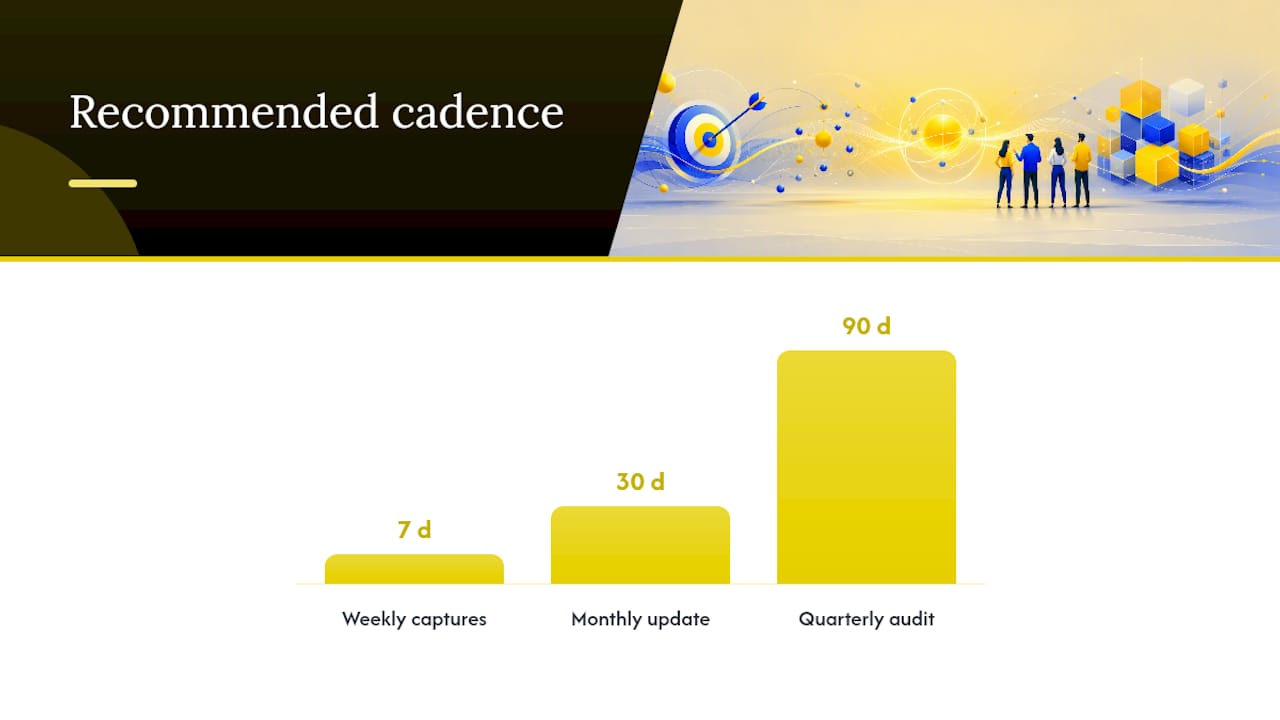
- Set a cadence. Weekly captures, a monthly message map update, and a quarterly deeper audit is a sustainable rhythm for most teams. Faster than that burns hours without adding insight; slower and you miss messaging shifts before they become obvious.
- Convert findings into prioritized tests and battlecards. Every recurring pattern becomes a hypothesis; every recurring objection becomes a battlecard line for sales.
Following this kind of google ads competitor research workflow keeps the process from collapsing into a folder of random screenshots nobody revisits.
Pro Tip: Log the capture date on every screenshot before you file it. Six months from now, “when did they start saying this” is the question that actually matters, and nobody remembers without a timestamp.
How Do Agencies Scale Competitor Ad Monitoring?
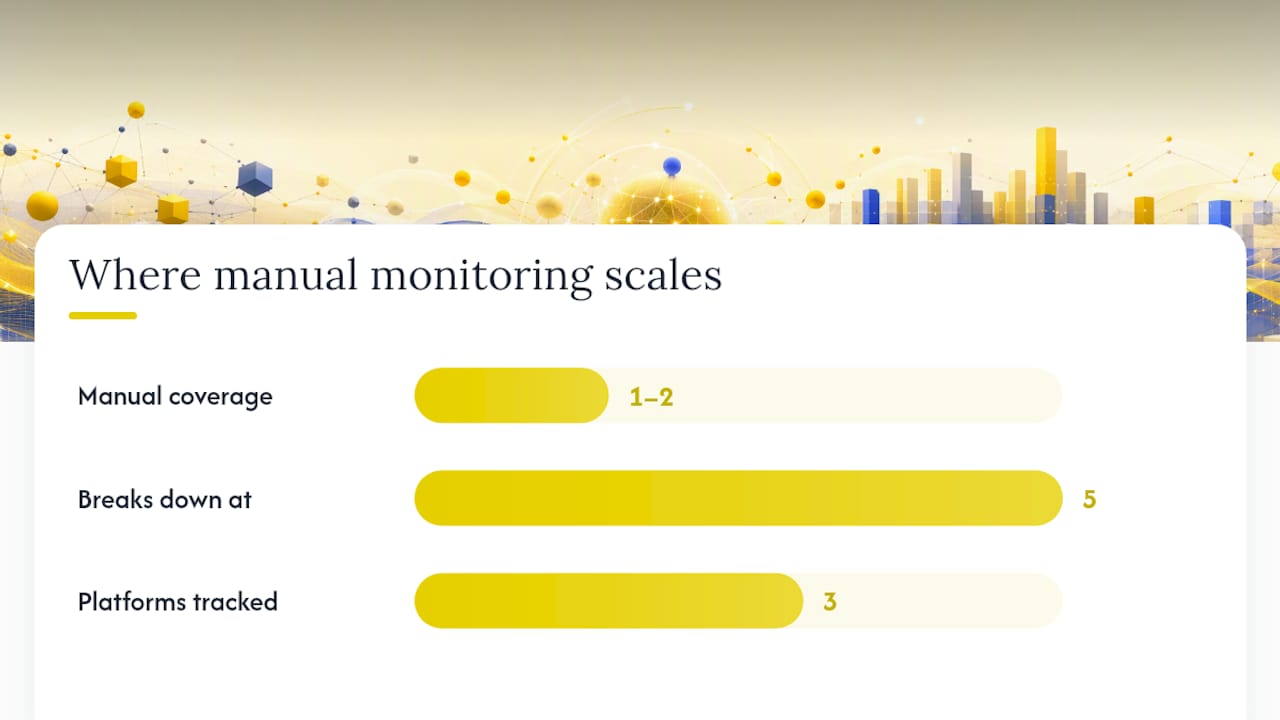
Manual monitoring works for one or two competitors. It breaks down past five, across three platforms, on a weekly cadence, which is exactly where automation earns its place.
The parts worth automating are narrow: change detection on running ads, longevity alerts when a variant crosses a meaningful threshold, and creative classification into formats and themes, which can be enhanced by AI-assisted marketing services to boost creative production workflows. What still needs a human is judgment: deciding whether a pattern is a genuine strategic shift or noise.
A platform built for this should produce a handful of concrete outputs:
- An updated message map showing hook, proof point, and CTA patterns across tracked rivals
- A prioritized test list ranked by how often a pattern recurs and how big the funnel gap looks
- Client-ready reports that translate raw captures into recommendations, not just screenshots
Automated ad monitoring across Meta, TikTok, Google, and LinkedIn applies this logic directly, flagging funnel gaps and surfacing prioritized fixes rather than leaving teams to sort through raw captures by hand. Automated tracking of messaging and headline changes turns anecdotal impressions into something you can measure and act on before a competitor’s pricing or product change becomes obvious.
What Mistakes Undermine Competitor Ad Analysis?
Copying a competitor’s ad language word for word is a brand and legal risk, not a shortcut. Reference the pattern, write your own version.
A creative that ran for three days isn’t proof of anything; it might have been killed for poor performance, not tested to failure gracefully. Verify longevity before treating any single ad as a signal worth acting on.
- Adjust frequency readings for audience size. A high-frequency ad against a tiny retargeting pool means something different than the same frequency against a broad cold audience.
- Loop in legal or compliance review before adapting language close to a competitor’s trademarked claims or protected copy.
- Roll out adapted messaging in staged tests against a control variant rather than swapping your whole campaign at once.
What Should Your First Competitor Ad Audit Produce?
Three outputs turn analysis into action instead of a slide deck nobody opens again.
- A one-page message map with columns for competitor, hook, core value prop, proof points, tone, and CTA, drawn from a proven messaging-analysis template structure.
- A creative inventory sheet tracking format, run length, platform, primary visual, and capture date for every ad you log.
- A prioritized-test brief for your top three hypotheses, each with a stated hypothesis, target audience, primary KPI, and rough sample size estimate before launch.
| Template | Core fields |
|---|---|
| Message map | Competitor, hook, value prop, proof points, tone, CTA |
| Creative inventory | Format, run length, platform, visual style, capture date |
| Test brief | Hypothesis, audience, KPI, sample estimate |
Run the audit, draft the test brief, and get the first experiment live within two weeks. That’s the cadence that actually compounds.
What This Looks Like in Real Agency Work
A message map once settled a pitch disagreement in minutes: the client’s team wanted a discount-led hook, but three competitors had already tested that angle and dropped it within two weeks. Automated change detection got that answer to the room faster than a manual audit ever would have. Internal research guides back that same pattern across dozens of accounts.
— Ovannes
Turn Captured Ads Into a Prioritized Test List Automatically
A platform is built for the exact workflow this guide describes: automated monitoring of competitor ads and customer journeys across Meta, TikTok, Google, and LinkedIn, with funnel gaps flagged and high-ROI fixes prioritized instead of buried in raw screenshots.
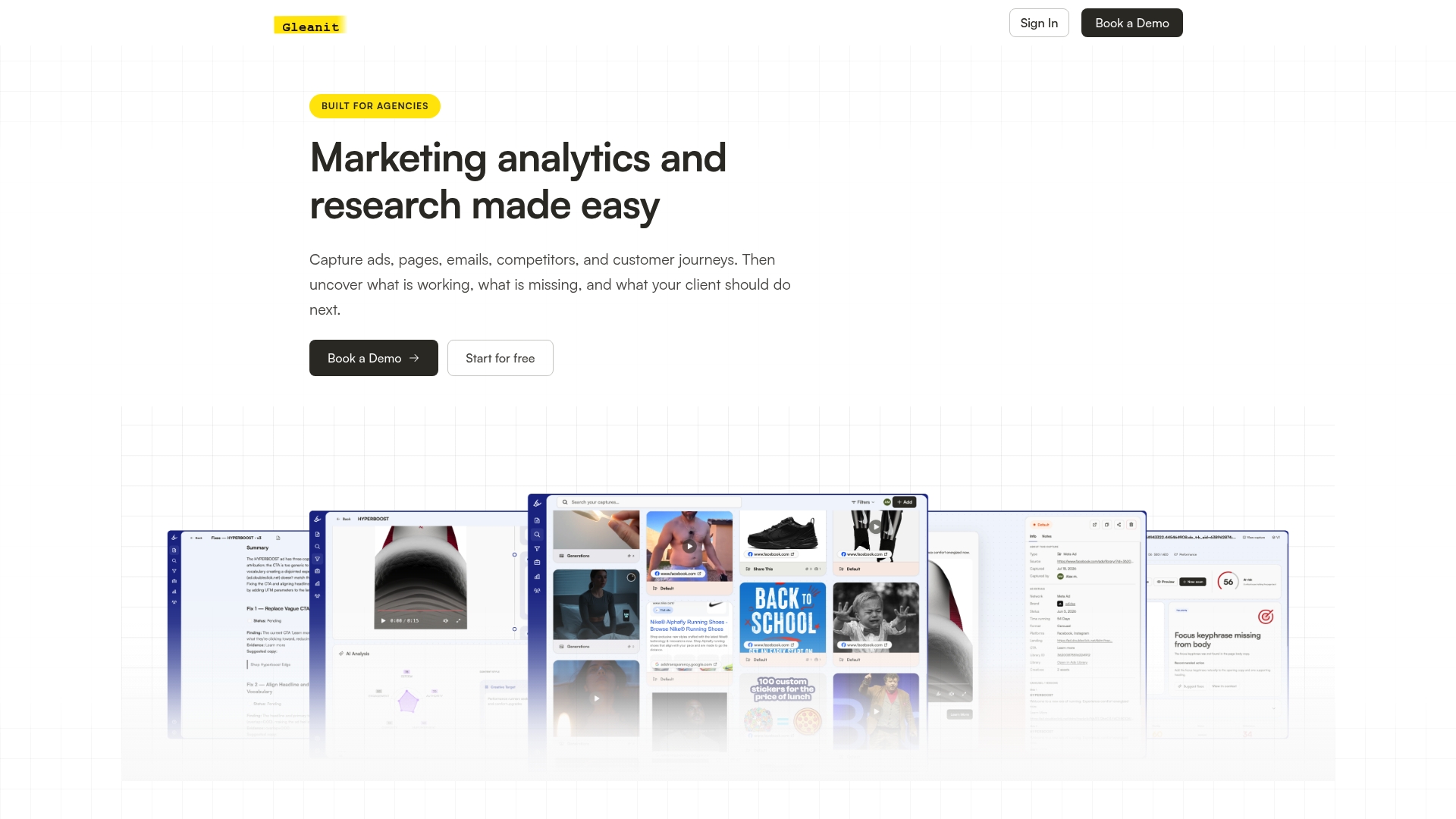
A trial gives you a sample prioritized report generated from your own tracked competitors, so you can see the message map and test list format before committing to a subscription. If your team is still stitching together screenshots and spreadsheets every week, that manual process is the bottleneck worth fixing first. Start a trial on the Gleanit platform and get your first competitor report generated this week.
Where to Verify These Sources
Check ad creative directly through the Meta Ad Library, Google Ads Transparency Center, and LinkedIn Ad Library. For structured messaging breakdowns, the Crayon step-by-step guide and Apricot Studio’s template are solid starting points.
Sources
Public libraries cover the basics for free; paid tools earn their keep once you need history and scale.
- Sprout Social — Competitor analysis tools and how to use them
- How to conduct competitor messaging analysis with template | Apricot Studio
- Crayon — Competitor messaging analysis: A step-by-step guide
- Seeto — Competitor messaging analysis: Spot shifts early
FAQ
What Are the Four P’s of Competitor Analysis?
The four P’s, product, price, place, and promotion, are a marketing-mix framework for comparing what a competitor sells, how they price it, where they distribute it, and how they promote it. Competitor ad analysis maps most directly onto the promotion category, though budget triangulation touches pricing signals too.
What Are the Five Steps of a Competitive Analysis?
Most structured approaches follow: select competitors, collect messaging and creative assets, break down positioning with a consistent framework, compare findings across competitors, and convert insights into prioritized tests or a positioning statement. That sequence matches the capture-to-prioritize workflow outlined above.
What Is an Example of a Competitor Analysis?
A common example is a message map comparing three rivals’ hooks, proof points, and CTAs side by side, then flagging that all three lean on a “fastest setup” claim, leaving a “most reliable” angle open for you to own.
Which Tool Is Best for Competitor Ad Analysis?
It depends on scale: public libraries like Meta Ad Library work for spot checks on a few competitors, while a platform like Gleanit fits agencies tracking multiple clients and rivals across Meta, TikTok, Google, and LinkedIn who need automated change detection and client-ready reporting rather than manual screenshotting.
Recommended
- Google Ads Competitor Research: A Practical Workflow for Marketers
- A Creative Testing Framework That Actually Scales Ad Results
- Campaign Post Mortem: A Repeatable Agency Template
- The LinkedIn Ad Library Guide Every Marketer Needs
Corrections: ovannes@hearye.co or our editorial policy.