
Fix tracking and conversion measurement before touching dashboards or attribution models. Most marketing teams find their biggest ROI leak isn’t a bad channel mix. It’s broken tags, duplicate events, or a conversion tied to the wrong value. Start today by pulling up your tag manager’s debug view and confirming that your top one or two revenue-driving conversions fire once, correctly, every time. Everything else on this marketing analytics checklist builds from that single check.
TL;DR:
- Ensuring that your top revenue-driving conversions fire correctly and exactly once is critical before addressing dashboard or attribution issues.
- Regularly validate tag coverage, check for duplicate firing, and reconcile tracked conversions with actual sales or leads to prevent measurement errors.
- Proper UTM hygiene, cross-domain tracking, and consent management are common pitfalls that can distort campaign data and should be audited frequently.
- Confirm that conversion data and attribution models are based on accurate, consistent, and properly tracked events before making budget or strategic decisions.
- Automate monitoring and schedule audits at least quarterly to catch issues early, especially when platforms or code updates can silently break your tracking setup.
Table of Contents
- The Marketing Analytics Checklist to Run This Week
- How to Validate Your Tracking Implementation
- UTM Hygiene, Cross-Domain Tracking, and Consent
- Conversion Accuracy and Attribution Sanity Checks
- Who Owns This, and How Often Should You Audit?
- Checking Your Marketing Analytics Stack Component by Component
- Advanced Analytics and Predictive Model Validation
- What to Fix First and Why
- Where Gleanit Fits Into Your Audit
- Sources
- FAQ
The Marketing Analytics Checklist to Run This Week
Run these in order. Each one exposes problems that make the next check meaningless if skipped.
- Confirm tag coverage. Open your tag manager’s preview mode and load your five highest-traffic pages. Every tag that should fire, fires once.
- Check for duplicate firing. Use your browser’s network tab to count requests per event. A “purchase” event firing twice inflates revenue and wrecks cost-per-acquisition math.
- Verify your top conversions against real numbers. Compare last month’s tracked conversions to actual sales or leads in your CRM. A gap over 10 to 15% signals a tracking problem, not a marketing one.
- Audit UTM parameters on live campaigns. Pull a sample of your paid social and email links and check for consistent casing, no typos, and no missing source or medium values.
- Test cross-domain tracking if checkout, booking, or a subdomain lives on a different domain than your main site.
- Confirm consent settings match what’s actually collected. If your cookie banner offers an opt-out, verify that declining actually stops non-essential tags from firing.
- Check attribution settings for sanity. Do direct traffic and branded search account for a suspiciously large share of conversions? That often means a lost referral or UTM problem upstream.
- Assign an owner and a next audit date. Every item above needs a name attached and a date on the calendar, or it will not get rechecked.
The pattern across these steps: collection problems first, then measurement logic, then reporting polish. A 10-step audit framework from Trackingplan follows a similar sequence, moving from tag validation and schema checks through consent and cross-domain stitching before touching dashboards.
Pro Tip: Screenshot your tag manager’s debug output the first time you run this checklist. Six months later, when something breaks, you’ll have a baseline to compare against instead of guessing what “normal” looked like.
How to Validate Your Tracking Implementation
Tag validation is not a one-time setup task. It’s a recurring test, because platforms update, developers ship code changes, and cookie policies shift underneath your tracking without warning.
Start with your tag manager’s built-in debugger or your browser’s network tab. Load a page, trigger the action you want to measure, and count how many times the corresponding request fires. One click should produce one event. If you see two or three, you likely have a duplicate tag or a container that’s loading twice.
- Check event names follow a consistent object-action pattern (e.g., “form_submit,” not a mix of “formSubmitted,” “lead_sent,” and “contact_complete”).
- Confirm required properties travel with each event: page URL, timestamp, value where applicable.
- Filter out internal traffic and known bots from your reporting views, or your engagement numbers will skew optimistic.
- Scan for personal data accidentally landing in URL parameters or custom dimensions.
A quick reconciliation test settles most doubts: pick one conversion type, walk through it yourself as a customer, and compare what your analytics tool recorded against what showed up in your CRM or order system. Gartner’s martech research found utilization across marketing technology stacks sits around 49%, and a large share of that waste traces back to tools nobody bothered to validate after setup.
UTM Hygiene, Cross-Domain Tracking, and Consent
Campaign tagging breaks quietly. Nobody notices a malformed UTM until a quarterly report shows an entire channel underperforming, and the real problem is that half its traffic landed in “(not set).”
- Standardize on lowercase for all UTM values; “Facebook” and “facebook” register as two separate sources in most platforms.
- Audit your link-building process. If different team members build links by hand, mismatched spelling is close to guaranteed.
- Test cross-domain tracking any time checkout, a booking widget, or a payment gateway lives outside your main domain. Sessions that don’t carry a linker parameter across that handoff will show as two separate visits instead of one journey.
- Verify your consent management platform actually blocks the scripts it claims to block. Decline the cookie banner yourself and check whether analytics and ad pixels still fire.
Consent isn’t a checkbox exercise. UK data protection guidance on storage and access technologies makes clear that consent for non-essential tracking must be specific, informed, and given through a real opt-in action. A pre-ticked box doesn’t count, and the “statistical purposes” exception does not extend to advertising measurement. When consent mode kicks in and modeled conversions replace observed ones, expect a visible reporting gap between platform dashboards and your own analytics property. That gap is not a bug. It’s the system working as designed.
Conversion Accuracy and Attribution Sanity Checks
Attribution only matters once conversion tracking is trustworthy. Before questioning which channel deserves credit, confirm the conversion itself is counted correctly and carries the right value.
- Walk your funnel step by step and confirm each stage (view, add to cart, checkout start, purchase) fires in the right order with no steps skipped.
- Map every tracked event to an actual revenue figure, not a flat placeholder value that doesn’t reflect what customers really spend.
- Reserve controlled experiments (geo holdouts, A/B tests) for high-stakes budget decisions, and lean on modeled approaches like marketing mix modeling for smaller, faster tactical calls.
- Never move significant budget on a single metric. Require at least two independent signals pointing the same direction first.
The IAB’s incrementality guidelines frame this well: a credible incrementality read needs a genuine counterfactual and deliberate control for bias, and the rigor of the method should scale with what’s riding on the decision. A practical attribution playbook can help formalize this triangulation step so it doesn’t rely on memory or gut feel.
Pro Tip: If two attribution models disagree significantly on which channel drove a conversion, don’t average them. Investigate which one has the tracking gap.
Who Owns This, and How Often Should You Audit?
Analytics drift when nobody owns it. Assign a data owner responsible for tag health, a data steward who checks reporting accuracy, and if you’re an agency, a point person per client account.
Cadence works in layers:
- Daily: automated monitors that flag traffic anomalies or a conversion count dropping to zero.
- Weekly: a quick check on campaign tagging and any new landing pages launched.
- Quarterly: a full audit covering every item in this checklist, similar to the cadence recommended for active campaign sites.
When fixes pile up, prioritize in this order:
- Data collection issues (broken tags, duplicate events).
- Attribution and measurement logic errors.
- Reporting and dashboard polish.
Score audit success with something simple: percentage of tracked conversions that reconcile with actual revenue.
Checking Your Marketing Analytics Stack Component by Component
A checklist is only as good as the tools underneath it. Before trusting any report, confirm each piece of your stack is actually doing its job.
- Tag manager: Is the container published, and does the version match what’s live?
- Analytics platform: Are goals or key events still mapped correctly after any recent redesign?
- Consent platform: Does it block scripts on decline, not just display a banner?
- CRM: Are lead and revenue records syncing with matching IDs, not mismatched emails?
- Data warehouse: Is the nightly or hourly ingestion job actually completing?
If your team is stretched across five or more platforms, a unified dashboard reduces how often integrations silently break without anyone noticing.
Advanced Analytics and Predictive Model Validation
Once foundational tracking holds up, predictive models and advanced segmentation become worth the investment. Skip this step before fixing collection, though, and you’re just building sophisticated forecasts on broken data.
Validate predictive models the same way you’d validate a person’s judgment: check their track record before trusting their next call. Pull a model’s past predictions for a metric like churn or lifetime value and compare them against what actually happened over the following quarter. A model consistently off by more than 15 to 20% needs retraining or a smaller scope, not blind trust.
Segmentation deserves the same scrutiny. If your “high-value customer” segment was built from data collected before a tracking fix, rebuild it. Old segments carry old errors forward, and marketing teams often keep using a segment definition for years after the data underneath it changed. Recheck segment size and behavior quarterly, not just once at setup.
Marketing mix modeling has become more accessible for teams without a data science department, but it depends entirely on clean, centralized inputs. IAB guidance on modernizing MMM recommends centralizing data in a warehouse with standardized naming and automated quality checks before layering any model on top, plus keeping multiple years of history so the model has enough seasonal variation to learn from. Skipping that groundwork is the most common reason MMM outputs disagree wildly with what the marketing team already knows to be true.

What to Fix First and Why
Fix collection before conversion definitions, conversion definitions before UTM hygiene, and UTM hygiene before running experiments. That order stops errors at the source instead of chasing symptoms downstream. Pick one item from this checklist and run it before the week ends.
— Ovannes
Where Gleanit Fits Into Your Audit
Running this checklist by hand across Meta, TikTok, Google, and LinkedIn takes real hours, and most small teams don’t have a spare analyst sitting around for it. This kind of gap can be addressed with automated monitoring across multiple platforms in one connected view, funnel gap diagnostics that flag where a customer journey breaks down, and prioritized recommendations ranked by ROI to clarify what to fix first.
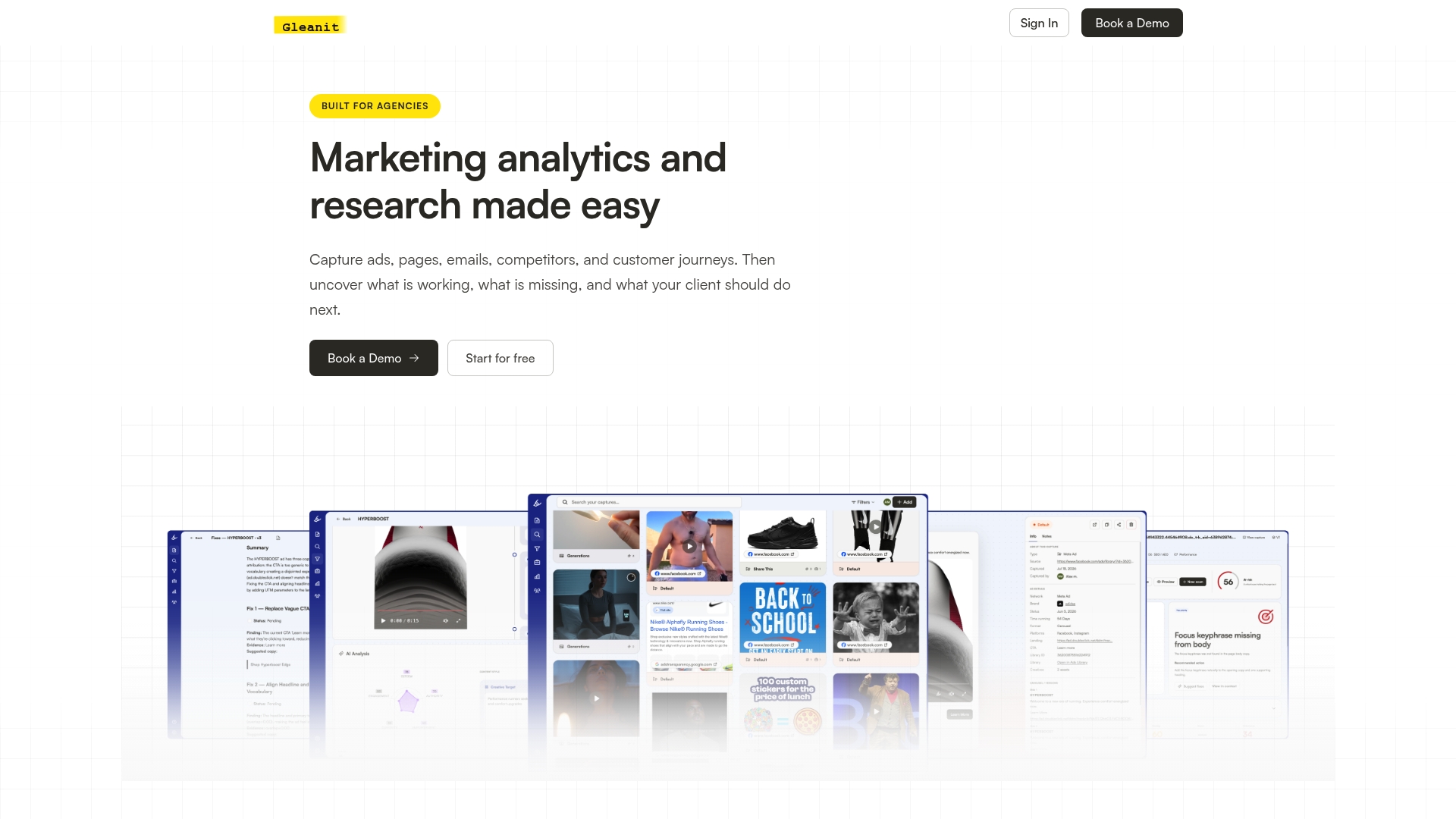
If time or cross-platform complexity is the blocker, start with a free marketing audit or a free ad audit to see where your own setup stands before committing to anything. New features are often released weekly and AI can be layered into report generation, so once checklist findings are in hand, turning them into a client-ready report can be done efficiently. For agencies managing several accounts, the Agency plan adds dedicated client workspaces; solo consultants can start with the Solo plan at $99 per month. Run the free audit first and see what it surfaces.
Sources
- UK ICO publishes guidance on storage and access technologies — Hunton Andrews Kurth (privacy & cybersecurity law blog)
- Gartner — Marketing technology (martech) survey and guidance
- IAB Guidelines for Incremental Measurement in Commerce Media
- The Ultimate Web Analytics Audit Checklist: 10 Steps for 2026 | Trackingplan
FAQ
What Should Be the First Item on a Marketing Analytics Checklist?
Verify that your tags fire correctly and your top conversions match real revenue or lead numbers. Fixing collection problems before touching attribution or reporting prevents wasted effort on data that’s already wrong.
How Often Should a Small Business Audit Its Analytics?
Run lightweight checks weekly and a full audit quarterly, a cadence supported by practical audit frameworks for active campaign sites. Add a check before any major campaign launch or website redesign.
How Do I Know if My UTM Tagging Is Broken?
Pull a sample of live campaign links and check for inconsistent capitalization, missing source or medium values, or typos. A sudden spike in “(not set)” or direct traffic in your reports is usually the first visible symptom.
What Does Gleanit Cost for a Small Agency?
The Solo plan runs $99 per month and the Agency plan runs $459 per month, both listed on Gleanit’s pricing page. Additional users or client workspaces each add $20 per month.
When Should I Run an Experiment Instead of Trusting a Dashboard Model?
Reserve controlled experiments like geo holdouts or A/B tests for high-stakes budget decisions, per IAB incrementality guidance. For smaller, faster calls, a modeled estimate paired with a second confirming signal is usually enough.
Recommended
- Monitor Google Ads: A Practical Checklist for Marketers
- Automate Marketing Reports for Agencies: Start With Data Governance
- Build Reliable Post Cookie Attribution in 90 Days for Agencies
- Unified Marketing Dashboard: Faster Insights for Agencies
Corrections: ovannes@hearye.co or our editorial policy.