
Run a short, scored audit: subscribe to 5 to 10 rivals, capture two to four weeks of sends into a matrix, score them 1 to 5 across content, subject lines, format, frequency, and monetization, then prioritize the shared gap you can fill. Public benchmarks put median open rates near 38%, so any rival trailing that badly is worth studying. Set up a dedicated research inbox today and pick your first 5 to 10 competitors.
TL;DR:
- Most rivals aim for an open rate near 38%, but those consistently below that threshold indicate a need to analyze their subject lines and content strategy.
- Regular scoring across five categories helps identify common weaknesses, such as infrequent publishing, poor branding consistency, or limited monetization options.
- Filling shared gaps, like adding scannable summaries or improving deliverability, offers the most defensible opportunities based on industry-wide weaknesses.
- Automated tools can streamline data collection, scoring, and gap prioritization, allowing teams to refresh audits every quarter efficiently.
- Monitoring audience signals indirectly, such as mentions of subscriber counts or engagement behaviors, helps identify market positioning shifts and segmentation practices.
Table of Contents
- What to track in every competitor send
- How to run the audit: subscribe, collect, score, prioritize
- Tools and automation for capturing competitor sends
- Deliverability and compliance signals worth recording
- Building the competitive matrix and scoring gaps
- Turning findings into a content roadmap
- Reading competitor audience signals and engagement patterns
- Benchmarking open rates, click-through rates, and growth trends
- Assessing design and branding consistency across sends
- Breaking down competitor pricing and monetization models
- Common mistakes and how agencies close the loop faster
- Speed up the audit with Gleanit’s free tools
- Sources
- FAQ
What to track in every competitor send
A newsletter competitive analysis only works if every analyst records the same fields the same way. Without a shared schema, one person’s “strong subject line” is another’s “average,” and the matrix becomes opinion dressed up as data.
For each send, log:
- Send date and time, including day of week, to spot cadence patterns.
- Subject line text and character count, plus whether it uses personalization, emoji, or numbers.
- Preview text, since many rivals treat it as a second subject line.
- Content format: curated links, long-form essay, roundup, interview, or a mix.
- Primary call to action and total CTA count, counted as any clickable link pointing outside the email body.
- Recurring segments or franchises, such as a weekly “deal of the week” block.
- Visible monetization signals, including sponsor blocks, affiliate links, paywalled sections, or upsells to a paid tier.
- Deliverability flags, such as landing in promotions or spam, image-only bodies, or broken unsubscribe links.
Infer monetization patterns by watching what repeats. A sponsor slot that appears in three straight sends signals a stable revenue line, not a one-off partnership. Standardize your CTA count by only counting links a reader would click to take action, not every hyperlinked brand name, and keep a free-text notes column for anything that does not fit a checkbox.
How to run the audit: subscribe, collect, score, prioritize
Choose 5 to 10 direct competitors rather than the entire category. A tighter list gives every send more attention and keeps your matrix readable. Collect for two to four weeks before drawing conclusions: a single issue can be an outlier, but a month of sends shows real cadence, recurring segments, and pricing patterns.
- Subscribe to each rival from a dedicated research inbox or a shared team address, never your personal email.
- Collect sends automatically where possible, using a forwarding rule or a tool like Zapier to push each email into a shared spreadsheet.
- Score each send 1 to 5 across five categories: content quality, subject line strength, format execution, frequency consistency, and monetization clarity.
- Compute a composite “serves readership” score by averaging the five category scores per rival, then sort rivals highest to lowest.
- Surface gaps by listing what no rival does well, not just what the top scorer does.
Pro Tip: Score subject lines against actual open behavior when you can see it (forwarded stats, public case studies, or your own send data for a shared topic), not just how clever the line reads.
Run this audit quarterly, and rerun it sooner after a major market event, a rival’s rebrand, or a platform policy change. Budget roughly half a day per quarter for a 5 to 10 rival sample: an hour to subscribe and set up capture, then two to three hours spread across the collection window for scoring and notes.

Tools and automation for capturing competitor sends
Most teams do not need custom software to start. A dedicated inbox with forwarding rules into a Google Sheet, using an export add-on or a simple Zapier connection, covers the first few quarters of audits without extra cost.
- Manual capture: a shared inbox plus a spreadsheet works fine for 5 to 10 rivals and a small team.
- Light automation: forwarding rules or Zapier zaps that log sender, subject, and timestamp automatically into a row.
- Extraction scripts: useful once you are tracking link counts, CTA counts, or HTML structure across dozens of sends a week.
- Shared storage: keep one row per send, with a separate column for qualitative notes so scores stay clean and comparable.
Version each quarter’s matrix as its own tab or sheet copy so you can compare quarter over quarter without overwriting history. Scale to automated extraction once you are tracking more than 10 rivals, more than a few sends per week, or once your team needs structured analytics rather than a read-through spreadsheet.
Deliverability and compliance signals worth recording
A newsletter can win every content category and still lose the game if it never reaches the inbox. Record whether each rival has visible authentication hygiene: SPF and DKIM passing, a published DMARC policy, and a working List-Unsubscribe header. You can check headers by viewing the raw email source in most clients.
- Note the unsubscribe experience: is there a one-click link, or does it bury the option behind a login?
- Watch for glaring misconfigurations, like images failing to load or links routing through broken redirects.
- Flag any rival landing in spam or promotions during your collection window.
Gmail’s guidance recommends a spam rate under 0.10%, with 0.30% treated as a reputational cliff, and bulk senders are expected to support one-click unsubscribe under RFC 8058. The FTC’s CAN-SPAM rules require accurate headers, clear ad disclosure, a valid postal address, and prompt honoring of opt-outs, so a rival skipping any of these is exposed, and so are you if your own sends skip them. If your own list shows rising spam complaints, tighten list hygiene and confirm your unsubscribe link works in one click before your next send.
Building the competitive matrix and scoring gaps
The matrix is the deliverable. Columns should include rival name, niche, send frequency, primary format, and scores for content, subject lines, format, frequency, and monetization, plus a free-text column for the rival’s unique angle and observed gaps.
- Normalize scores on the same 1 to 5 scale across every rival so averages are comparable.
- Compute a composite score by averaging the five categories, then sort the sheet to reveal the leader and the laggards.
- Look for shared gaps: a weakness that shows up across most rivals, not just one, is your strongest opportunity.
- Convert the top gap into an experiment: if nobody offers a scannable summary block, test one in your next three sends.
A gap shared by most of your sample is more defensible than a single rival’s blind spot, because it points to a structural hole in how the category serves readers rather than one competitor’s oversight.
Turning findings into a content roadmap
Rank opportunities by reader impact, ease of execution, and fit with what your brand already does well. A gap that is easy to fill but irrelevant to your strengths is a distraction, not a roadmap item.
- Pick one or two top-ranked gaps and design a specific test, such as a single-CTA issue instead of five competing links.
- Run subject-line A/Bs against the pattern most rivals ignore, whether that is length, personalization, or numbers.
- Test a gated deep-dive if your matrix shows no rival offers long-form value behind a simple opt-in.
- Measure over two to four sends, tracking open rate, click-through rate, and unsubscribe rate against your own baseline.
Pro Tip: Give every test a clear kill criterion before you launch it, such as “revert if opens drop more than five points,” so a bad experiment does not quietly become permanent.
Fold winning tests into your regular editorial calendar and retire the ones that do not move the numbers.
Reading competitor audience signals and engagement patterns
Newsletters rarely publish subscriber counts, but audience clues show up indirectly. Watch for signs a rival mentions in-copy: “welcome to our 50,000 readers” lines, sponsor rate cards that sometimes leak circulation figures, or LinkedIn and Twitter bios listing subscriber counts.
Engagement is easier to infer than raw audience size. Track how often a rival references reader replies, forwards, or referral programs. A newsletter that regularly runs a “reader question of the week” segment is signaling active two-way engagement, while one that never surfaces reader voice may be growing through paid acquisition alone.
Cross-reference the newsletter against the same brand’s public content, social posts, blog updates, and product announcements. A rival tightening its newsletter frequency while ramping up social posting may be shifting budget, not just testing formats. Watching both channels together catches positioning shifts that a single newsletter issue never reveals on its own. Segment inferences by watching for personalization: does the rival appear to send different content to different reader groups, evidenced by subject lines that reference a specific role, industry, or stage? That is a sign of list segmentation you may not have built yet, and it belongs in your gap notes column alongside content and monetization findings.
Benchmarking open rates, click-through rates, and growth trends
You cannot see a rival’s real send-level stats, so benchmark against public reference points instead of guessing. Public newsletter benchmarking data shows a median open rate near 38%, a median click-through rate near 3.3%, median monthly list growth near 3.5%, and a median unsubscribe rate near 0.2%.

Use these figures as a baseline, not a target for every niche: a tightly focused B2B newsletter may run higher opens than a broad consumer list, and a rival publishing daily will likely show lower per-send opens than one publishing weekly. What matters for your audit is direction, not precision. If a rival’s public case study, media kit, or investor update mentions actual open or click numbers, record those in your matrix with a source note, since they beat inference every time.
Track growth trend signals over your collection window: does the rival’s referral link change, does a “refer a friend” push appear more often, or does a paid acquisition ad for the newsletter show up in a social feed. Those are proxies for whether the list is actively growing or stagnant, and they belong next to your frequency and format scores in the same row.
Assessing design and branding consistency across sends
Design carries as much signal as copy. Score whether a rival’s newsletter looks the same every week: consistent header, consistent color use, consistent typography, and a recognizable sign-off. Inconsistency often signals a newsletter run without a template, which is itself a gap you can exploit by shipping a more polished, repeatable format.
Check mobile rendering specifically, since most newsletter opens happen on a phone. A rival whose images do not scale, whose text runs too small, or whose CTA buttons sit too close together is losing clicks to friction, not disinterest. Note whether the design distinguishes editorial content from sponsor content clearly, since a newsletter that blurs the two risks both reader trust and, per CAN-SPAM’s disclosure requirement, possible compliance exposure.
Look for branding consistency between the newsletter and the rival’s other channels: same logo treatment, same voice, same visual language. A newsletter that reads like it was designed by a different team than the website is a small tell that the newsletter is a secondary channel, not a core product, and that gap in polish is one your own newsletter can close.
Breaking down competitor pricing and monetization models
Not every newsletter monetizes the same way, and your matrix should capture which model each rival runs. The common patterns are sponsor slots sold per issue, affiliate links embedded in recommendations, a paid tier that gates deeper content, and product upsells that route readers to the rival’s own paid offering.
Record where the monetization sits in the send: top of the email suggests a sponsor with negotiating leverage, buried near the footer suggests either a lower-value slot or a newsletter still testing revenue. Watch for a paywall pattern, such as a preview paragraph followed by a subscribe link, and note the price if it is visible on the linked landing page.
A rival running no visible monetization at all is worth flagging too. It usually means the newsletter is a top-of-funnel tool for a separate paid product, and the newsletter itself is not the revenue line. That distinction changes how you interpret their content choices: a free-to-grow newsletter optimizes for shares and list size, while a paywalled one optimizes for retention and perceived depth. Map each rival to one of these models in your matrix rather than leaving monetization as a single generic score, since the model shapes almost every other decision the rival makes about frequency and format.
Common mistakes and how agencies close the loop faster
The most common mistake is copying a rival’s tactic instead of the structural reason it works. A well-timed subject line style is not a strategy, and lifting it without understanding the underlying gap it fills rarely holds up past one send. Favor gap ownership: find what no rival serves well, and build your roadmap around owning that space.
Agencies that repeat this well typically convert the matrix into a RICE-style priority list (reach, impact, confidence, effort) and turn it into a recurring client deliverable rather than a one-time exercise. Audit templates and workshop formats can be designed around a repeatable cadence to help agencies close the loop faster.
— Ovannes
Speed up the audit with Gleanit’s free tools
Building your own capture pipeline works, but it takes setup time most teams would rather spend on the roadmap itself. Some platforms automate parts of a newsletter competitive analysis to save time, including capturing competitor sends, scoring them against a matrix, and generating prioritized reports with AI assistance.
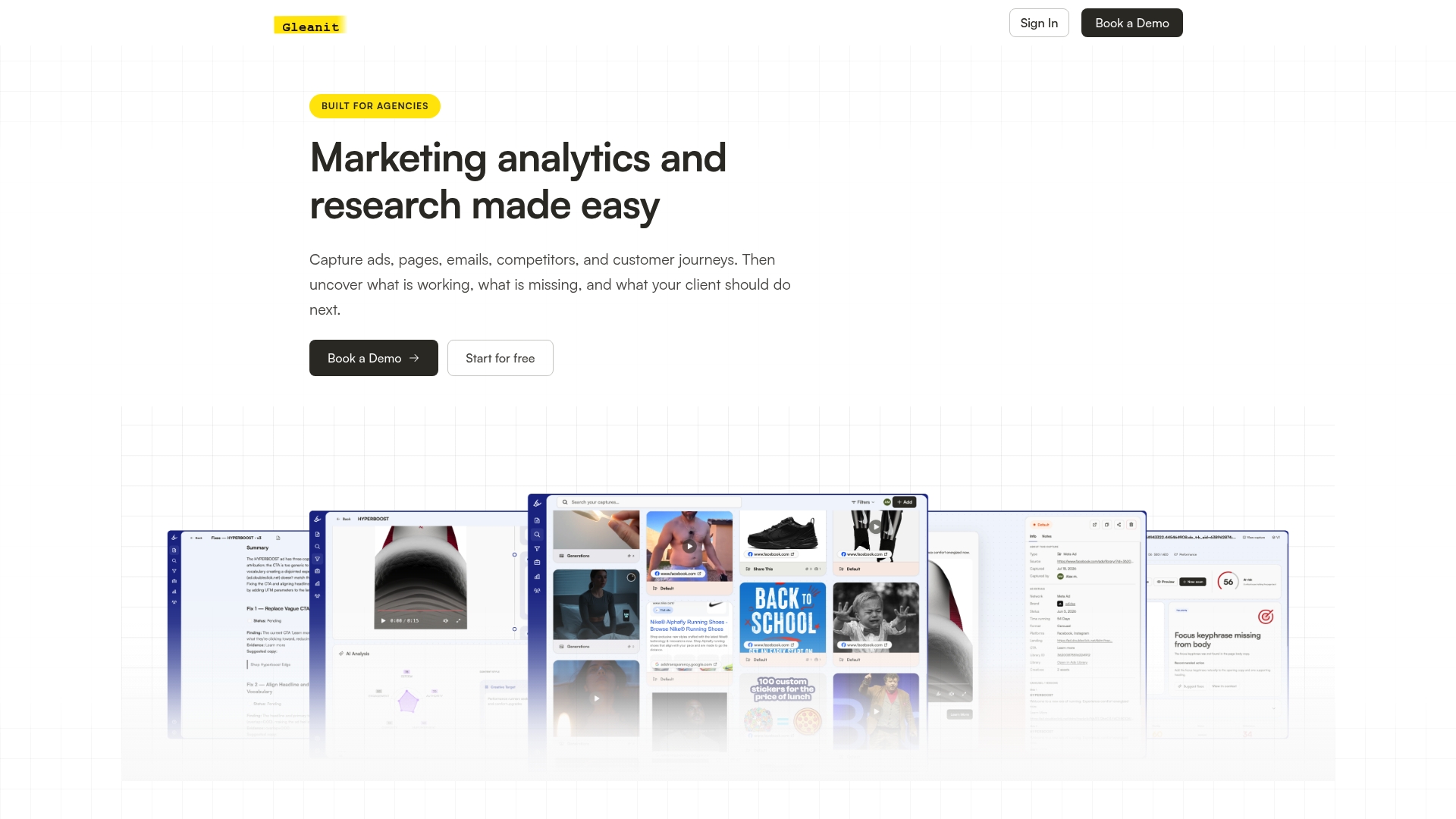
- Capture: automated monitoring pulls in competitor content so you are not manually forwarding emails.
- Scoring: the platform applies a structured matrix so results are comparable across rivals and quarters.
- Prioritized recommendations: gaps get ranked by impact, not just listed.
- AI report generation: findings turn into a client-ready document without a manual write-up.
Start with the free competitor analysis tool to populate your first matrix, or run a free email audit on your own newsletter to see where your sends stand before you compare them to rivals. Teams running this quarterly can move to the Agency plan for continuous tracking at Gleanit.
Sources
The FTC’s CAN-SPAM guidance backs the legal disclosure and opt-out requirements cited above. Gmail’s sender guidelines support the spam-rate thresholds. The beehiiv workflow guide supports the audit cadence, and Newsletter Benchmarks supports the open rate, CTR, growth, and unsubscribe figures. Mailercloud’s deliverability reference supports the authentication and monitoring recommendations, and list hygiene guidance draws on this email validation process.
- How To Do a Newsletter Competitive Analysis (Step-By-Step) | beehiiv Blog
- Email sender guidelines FAQ - Gmail Help
- CAN-SPAM Act compliance guide for business | FTC
- Newsletter Benchmarks
FAQ
What are the four P’s of competitor analysis?
The four P’s, adapted for newsletters, are product (content and value delivered), price (the monetization model), place (distribution and send timing), and promotion (CTAs and conversion paths). Scoring each rival against these four areas gives a fuller picture than judging content alone.
What is the best tool for competitor analysis?
There is no single best tool: a shared spreadsheet with a dedicated research inbox works for a small sample, while platforms like Gleanit automate capture and scoring for teams running audits every quarter. The right choice depends on how many rivals you track and how often you repeat the audit.
What are some examples of competitive analysis?
Common examples include a scored newsletter matrix comparing content, subject lines, and frequency across rivals, a deliverability check comparing authentication and unsubscribe practices, and a pricing breakdown mapping each rival’s monetization model. Each example works best when repeated on a regular cadence rather than run once.
What are 5 criteria for understanding competitors?
A practical five-criteria set for newsletters is content quality, subject line strength, format execution, frequency consistency, and monetization clarity, scored 1 to 5 for each rival. Averaging these into a composite score lets you rank rivals and spot the gap most of them share.
How long should I collect competitor newsletters before drawing conclusions?
Collect sends for two to four weeks before scoring, since a single issue can be an outlier while a few weeks reveals real cadence and recurring patterns. Rerun the full audit quarterly, or sooner after a major market shift.
Recommended
- 45 Minute LinkedIn Ads Competitor Audit for Agencies
- Google Ads Competitor Research: A Practical Workflow for Marketers
- Agencies: Facebook Ads Benchmarks 2026, Medians, Percentiles, 7 Day Tests
- One Afternoon TikTok Competitor Audit for Agencies, When to Automate
Corrections: ovannes@hearye.co or our editorial policy.