
The reliable path to post cookie attribution is a privacy-first stack: server-side event capture, persistent first-party identifiers, periodic incrementality tests, and media mix modeling to guide budget. This replaces the old deterministic cookie chain with a triangulated system that cross-checks itself. Expect to recover most of the signal you lost, not all of it. A small, permanent measurement gap is the cost of doing business honestly in 2026.
TL;DR:
- Combining server-side event capture, first-party identifiers, consent-aware modeling, and media mix modeling creates a triangulated system that recovers most lost attribution signal.
- Building and validating a robust server-side attribution infrastructure requires meticulous setup, regular reconciliation tests, and strict governance to prevent data drift and errors.
- Consent limitations reduce deterministic tracking to a fraction of total conversions, making modeling and experiments essential for calibration and calibration validation.
- Probabilistic matching fills B2B attribution gaps at around 30 to 60 percent match rates, but should only be used as a fallback to deterministic methods.
- Ongoing validation through CRM reconciliation, event audits, and experiments is critical to maintaining data trust and identifying issues before they escalate.
Table of Contents
- What Actually Works Now for Attribution Without Cookies
- Building Server-Side Capture and First-Party Identity Stitching
- Where MMM and Incrementality Testing Fit In
- A Four-Step, 90-Day Implementation Checklist
- Common Mistakes and Governance Rules to Follow
- How Probabilistic and Deterministic Matching Work Together
- Why Identity Graphs and Unified Profiles Matter More Now
- What GDPR and CCPA Actually Require Beyond Consent Banners
- Comparing the Alternatives: What to Use and What to Avoid
- How to Validate That Your Attribution Data Is Actually Right
- Why Cookie-Based Attribution Stopped Being Reliable
- Upload Windows, Consent Limits, and Other Practical Constraints
- An Agency’s View on Making This Actually Work
- Getting Your Attribution Stack Running With Gleanit
- Sources
What Actually Works Now for Attribution Without Cookies
Cookieless measurement isn’t one tool replacing another. It’s four different methods, each covering the others’ blind spots.
Server-side event capture sends conversion data from your own servers instead of relying on a browser script that ad blockers and Apple’s Intelligent Tracking Prevention can kill. It’s durable, but it only tells you what happened on your own properties.
First-party identifiers (logged-in IDs, hashed emails, your own domain cookies) let you stitch a visitor’s actions together without touching a third-party tracker. They’re precise where they exist, but they don’t cover anonymous or first-time visitors.
Consent-aware modeling, including Google’s Consent Mode v2, fills gaps left by visitors who decline tracking. Modeled outputs can recover 10 to 40 percent of additional conversions depending on consent rates and how carefully the tagging was built. That’s an aggregate estimate, not a person-level record.
Media mix modeling (MMM) and incrementality testing work top-down and experimentally, telling you what’s actually driving revenue at a channel level, independent of any individual’s tracked journey.
No single layer is sufficient on its own:
- Server-side capture is durable but incomplete without identity resolution.
- Modeling scales but trades precision for coverage.
- MMM sees the whole budget but misses granular, campaign-level detail.
- Incrementality testing is the closest thing to ground truth, but it’s slow and resource-intensive to run constantly.
Combine them and you get a triangulated system that catches what any one method alone would miss.
Building Server-Side Capture and First-Party Identity Stitching
This is the plumbing work, and it’s where most attribution projects actually fail. Get this wrong and every dashboard downstream is fiction.
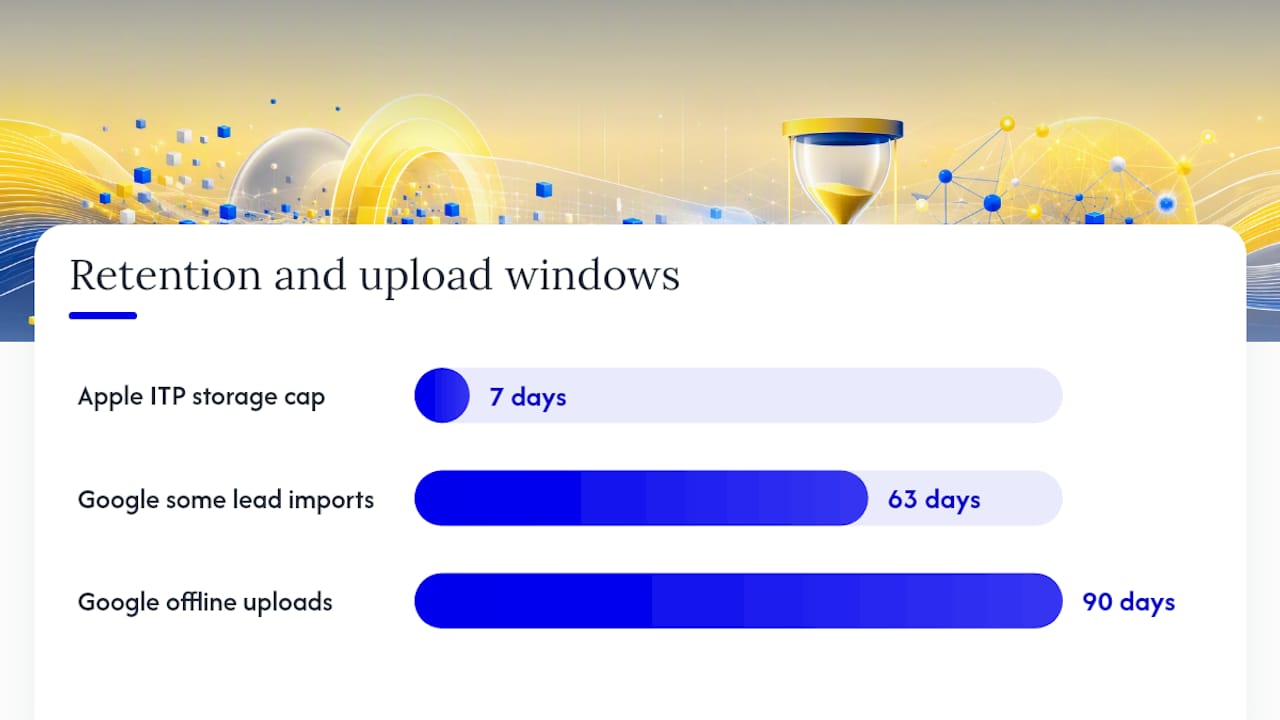
Server-side capture routes conversion events through a server you control (a Conversions API endpoint, a tag management server container) instead of a client-side pixel that a browser can block. It survives ITP’s storage limits and ad blockers because the browser never has to fire the tracking call directly. Apple’s ITP caps script-writable storage at just seven days, which is why so many multi-week B2B journeys look broken in standard analytics.
Here’s the build sequence RevOps and engineering teams should follow:
- Capture and persist identifiers at first touch. Store UTM parameters, click IDs (gclid, fbclid), and a first-party visitor ID in an HttpOnly cookie set by your own server, not a third-party script.
- Hash personal data before it leaves your systems. Email addresses and phone numbers should be hashed (SHA-256) before being passed to ad platforms for matching.
- Stitch logged-in IDs to anonymous sessions the moment a visitor authenticates, so pre-signup behavior isn’t orphaned.
- Deduplicate events using a shared event ID between client and server sends, and standardize timestamps to avoid double-counting.
- Respect upload windows. Google’s offline conversion imports allow a 90-day upload window, narrowing to 63 days for some lead imports. Miss that window and the conversion never reaches the platform’s bidding model.
For B2B accounts without a person-level match, reverse-IP and firmographic enrichment can serve as a fallback, with typical match rates of 30 to 60 percent on desktop traffic. That’s useful, not definitive. Validate everything with a reconciliation test: pull a sample of CRM-confirmed conversions and check whether your server-side pipeline actually recorded them.
Pro Tip: Run your event reconciliation test monthly, not once at launch. Tag managers and CRM fields drift, and a broken event three months in is far more expensive to catch than one caught in week one.
Where MMM and Incrementality Testing Fit In
Server-side data tells you what happened inside your own systems. It can’t tell you what would have happened without the ad spend. That’s the job of modeling and experiments.
Media mix modeling is a statistical, top-down method that regresses revenue or conversions against spend across channels over time, without needing individual-level tracking at all. It’s built for budget allocation decisions, not campaign-level optimization.
Incrementality tests are the ground truth. A geo-lift test turns off or reduces spend in a set of matched regions and compares outcomes against untouched control regions. A holdout test does the same thing with audience segments instead of geography. Both answer the question platform-reported attribution can’t: would this conversion have happened anyway?
Recommended cadence:
- Run at least one incrementality test per major channel per quarter, especially for the channel receiving the most credit in your platform dashboards.
- Use incrementality results to calibrate your MMM model’s coefficients, not the reverse.
- Feed the calibrated model’s outputs back into platform bidding strategies as guardrails, not gospel.
- Label every number in your reporting as “modeled” or “observed.” Mixing the two without labels is how finance teams lose trust in marketing data.
Combining server-side capture, MMM, and incrementality testing is the practical way to recover most of your lost attribution clarity, even if a residual gap remains. Gleanit’s guide to media mix modeling walks through model setup for teams doing this for the first time, and the multi-touch attribution playbook covers how to validate model outputs against real experiments.
A Four-Step, 90-Day Implementation Checklist
You don’t need a year-long transformation project. You need four sequenced steps, each with a clear owner and a way to check your work.
- Audit every event in week one. Pull your event list and check for missing conversion events, form submissions that don’t fire tags, and server-side receipts that never confirm on the ad platform side. Most teams find at least one broken event they didn’t know about.
- Stand up server-side capture for your top three conversion events. Prioritize by revenue impact, not by ease of implementation. Persist first-party keys (hashed email, logged-in ID) at the point of capture so they survive for the full sales cycle.
- Run one incrementality test on your highest-spend channel while simultaneously feeding 90 days of clean spend and conversion data into an MMM model. You need both running in parallel to calibrate one against the other.
- Reconcile with CRM and finance, then push value-weighted conversions back to platforms. Assign real economic value to each CRM milestone, for example $10 for a content download versus $1,500 for a completed demo, rather than treating every conversion as equal. That value signal is what teaches bidding algorithms to chase the right outcome instead of the cheapest one.
Pro Tip: If you only have budget to do one of these four steps well this quarter, do step one. A perfectly built server-side pipeline fed by broken source events just produces confident, wrong numbers faster.
Gleanit’s monitoring checklist for Google Ads is a useful companion for step one, since a missed event usually shows up first as an unexplained gap between platform-reported and CRM-confirmed conversions.
Common Mistakes and Governance Rules to Follow
Most attribution failures aren’t technical. They’re governance failures that let bad data quietly compound.
Consent Mode v2 is frequently misunderstood: it doesn’t obtain consent from anyone. It transmits a consent state to Google’s systems, and it has to be wired to an actual consent management platform to mean anything legally. Treat it as a signal pipe, not a compliance solution.
Avoid device fingerprinting as a workaround for lost cookies. It sits in a legally uncertain space in most jurisdictions and tends to create more audit risk than the attribution gap it claims to solve.
A few governance rules worth locking in now:
- Document your data retention and deletion schedule for every identifier you store, and review it against your privacy policy annually.
- Report conversions as value-weighted CRM milestones, never as flat conversion counts, so finance and marketing are looking at the same number.
- Set a fixed cadence for incrementality tests (quarterly, at minimum) rather than running them only when a channel’s performance looks suspicious.
- Keep an audit trail of every model change, event schema update, and consent configuration change, dated and owned by name.
Pro Tip: Assign one person to own the “why did this number change” question every month. Without a named owner, attribution discrepancies get debated in meetings instead of fixed in code.
How Probabilistic and Deterministic Matching Work Together
Deterministic matching links a person to an action using an exact, verifiable identifier: a logged-in user ID, a hashed email that matches on both sides, or a first-party cookie you set yourself. It’s precise. When it works, you know exactly who did what. Its weakness is coverage: it only works when the identifier actually exists on both ends of the match.
Probabilistic matching estimates a likely connection using signals like IP address, device type, browser characteristics, and time patterns, without a guaranteed one-to-one link. It’s how many cross-device and B2B account-level matches happen today, since a single decision-maker often researches on a work laptop, mobile phone, and home desktop without ever logging into the same account across all three.
In practice, most post-cookie stacks run both simultaneously and let deterministic matches take priority when they exist. Probabilistic matching fills the gap for anonymous or cross-device traffic, at the cost of some accuracy. Reverse-IP enrichment for B2B firmographic matching is a probabilistic technique, and it’s why match rates for that method top out around 30 to 60 percent rather than approaching certainty.

The practical takeaway for analysts: label which matches in your reporting are deterministic and which are probabilistic. A dashboard that blends both without distinction will overstate its own confidence, and someone in finance will eventually ask a question you can’t answer cleanly. Weight decisions more heavily toward deterministic data when the stakes are high, like budget reallocation, and treat probabilistic matches as directional signal for lower-stakes optimization calls.
Why Identity Graphs and Unified Profiles Matter More Now
An identity graph is the structure that holds all of a single customer’s known identifiers together: email hashes, device IDs, logged-in account IDs, and offline CRM records, linked into one profile. Without third-party cookies doing the stitching automatically, building and maintaining this graph in-house or through a first-party data platform becomes the actual foundation of your attribution.
The practical effect is that a unified customer profile turns disconnected touchpoints into a single journey. A person who clicks a paid social ad on their phone, researches on a work laptop three days later, and finally converts through a direct email link looks like three unrelated events without identity resolution tying them together. With a graph in place, that’s one journey with three touches, and your attribution model can credit each channel appropriately instead of over-crediting whichever channel happened to be present at the final click.
Building this well requires deciding where the graph lives. Options include a customer data platform, a data warehouse with identity resolution logic built in, or a CRM extended with matching rules. Whichever you pick, the resolution logic needs regular auditing, because identity graphs drift: people change email addresses, share devices, and switch jobs, and stale matches quietly corrupt attribution over time.
For B2B teams specifically, account-level resolution deserves its own layer above person-level identity. A robust cookieless stack treats the account, not just the individual contact, as the unit of measurement, since B2B deals typically involve multiple people from the same organization touching different channels independently before a decision gets made.
What GDPR and CCPA Actually Require Beyond Consent Banners
Consent banners get most of the attention, but the deeper compliance requirements shape how your attribution architecture has to be built, not just how it asks permission.
Under the EU’s General Data Protection Regulation, hashed email addresses and device identifiers used for matching still count as personal data if they can be linked back to an individual, even indirectly. That means your retention schedule, data minimization practice, and legal basis for processing all apply to your attribution pipeline, not just to your marketing emails. Storing first-party identifiers indefinitely “just in case” is a real compliance liability, not a hypothetical one.
The California Consumer Privacy Act (and its expansion under the California Privacy Rights Act) gives consumers the right to know what’s collected and to request deletion, which means your identity graph needs a practical way to locate and purge a specific person’s data across every system it touches, including any server-side capture pipeline and CRM import. If your architecture can’t answer “show me everything you have on this one person” within a reasonable timeframe, that’s a gap worth fixing before it becomes a request you can’t fulfill.
Both frameworks also affect cross-border data transfer and vendor contracts. If your server-side capture pipeline routes data through a third-party cloud processor, that processor needs a data processing agreement in place, and the jurisdiction where data is stored matters for GDPR specifically. This isn’t just a legal team’s problem: the technical architecture decisions your engineers make (which region a server lives in, which vendor processes hashed emails) carry direct compliance weight.
Comparing the Alternatives: What to Use and What to Avoid
Not every cookieless method deserves equal trust, and treating them all the same is a mistake worth correcting early.
Server-side capture with first-party identifiers is the most durable and defensible option. It’s deterministic where identifiers exist, survives browser restrictions, and creates a clean audit trail. The tradeoff is engineering effort: someone has to build and maintain it.
Consent-aware modeling (Consent Mode v2 and similar) scales effortlessly once configured, filling gaps from users who decline tracking. Its weakness is that it produces aggregates, not individual journeys, so it’s better suited to reporting totals than to optimizing individual campaigns.
Device fingerprinting identifies users through a combination of browser and device characteristics without any cookie or explicit identifier at all. It’s technically effective at matching, but it sits in increasingly hostile legal territory across multiple jurisdictions and several browser vendors actively work to block it. Most compliance-conscious teams should avoid it as a primary method.
Conversion modeling and MMM don’t try to track individuals at all. They estimate impact statistically from aggregate spend and outcome data. This makes them privacy-safe by design, but they answer budget-level questions, not campaign-level ones, and they need real experimental data to stay calibrated.
Probabilistic account matching (reverse-IP, firmographic enrichment) fills the B2B gap where person-level identifiers are missing, at match rates around 30 to 60 percent. Treat it as a fallback, not a primary signal.
The honest comparison isn’t which method wins. It’s which combination, deployed together, gives you both precision where it’s available and coverage where it isn’t.
How to Validate That Your Attribution Data Is Actually Right
Building the stack is only half the job. Without ongoing validation, small errors compound into a system nobody trusts.
Start with reconciliation testing: pull a random sample of confirmed CRM conversions each month and check whether your server-side pipeline captured them with the correct value and timestamp. Any gap larger than a few percentage points signals a broken event or a dropped identifier somewhere in the chain.
Cross-check platform-reported conversions against your own warehouse numbers regularly. Platforms have an incentive to report generously, since attributed conversions justify ad spend on their own network. A persistent, unexplained gap between what Meta or Google reports and what your CRM confirms is worth investigating before you trust either number for budget decisions.
Audit your identity graph on a fixed schedule, not just when something looks wrong. Check for duplicate profiles, stale matches, and identifiers that haven’t been used in months, since those distort both deterministic and probabilistic matching accuracy over time.
Finally, use incrementality tests as your outside check on the whole system. If your platform dashboards and MMM model both claim a channel is driving strong returns, but a geo-lift test shows minimal incremental lift, trust the experiment over the model. Experiments measure what actually happened when you changed something; models estimate what probably happened based on patterns. When they disagree, the experiment wins.
Document every validation check, including the ones that pass, so you have a running audit trail that shows your data quality over time rather than a single snapshot.
Why Cookie-Based Attribution Stopped Being Reliable
Third-party cookie attribution was never as accurate as the clean dashboards made it look, and the gap between reported and reality has been widening for years.
Safari and Firefox block third-party cookies by default, and Chrome’s own posture has shifted several times since 2024 and 2025, leaving marketers to plan around inconsistent browser behavior rather than a single fixed rule. That’s the core problem: attribution built entirely on third-party cookies degrades gradually and unevenly across browsers, not all at once on some fixed deprecation date. Waiting for a single cutover event to force a migration means you’ve already been operating on incomplete data for years without realizing it.
Apple’s Intelligent Tracking Prevention compounds the issue for longer sales cycles specifically. Script-writable storage gets capped at just seven days, which quietly breaks attribution for any B2B journey that takes longer than a week between first touch and conversion, and most meaningful B2B deals take far longer than that.
The result is a measurement system that looked precise but was actually just consistent, right up until browser policy made the underlying data disappear. Post-cookie attribution isn’t a downgrade from some golden era of perfect tracking. It’s an admission that the old system was always more fragile than the dashboards suggested, and a shift toward methods that were built to survive exactly this kind of change.
Upload Windows, Consent Limits, and Other Practical Constraints
Every layer of a cookieless stack has a hard operational limit that determines how fast you can move and how much signal you actually recover.
Google’s offline conversion import allows a 90-day upload window for most conversion actions, narrowing to 63 days for certain lead-based imports. Miss that window on a long B2B sales cycle and the conversion never reaches the platform’s bidding algorithm, no matter how accurately your CRM recorded it. This makes early capture of click IDs and first-party keys non-negotiable, since you can’t retroactively attribute a conversion to a click you never stored.
Consent rates set a hard ceiling on how much deterministic data you’ll ever have. If half your traffic declines tracking consent, no amount of engineering effort recovers that half deterministically. Consent-aware modeling can estimate an aggregate lift, typically 10 to 40 percent depending on consent rates and implementation quality, but that’s a modeled estimate layered on top of a real, permanent gap.
Realistic timelines matter too. Server-side capture typically takes two to six weeks to build and validate, depending on how many conversion events you’re prioritizing. Incrementality tests need a minimum sample size and duration, often two to four weeks per test, to produce a statistically usable result. MMM needs at least several months of clean historical data before its outputs are trustworthy enough to act on. None of this compresses into a single sprint, and teams that rush the timeline usually end up rebuilding the same pipeline twice.
An Agency’s View on Making This Actually Work
Most attribution advice reads like a whitepaper because it was written by people who’ve never had to explain a broken dashboard to a client on a Tuesday morning. The gap between the theory and the reality is where agencies actually earn their fees.
At Gleanit, the pattern shows up constantly across client accounts: teams add a new ad platform or landing page, and nobody checks whether the server-side event fired correctly until three weeks later when the numbers look wrong. The fix isn’t more dashboards. It’s a standing weekly check on event health, the same discipline as checking whether the lights are on before opening the store. CRM reconciliation works the same way. Client after client discovers their “cost per lead” number was quietly wrong because a form fill wasn’t matched to the right CRM stage, and nobody assigns real dollar value to that stage until the discrepancy is too large to ignore.
The agencies that adapt fastest treat this as an engineering problem with a marketing outcome, not the reverse. Gleanit’s funnel gap diagnostics exist for exactly this reason: catching the broken event before the client asks why performance “suddenly” dropped.
— Ovannes
Getting Your Attribution Stack Running With Gleanit
Building this playbook manually means stitching together a tag management server, a CRM export process, a spreadsheet for incrementality results, and someone checking all of it every week by hand. Gleanit gives agencies that same visibility from one connected view instead, with automated monitoring of ad accounts and customer journeys across Meta, TikTok, Google, and LinkedIn.

What makes it useful for the work described above isn’t just data collection. Gleanit’s funnel gap diagnostics flag exactly where a journey breaks down, whether that’s a missing server-side event, a form that stopped firing, or a channel quietly underperforming its reported numbers, and it prioritizes fixes by potential impact rather than burying them in a report nobody reads. New capabilities ship weekly, so the platform keeps pace as platform policies and consent requirements keep shifting under you. AI-assisted reporting turns the reconciliation work described in the playbook above into a client-ready document instead of a manual export job.
If you’re managing this across multiple client accounts and doing the audit and reconciliation work by hand right now, start a trial at Gleanit and connect your first ad account to see where your own event gaps actually are.
Sources
For deeper technical detail, the post-cookie attribution architecture breakdown covers server-side capture and upload windows in depth, while the cookieless attribution guide focuses on identity stitching for B2B accounts. For modeling and experiment design, see the triangulation approach for 2026. Gleanit’s own cross-channel attribution playbook and creative testing framework operationalize several of the steps above for agency teams.
- Understanding Performance Marketing: The Post-Cookie Attribution Architecture | Deviate Labs
- How to Do Cookieless Attribution | Abmatic AI
- Cookieless Attribution 2026: What Actually Works
Recommended
- Campaign Post Mortem: A Repeatable Agency Template
- Cross-Channel Attribution: A Practical Playbook for Analysts
- Multi-Touch Attribution Models: A Practitioner’s Guide
Corrections: ovannes@hearye.co or our editorial policy.