
Start in TikTok Creative Center. Open Top Ads and Advertiser Search, watch 15 to 20 top-performing ads in your category using both a 7-day and a 30-day window, and log the hook, format, and audio pattern for each. That single afternoon gets you a set of testable creative hypotheses you can run in your own account this week. If you’re tracking more than a couple of clients or need TikTok signals correlated against Meta and Google, that’s your cue to move past manual audits into automated monitoring.
TL;DR:
- Tracking both 7-day and 30-day ad performance windows helps distinguish viral spikes from durable creative patterns for better hypothesis testing.
- Filtering by industry, region, and campaign objective ensures relevant samples, while logging pattern structures rather than brand-specific ads improves insight.
- Metrics like 2- and 6-second view rates and click-through rates predict early retention and engagement more reliably than overall impressions.
- Manual audits suit small-scale or one-time checks, but automated tools are essential for managing multiple clients, cross-platform signals, and frequent creative updates.
- Avoid survivor bias by verifying top ads over multiple timeframes, and focus on why patterns succeed rather than copying surface-level strategies blindly.
Table of Contents
- How to use TikTok Creative Center for TikTok ads competitor research
- A repeatable workflow for competitor ad research
- Which TikTok ad metrics actually predict performance?
- When manual audits are enough, and when to automate
- Common competitor research mistakes to avoid
- How Gleanit approaches competitor ad audits at agency scale
- What actually separates good competitor research from busywork
- Ready to move past manual TikTok ad audits?
- Sources
How to use TikTok Creative Center for TikTok ads competitor research
TikTok Creative Center is free, and it’s the right first stop for anyone doing serious TikTok ads competitor research, because it doesn’t just show you ads. It shows you which ads TikTok’s own algorithm considers winners.
Three areas matter most:
- Top Ads dashboard ranks creatives by performance within a category, not just by recency. That ranking is the whole point: TikTok Creative Center surfaces ads that are already proving themselves, so you skip the noise of ads nobody is watching.
- Advertiser Search lets you pull up a specific brand’s active and recent creative library, which is useful once you’ve identified two or three direct competitors worth tracking closely.
- Trend Discovery shows rising sounds, hashtags, and formats before they saturate your feed, which helps you time creative refreshes around momentum rather than guesswork.
Log in with a Business account. Free accounts see basic ad examples, but a Business login unlocks deeper performance context and finer filtering. Set your filters deliberately: region, industry vertical, campaign objective, ad format, and time window. Skipping any one of these gets you a flood of irrelevant creative.
What you can reliably observe: format choice, runtime, hook structure, music or voiceover, and in many cases directional engagement signals. What you can’t see: a brand’s full historic ad log, its actual spend, or the private targeting and bidding decisions behind the results. Treat Creative Center as a window into what’s working publicly, not a leaked media plan.
A repeatable workflow for competitor ad research
Running this well takes one afternoon and a spreadsheet. Here’s the order that works:
- Pick your filters first. Choose one industry vertical, one region, and one objective (traffic, conversions, app installs) so your sample is apples to apples.
- Pull two time windows. Check the 7-day view to catch what’s freshly gaining traction, then the 30-day view to see what’s held up. A dual-window comparison separates viral flukes from durable creative patterns, which matters because plenty of ads spike for a day and disappear.
- Watch 15 to 20 top ads, with sound on. Muting the audio throws away half the signal.
- Log each ad in a standard set of fields: hook type (question, bold claim, pattern interrupt), format (in-feed, Spark Ad, TopView), runtime, sound choice, CTA placement, apparent landing flow, and inferred campaign objective.
- Group by pattern, not by brand. You’re looking for repeated structural choices across multiple advertisers, since that’s a stronger signal than any single ad doing well.
- Turn the strongest patterns into test hypotheses. Write each as: “If we open with a pattern-interrupt hook instead of a product shot, CTR will improve because attention capture happens in the first two seconds.” Attach a KPI, a minimum sample size, and a stop date before you launch.
Pro Tip: Log audio choices as seriously as you log hooks. Trending-sound placements often signal an advertiser leaning on organic discovery, while custom voiceover or original scoring usually signals a brand investing in a distinct voice rather than chasing a trend wave. That distinction tells you whether a competitor is playing a short-term reach game or building something durable.
Keep your notes in a shared template so the next audit takes an hour instead of an afternoon. Structure beats memory here.
Which TikTok ad metrics actually predict performance?
Not every number in a benchmark report deserves equal weight. Some tell you about creative fit; others just reflect how TikTok happened to distribute an ad that day.
- 2-second and 6-second view rates measure whether your hook survives the scroll. Weak early retention almost always traces back to the first frame, not the offer.
- CTR signals whether the creative and the copy are compelling enough to act on, but it swings hard by format.
- CVR measures whether the landing experience matches what the ad promised. A high CTR paired with a weak CVR usually means a mismatch between the hook and the page.
- CPA rolls everything together, but on its own it won’t tell you which upstream metric broke.
- Runtime distribution matters more than people assume. Shorter cuts tend to dominate top-ads lists in categories built on impulse purchases; longer, story-driven runtimes hold up better for considered purchases.
Format choice alone moves the numbers meaningfully. Spark Ads generally post higher CTR and CVR than generic in-feed placements, which is why format-blind benchmarking leads teams to the wrong conclusions about what’s “working.”
Set your test targets against category benchmarks rather than platform-wide averages. Gleanit’s own TikTok ad benchmark data breaks these figures out by industry, which matters, because a strong CTR in beauty is a mediocre one in software.
When manual audits are enough, and when to automate
A manual audit is the right tool when you’re building a single campaign brief, doing a one-off competitive check before a pitch, or managing an account small enough that you personally remember what changed last month.
The math changes once you cross a few thresholds:
- Multiple clients. Running the same 15 to 20 ad review across five accounts every month eats a full day you could spend on strategy.
- Cross-platform correlation. If you need to know whether a competitor’s TikTok push lines up with a Meta or Google shift, spreadsheets stop scaling fast.
- Change alerts. Competitors refresh creative constantly. Catching a shift within days, not weeks, requires scheduled capture, not a recurring calendar reminder.
- Funnel-gap diagnostics. Manual review shows you the ad. It doesn’t show you where a competitor’s funnel likely leaks after the click.
At that point, automated monitoring earns its cost. The category of tool worth evaluating handles scheduled ad capture across platforms, flags meaningful creative changes automatically, and uses AI to draft the reporting layer instead of leaving that to an analyst on a Friday afternoon.
Pro Tip: Before buying any monitoring platform, confirm it captures Meta and Google alongside TikTok, and that it ties creative signals to funnel outcomes, not just impressions. A tool limited to single-platform capture without funnel-gap analysis leaves you re-doing the correlation work by hand, which defeats the reason you automated in the first place.
Common competitor research mistakes to avoid
The biggest error is survivor bias: pulling five ads from a single strong day and treating them as the category playbook. A single-day spike often reflects a trending sound or a lucky placement, not a repeatable pattern. Always cross-check a 7-day standout against the 30-day view before you trust it.
A few more traps worth flagging:
- Ignoring sound. Muted review misses half the strategic signal, especially creator-fit and pacing cues.
- Copying scripts verbatim. Extract the structure and pacing, not the exact lines. What worked for a competitor’s audience and brand voice may flop for yours.
- Skipping the logging template. Freeform notes fall apart after the third competitor. A fixed tagging schema (hook, format, runtime, sound, CTA) keeps comparisons honest over months, not just for one audit.
How Gleanit approaches competitor ad audits at agency scale
Running this workflow for one client is manageable. Running it for a dozen, across TikTok, Meta, and Google, is where manual review breaks down fast.
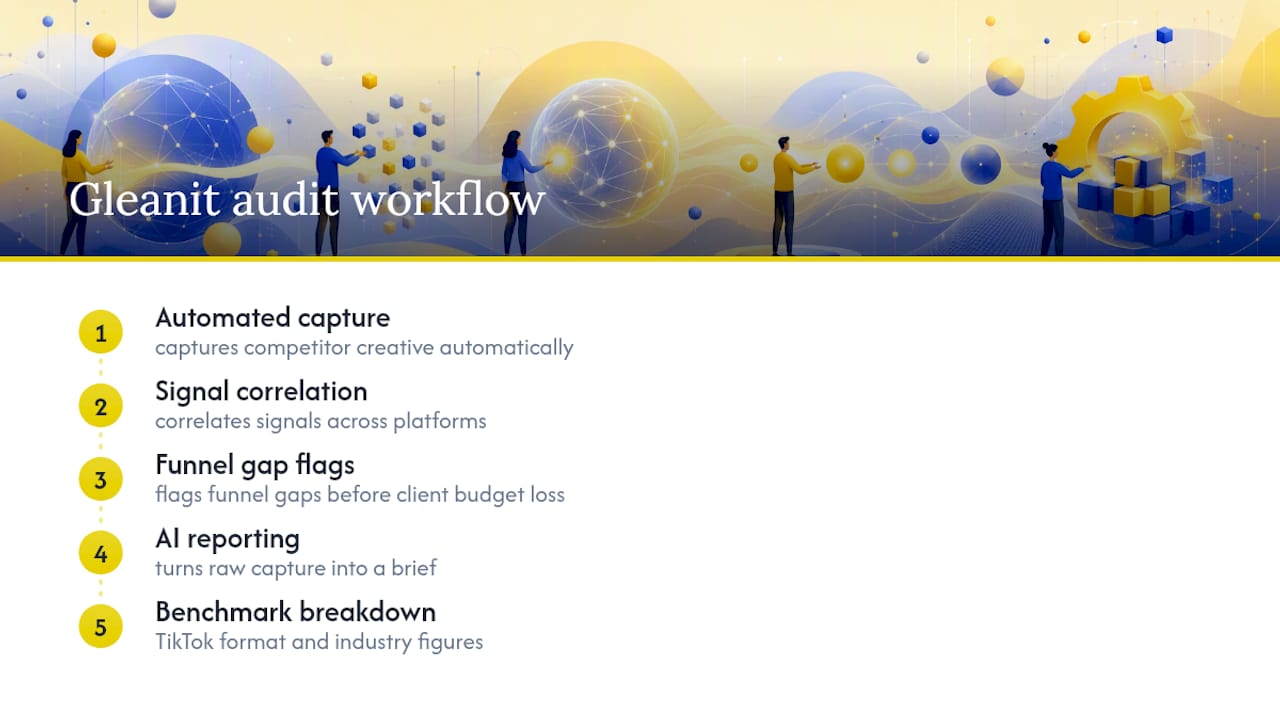
That’s the exact gap Gleanit builds for. The platform captures competitor creative automatically, correlates signals across platforms, and flags funnel gaps before they cost a client budget. Its AI reporting layer turns raw capture into a brief an account lead can send without rewriting it. For deeper benchmark reading, Gleanit’s TikTok ad benchmark breakdown covers format and industry figures worth checking before you set your own test targets.
What actually separates good competitor research from busywork
Most competitor research fails for a boring reason: it counts things that look impressive instead of things that predict outcomes. Watching a competitor’s top ad because it has flashy numbers on a dashboard is not analysis, it’s spectating. The workflow that actually moves your account forward treats every observed pattern as a hypothesis, not a template to clone.
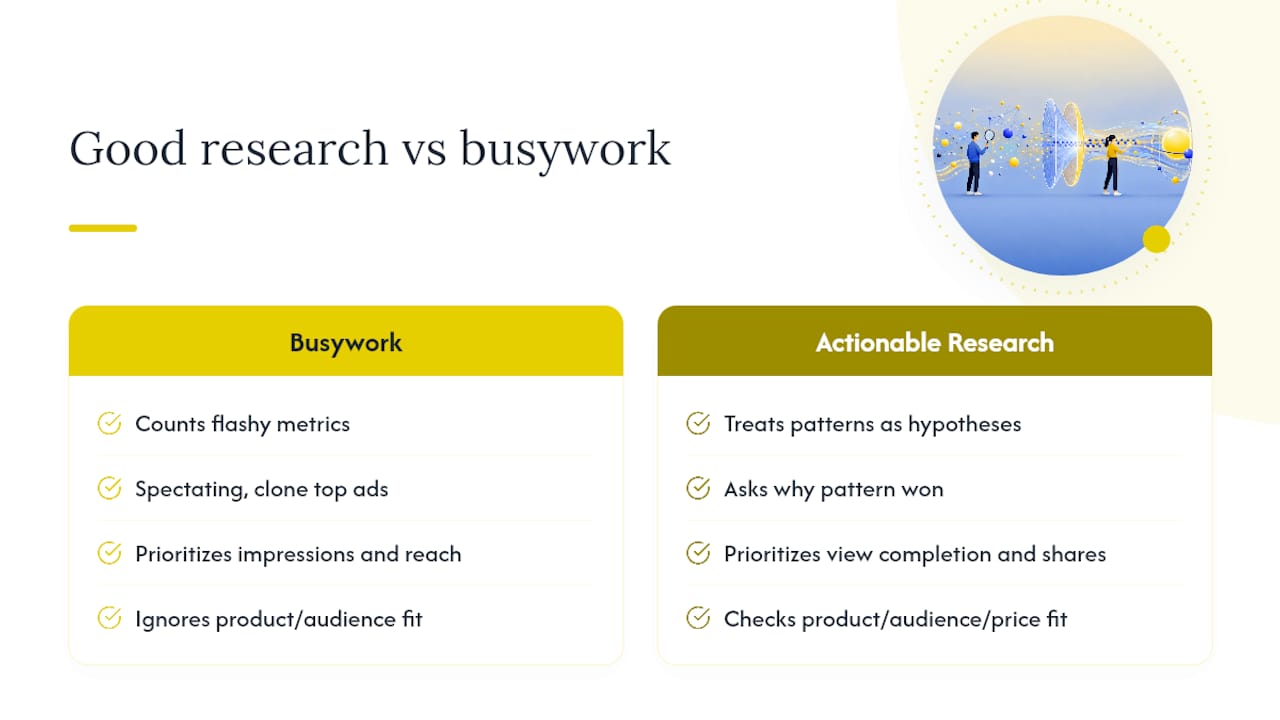
The conventional advice, “see what competitors are doing and do something similar,” skips the harder and more useful question: why did that pattern win, and does the same mechanism apply to your product, audience, and price point? A pattern-interrupt hook works in beauty because the buying decision is impulsive. It may do nothing for a B2B software ad where the buyer needs three more seconds of context, not less.
Prioritize depth signals like view completion and shares over raw impression counts, since those correlate more directly with actual conversion behavior than surface-level reach ever will. And once you’ve validated a pattern manually, don’t keep re-running the same audit by hand every month. That’s a scheduling problem, not a strategy problem.
— Ovannes
Ready to move past manual TikTok ad audits?
If you’ve run the Creative Center workflow above a few times, you already know where it starts to strain: five clients, three platforms, and a spreadsheet that’s now three tabs deep. Gleanit is built for exactly that point. It automates ad capture across TikTok, Meta, and Google, correlates creative shifts against funnel performance, and surfaces prioritized fixes instead of a pile of screenshots someone has to interpret manually.
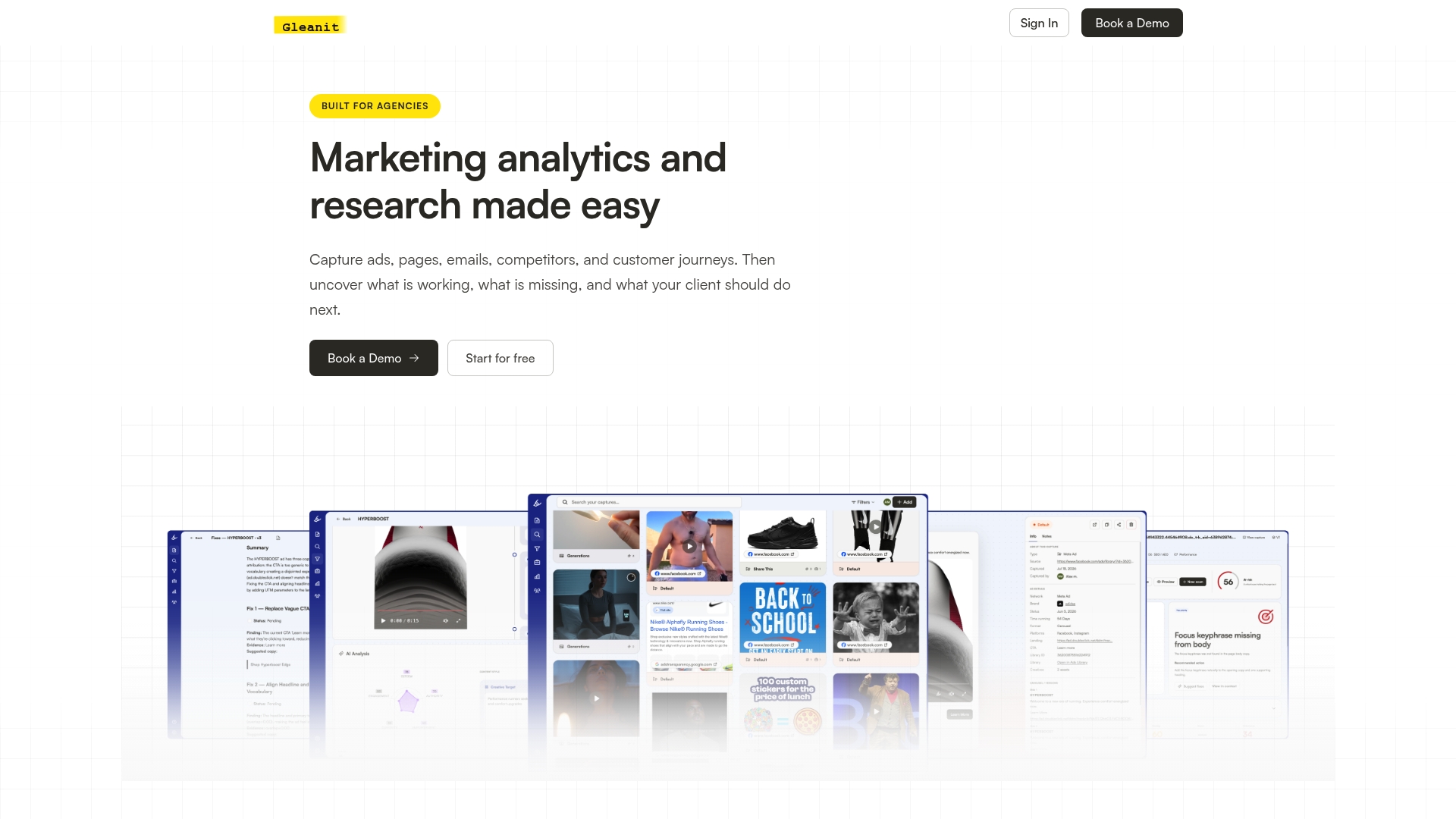
Its AI reporting layer drafts the client-ready summary automatically, and new capture features ship weekly, so the tool keeps pace with how fast TikTok’s ad formats actually change. If you also run creator-led campaigns, pairing this with resources like Influenna’s creator strategy coverage helps round out the audience-fit side of the picture. When you’re ready to see it against your own client roster, start a free trial at Gleanit and run your next competitor audit in minutes instead of an afternoon.
Sources
- How to See Your Competitor’s TikTok Ads (Full Walkthrough)
- TikTok Creative Center guide: How to find winning ads
Recommended
- Google Ads Competitor Research: A Practical Workflow for Marketers
- Unified Marketing Dashboard: Faster Insights for Agencies
- A Creative Testing Framework That Actually Scales Ad Results
Corrections: ovannes@hearye.co or our editorial policy.