
Capture proof right after a positive experience, get written consent, and hand a short quote or rating to your ad team as a testable asset. Think a 10–15 word line like “Set up in an afternoon, and our CPA dropped,” or a plain rating with a review count. Follow FTC guidance on testimonials, then run an A/B test to confirm the proof helps.
TL;DR:
- Start with ratings and specific text testimonials; add video or user generated content once you know which claims resonate and can clear usage rights.
- Choose testimonials that name a result, timeframe, or change from before to after, then tag each by the objection it answers.
- Verify each customer and claim, disclose paid or other material ties visibly in the ad, and preserve the testimonial’s meaning when trimming it.
- Offer any incentive to every respondent regardless of sentiment, because rewards conditioned on positive feedback can create liability under FTC guidance.
- Keep the offer, audience, and placement constant, change one variable, and wait for enough conversions across a full business cycle before naming a winner.
Table of Contents
- Which types of social proof are worth capturing?
- How do you collect proof consistently?
- What legal and authenticity rules apply to testimonials?
- Which ad formats and treatments make social proof convincing?
- How do you measure whether social proof improves results?
- What do ready-to-use templates look like?
- How does Gleanit support social proof capture for ads?
- What should small teams prioritize first?
- Next steps: run a free audit and ship your first proof test
- FAQ
- Sources
Which types of social proof are worth capturing?
Not every credibility signal pulls the same weight in an ad. Pick based on what the ad needs to do and how much production time you have.
- Reviews and ratings: star averages and review counts. Best for conversion and lowering hesitation at the bottom of the funnel. Low effort, easy to automate from review platforms.
- Short text testimonials: one or two sentences tied to a specific result. Strong for conversion and cost per acquisition. Needs light human curation to pick the best line.
- Video testimonials: a customer talking briefly. Strong for awareness and mid-funnel trust. Highest production effort, though a phone recording often works.
- User-generated content (UGC): photos, unboxings, screen recordings, social posts. Good for awareness and thumb-stopping creative. Needs rights clearance and editing.
- Case metrics: a measured outcome such as hours saved or revenue growth. Strong for B2B and considered purchases. Needs the customer’s approval and a way to check the number.
- Expert endorsements: a named specialist or publication vouching for you. Useful for new brands that need borrowed credibility. Slow to secure and must be disclosed properly if there is any compensation.
- Social cues and peer affiliations: showing that people someone knows already like or follow the brand. Field experiments found that displaying a peer’s affiliation next to an ad significantly increased clicks and connections, and the effect grew with stronger ties and more cues.
If you are starting from zero, begin with ratings and short text testimonials. They are cheap to collect, quick to approve, and they plug into almost every ad format. Add video and UGC once you have a steady stream of text proof and a sense of which claims resonate.
One more filter matters: specificity. A quote that names a result, a timeframe or a before-and-after moment does more work than generic praise. When you review incoming proof, tag each piece by the objection it answers (price, ease, trust, results). That tag is what lets a creative team match proof to a funnel stage later, and it is the difference between a pile of quotes and a usable library.
How do you collect proof consistently?
Reliable capture is a process, not a one-off outreach blast. The best results come from asking at the moment a customer feels the win.
- Pick a trigger. Use the post-purchase window, a product milestone (first report sent, first campaign launched), a support ticket closed with a thank-you, or a high satisfaction score.
- Choose the channel that matches the moment. In-app prompts suit milestones, email and SMS suit post-purchase, and a QR code on packaging or a receipt suits offline customers.
- Ask a narrow question. “What changed after you started using us?” beats “Leave a review.” For video, ask for one concise story.
- Ask for permission in the same breath. Include a plain consent line covering where and how you may reuse their words, name and image.
- Log the metadata. Store consent status, product, date, the exact original wording, channel, and what uses were approved.
- Route it. Send new proof to one central library, then have a human pick hero quotes and flag anything that needs verification.
On incentives, keep them value-based and never conditioned on a positive opinion. The FTC says that compensation or incentives conditioned on expressing a particular sentiment can create liability. A thank-you offered to everyone who responds, whatever they say, is far safer than a discount for five stars.
Pro Tip: Ask soon after a success moment, and let customers record on their phone. Slightly imperfect video often reads as more credible than a polished studio take.
To scale, automate the asking and the filing, not the judgment. Triggers, reminders and storage can run on their own, while a person picks which quotes become ads. For more ideas on sourcing real-world examples, this guide to Facebook Ad Library searches shows how to study what other brands put in front of customers.
What legal and authenticity rules apply to testimonials?
Testimonials are advertising, and the rules follow from that. The FTC’s Q&A explains that businesses can be held responsible for fake or false reviews, for review suppression, and for misuse of fake indicators of social media influence. It also advises verifying authenticity before you use a testimonial.
Use this checklist before any customer words go into an ad:
- Confirm the person is real and was a customer. Match the reviewer to an order, account or support record.
- Check the claim is typical or qualified. If one customer got an unusual result, say so or choose a more representative quote.
- Disclose material connections. Free product, payment, affiliate commissions or employee status must be made clear.
- Make disclosures hard to miss. Place them in the ad itself, in the video and audio where relevant, and never behind a “more” link that viewers will not open. The Federal Register guidance on endorsements warns specifically against disclosures hidden that way.
- Treat republishing as endorsing. That same guidance gives examples showing that reposting a positive review turns it into an endorsement you answer for.
- Do not edit meaning. Trim for length, but never change what the customer said or imply more than they claimed.
- Keep records. Save the original message, the date, the consent and the version that ran in the ad.
The FTC states that testimonials are advertising, which means the same truthfulness standard applies to a customer quote in a paid post as to any claim you write yourself.
For paid social, put the disclosure in the visible caption or on screen at the start. For landing pages, keep it next to the testimonial rather than in a footer. When you are unsure whether a specific case needs a disclosure, ask legal counsel, because the right answer depends on the facts.
Which ad formats and treatments make social proof convincing?
The best format depends on the placement and on how much attention you can earn at the start. These are the executions worth testing first:
- Quote overlay: a single line on a clean background or product shot. Fast to produce and easy to swap in bulk.
- Short testimonial video: 15–30 seconds, with the strongest sentence at the start and captions burned in.
- UGC montage: several customers in quick cuts, each saying one thing, ending on the product.
- Metric-first creative: lead with the number (a rating, a result, a customer count that you can substantiate), then show the quote that explains it.
- Carousel of reviews: one review per card, with the product visible on the first card.
A few rules raise believability. Keep quotes short, because long ones get skimmed. Attribute them with a first name and a role or context (“Dana, agency owner”), and add the timeframe when it helps. Show the product in use so the proof is attached to something concrete.
Channel details matter as much as the creative. On TikTok, write the caption first, since many people read before they watch, and keep the proof in the spoken hook. On Meta, choose a thumbnail frame that already carries the quote so the message lands before the video plays. For display, check legibility at small sizes and cut anything that needs more than a glance.
Always pair the proof with one clear next step. “Start your free audit” next to a customer saying the audit found a quick win gives the reader a reason to click now. For B2B campaigns, the LinkedIn Ad Library guide is useful for seeing how other brands present proof to professional audiences. A partner write-up on social proof strategies offers additional practitioner examples if you want more ideas to test.
How do you measure whether social proof improves results?
Measure against the goal of the ad, not vanity metrics. For conversion campaigns, watch conversion rate and cost per acquisition first. Click-through rate, add-to-cart and form starts are useful secondary signals that show where the proof is helping or stalling.
Three test setups cover most needs:
- Proof versus no proof. Same offer, same audience, same placement. One ad carries the quote or rating, the other does not. This is the cleanest test of whether proof adds value at all.
- Proof format comparison. Keep the same quote and compare the delivery: overlay versus video versus carousel. Change one variable only.
- Audience-level experiment. Show the same proof to cold prospects, retargeting and existing leads. Proof often matters more to people who do not yet know you.
On sample size and run length, let each variant collect enough conversions that the gap is not just noise, and run for at least one full business cycle so weekday effects even out. Early leads in the first day or two are common and often fade, so resist calling a winner until the result holds steady. Your ad platform’s built-in experiment tools can tell you when a result is reliable.
Pro Tip: Change one thing per test. If the quote, image and call to action all differ, you will not know which one moved the number.

For reporting, open with the lift percentage and the absolute difference, then the audience and dates, and close with what you learned and what to test next. Gleanit’s creative testing framework lays out a repeatable loop for exactly this kind of work.
What do ready-to-use templates look like?
Here is a small kit you can copy and adapt.
Ad copy templates
- Quote overlay: “[Short quote]” and then “[First name], [role]” on a separate line, followed by “[Product]: [one-line benefit].”
- Metric-first: “[Result or rating] from [type of customer]. Here is what [first name] said: ‘[quote].’”
- UGC caption: “[First name] showed us how they use [product] to [outcome]. Watch the 20-second version.”
Capture messages
- Email or SMS: “Hi [first name], you recently [milestone]. What changed for you? Reply with a sentence or two. May we share your words in our marketing? Reply YES if so.”
- In-app modal: “Nice work on your first [milestone]! Tell us in one sentence what it did for you. Check the box if we can quote you.”
Consent snippet (use verbatim): “I agree that [Company] may use my words, name and photo in advertising and on its website. I understand I can ask for removal at any time.”
Then work each piece through the same short path:
- Verify the customer and the claim against your records.
- Tag the quote by objection, funnel stage and product.
- Edit for length without changing the meaning.
- Design the asset in the format you plan to test.
- Test it against a control with a single changed variable.
How does Gleanit support social proof capture for ads?
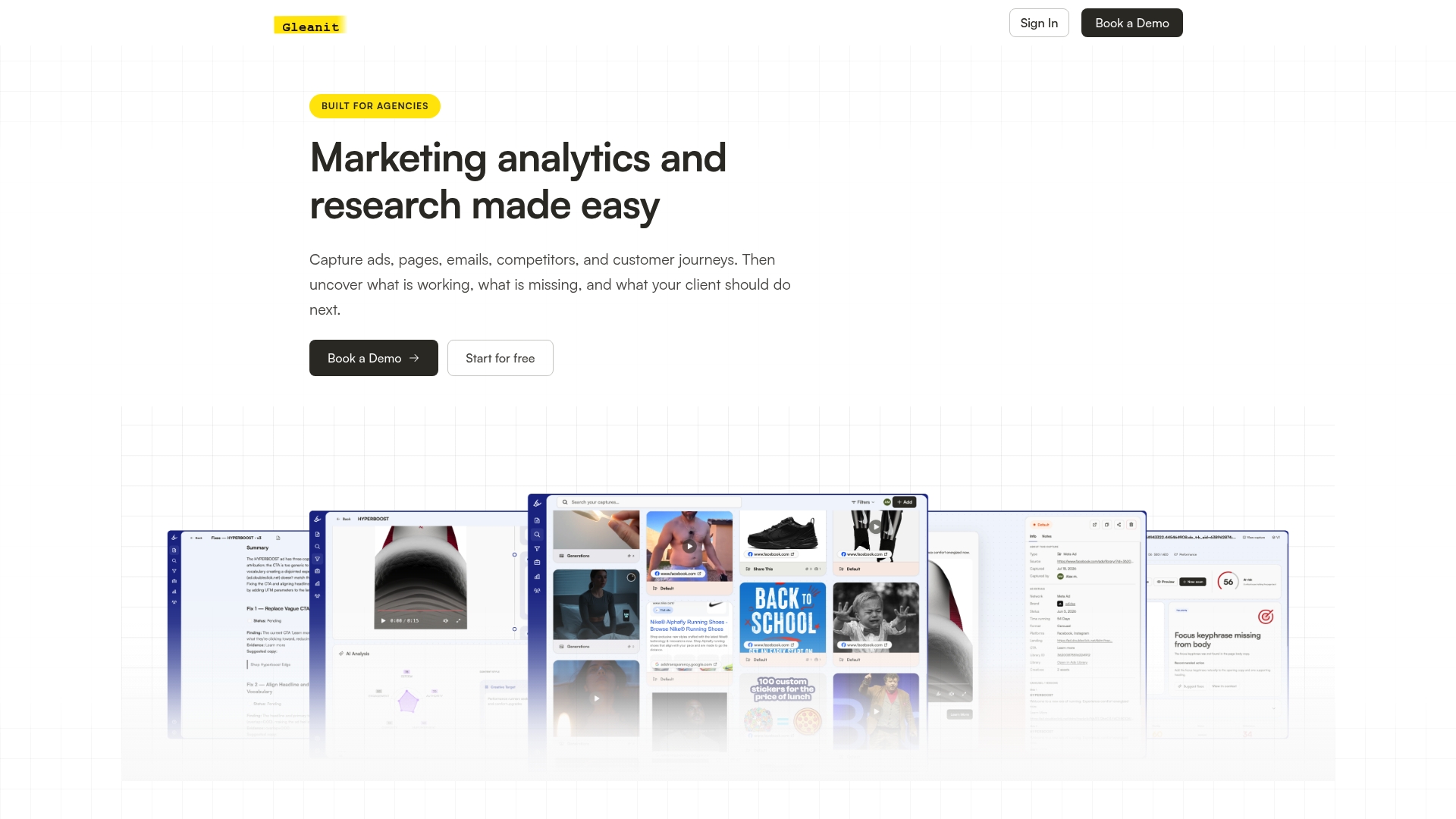
We built Gleanit to make the operational parts of this workflow lighter. Our platform monitors ads, pages and emails across Meta, TikTok, Google and LinkedIn, and captures what it finds into a centralized swipe file, so the examples your team studies live in one place. Client-dedicated workspaces keep each account’s assets separate, and our AI-assisted reporting and audits help you see where a funnel lacks credibility signals.
That supports the handoff to the people who design and measure the ads. Your creative team can start from an organized library and a clear list of gaps.
A low-effort starting point is our free ad audit.
What should small teams prioritize first?
If resources are tight, automate capture and consent before anything else, then put every asset in one place. Test one proof format before building a larger library. Keep a person in charge of choosing hero testimonials and editing video, because judgment is where quality comes from. And run one clean controlled A/B test before you rework your whole creative approach.
— Ovannes
Next steps: run a free audit and ship your first proof test
Start by finding where proof is missing, then test one fix. Our free audits are a place to start:
- Run the free ad audit to see which live ads would benefit from a quote or rating.
- Run the free marketing audit to spot gaps across your funnel.
- Pull your best customer quotes, pick one template from this article, and launch a single A/B test this week. If you want ongoing monitoring afterward, check our plans and pricing.
FAQ
Can you give an example of social proof advertising?
A common example is a short ad built around a customer quote, such as “Cut our reporting time substantially,” paired with the customer’s first name, role and the product in use. Another is a carousel where each card shows one review. Both work because they let a real customer make the claim instead of the brand.
What are social proof ads?
Social proof ads use evidence from other people, such as reviews, ratings, testimonials, user content or peer affiliations, to make an offer more believable. Experimental work found that showing a peer’s affiliation alongside an ad increased clicks. The proof must be genuine and properly disclosed where required.
How do I get social proof?
Ask customers right after a positive moment, such as a purchase, a milestone or a resolved support ticket. Keep the request short, include a clear consent line, and store the original wording with the date and approved uses. Give any thank-you incentive to everyone who responds, not only to those who write positive comments.
Do I need permission to use a customer’s review in an ad?
Get written permission, because republishing a positive review can make it an endorsement that you are responsible for under FTC endorsement guidance. A simple consent checkbox or reply-YES message works, as long as you keep a record of it.
Sources
- The Consumer Reviews and Testimonials Rule: Questions and Answers | Federal Trade Commission
- Federal Register, Volume 88 Issue 142 (Wednesday, July 26, 2023)
- Dl
Recommended
- Get Tests Live in Two Weeks: Competitor Ad Analysis for Agencies
- A Creative Testing Framework That Actually Scales Ad Results
- 2 Minute Capture Routine to Build an Ad Swipe File Agencies Use
- Google Ads Competitor Research: A Practical Workflow for Marketers
Corrections: ovannes@hearye.co or our editorial policy.