Most roundups of direct mail examples show you a pretty photo and move on. But a photo doesn't tell you why the piece worked. It hides the structural choice you can copy, even on a tiny budget.
So this guide is built as a study reference. For each example you'll learn what happened, why it landed, and what to note in your swipe file. We've grouped the 15 pieces into four buckets: classic letters, creative consumer mailers, B2B and account-based mail, and nonprofit appeals. Each one is sourced, so you can verify the claims yourself.
What you'll learn from these direct mail examples
- How 15 real campaigns, from 1974 to 2024, changed a mechanic instead of just printing a nicer flyer
- Which patterns recur across sales letters, dimensional mailers, B2B ABM, and fundraising
- What the published response rates and ROI figures actually were, with sources
- How to adapt each pattern to a small-business, B2B, or nonprofit budget
How we researched these direct mail examples
What we used. Published case studies and award write-ups from Cannes Lions and The One Club, fundraising case archives from SOFII, swipe-file archives, and direct-marketing trade coverage. Where an agency or charity published response numbers, we cite them.
How we built this list. We collected dozens of candidate pieces, then filtered to 15 that meet our criteria below. Together they span the full range of formats and budgets, from a one-page letter to a five-figure dimensional ABM program.
Tools we used: a browser, award and case-study databases, and Gleanit, where this list lived as captures (each with its source URL and a note) before it became a post.
How we evaluated. Three filters: the piece was real and documented, it changed a mechanic rather than just polishing the message, and there's a lesson that transfers to teams without a Super Bowl budget.
What we think. These are practical teardowns, not award worship. A trophy is nice; a repeatable pattern is better.
In our experience, the direct mail you remember is the piece someone saved with a note about why. Most entries here started as captures in our own library, tagged by mechanic, which is what made them usable when we sat down to write.
Scope of this guide. We did not independently audit response rates or revenue figures beyond what the brands, agencies, and trade press published. Numbers are as reported at the time, and we say so in each entry.
Limitations include a bias toward English-language US, UK, and Irish campaigns, because that's where the public case studies and our own captures were concentrated.
Key takeaways from these examples
- The best direct mail examples change the mechanic, not the message. Think a candle that controls a light switch, or a card that says the bar was "too chunky to deliver."
- Story beats specs. The most profitable piece in history (the WSJ letter) was two pages of plain prose, no graphics.
- Physical depth buys attention. Dimensional mailers get opened almost every time because mailrooms treat them as parcels, not advertising.
- Tangibility raises the ask. Nonprofits that asked donors to fund one concrete thing (a well, an ambulance) beat broad "help the crisis" appeals.
- Mail is a touch, not a campaign. The B2B winners paired the piece with an email and a phone follow-up within days.
- None of it helps if you can't find the example when you brief your own mailer. Save the source and a one-line "why," not a screenshot.
Direct mail examples at a glance: cited facts
These published figures show the range of what direct mail has delivered. They are reported by the brands, agencies, charities, or trade press named, not independently verified by Gleanit:
- The Wall Street Journal "Two Young Men" letter ran as the control mailing for ~28 years (1975–2003) and is credited with roughly $2 billion in subscription revenue.
- Dimensional mail is reported to reach the intended recipient about 87% of the time, versus 23% for standard sales letters, with response rates near 8.5%.
- UN Women's "Child Wedding Cards" cost under $1,500 to produce and reached more than 25 million people (Cannes Lions Grand Prix for Good, 2024).
- Trócaire's September "exceptional ask" drew 22 ordinary donors each funding a field ambulance, raising ~€270,000 at an 8.5% response rate.
- A US carpet-cleaning postcard campaign reported spending $13,950 to generate $224,500 in revenue, about a 1,509% return.
Examples: the canon (sales letters that defined direct mail)
1. The Wall Street Journal "Two Young Men" letter (1974)
Freelancer Martin Conroy wrote a two-page "Dear Reader" letter. It opens with two college classmates, alike in every way, who meet again 25 years later. One is a manager. The other is the president of the company.
The difference, the letter argues, is "what each person knows and how he or she makes use of that knowledge." That, of course, is what a Wall Street Journal subscription provides. The letter ran as the WSJ's control mailing for roughly 28 years. By the paper's own math, it is credited with about $2 billion in revenue. No copywriter ever beat it in testing.
Why it worked: it sold an outcome (success, status) through a story the reader steps into. Then it named one believable cause for the gap, "applied knowledge", and made the product the source of it. The soft, story-first structure disarmed the reader's sales radar.
What to steal: lead with a story your prospect sees themselves in, isolate one believable reason for the outcome they want, and make your product that reason. Plain words on plain paper can out-earn any design.
2. Gary Halbert's "coat of arms" letter (1970s)
Copywriter Gary Halbert mailed a short letter offering people a research report and a printout of their family name's coat of arms. The genius was disguise. It used real first-class stamps, a handwritten-style envelope, and a physical return address and phone number. The copy read like a personal note from a real person, not a company. In some variation, it's been estimated to have been mailed hundreds of millions of times, building a thriving family-heritage business.
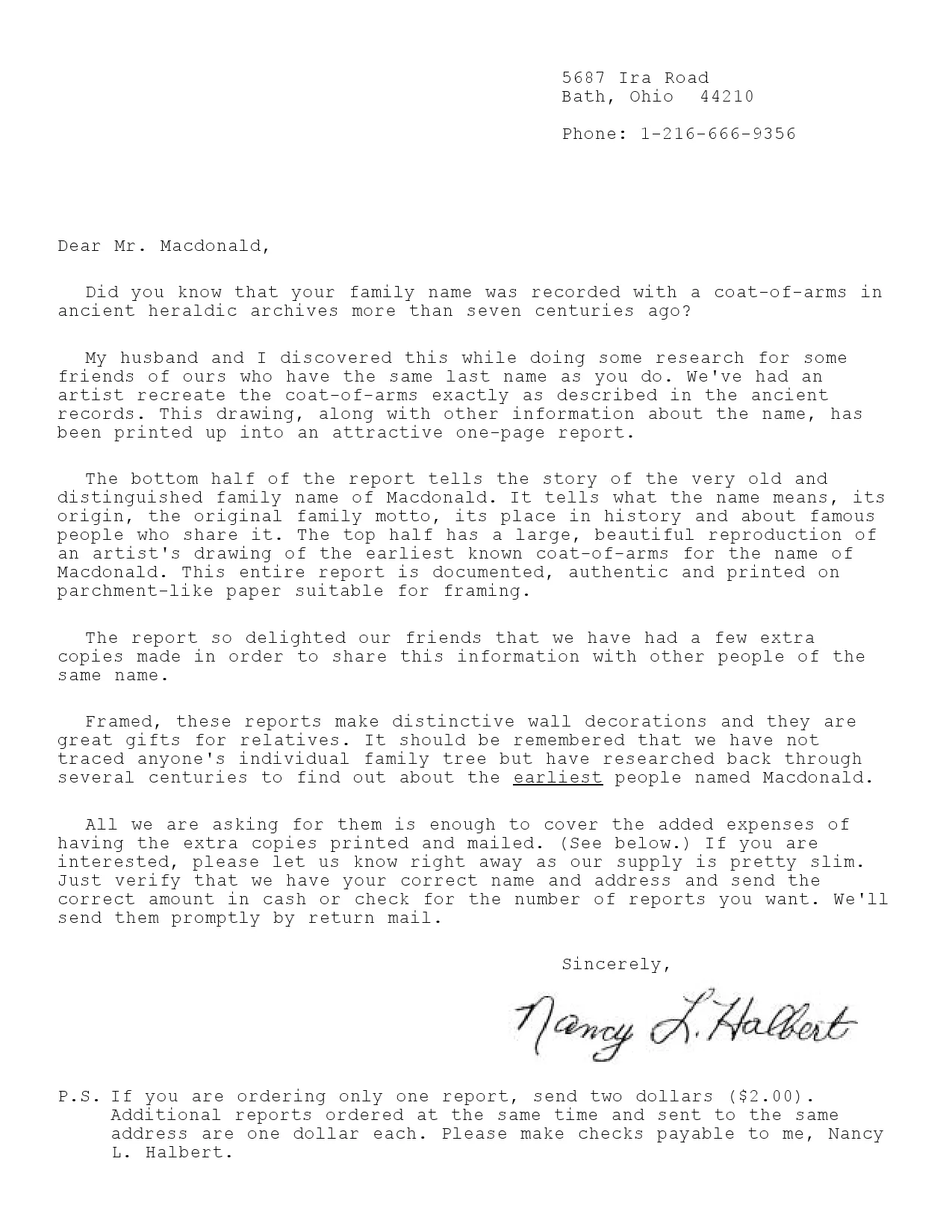
Why it worked: it solved the hardest problem in direct mail, getting opened, by not looking like direct mail at all. Every cue (stamp, envelope, tone) signaled "a human wrote this to you."
What to steal: the format is the first message. A real stamp, a handwritten address, and a personal tone can lift opens before a single word of your offer is read.
Examples: creative consumer mailers
3. KitKat Chunky "Chunky Mail" (JWT London, 2011)
To promote how big the KitKat Chunky bar is, JWT London mailed a parody of the Royal Mail "Sorry, we couldn't deliver your item" card. The reason for non-delivery? The bar was "too chunky" for the letterbox. The card doubled as a voucher to collect a free Chunky at a local shop.
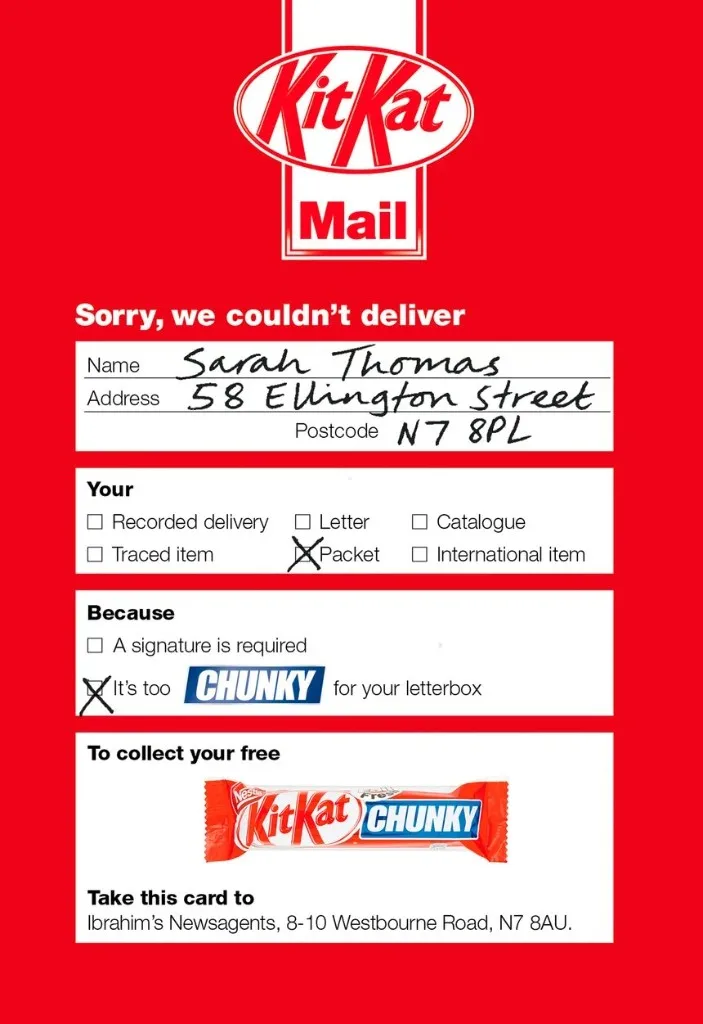
Why it worked: it hijacked a universally recognized piece of mail, the missed-delivery card, so the joke landed instantly. The product's only selling point, size, became the creative device. The free-bar voucher gave an immediate reason to act.
What to steal: borrow a familiar mail format your audience already knows how to read, and let your product's single differentiator drive the gag. Pair it with a low-friction offer.
4. WWF Earth Hour candle box
To get CEOs and business leaders to switch off their lights for Earth Hour, WWF mailed each a yellow candle in a specially designed box. One side looks like a building façade with lit windows. Pull the candle out to use it, and the building "goes dark", the entire ask, demonstrated with one object. Reporting on the campaign cites a 260% increase in corporate support. It helped make the Philippines the top participant of Earth Hour 2009, with 650 towns and cities switching off their lights.
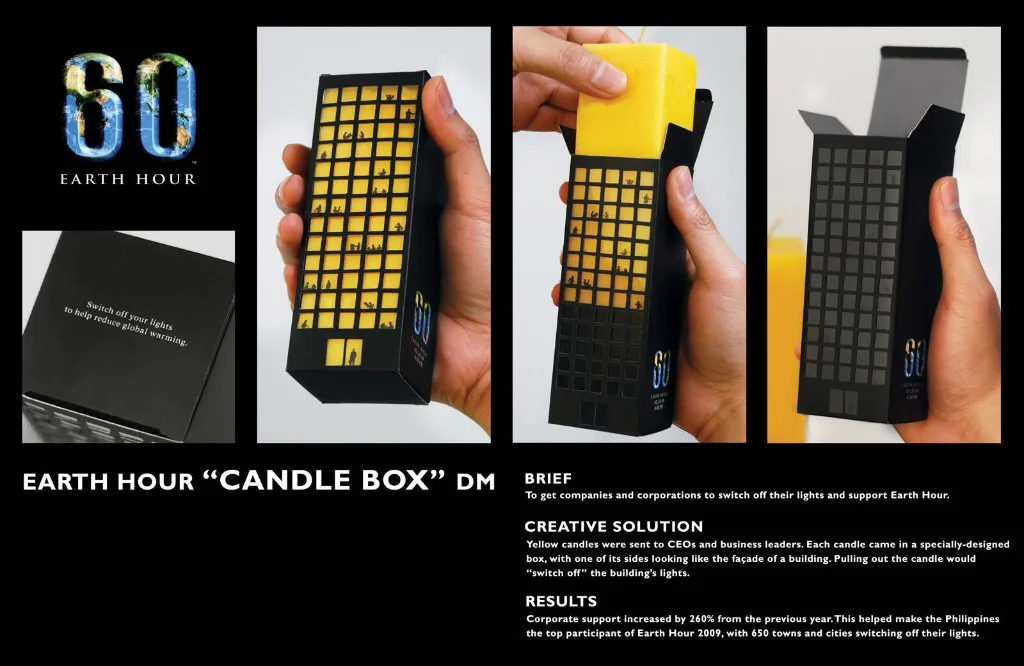
Why it worked: the object was the message. There was nothing to read, the interaction taught the ask in two seconds, and the recipient kept a useful item that reinforced it.
What to steal: when you can, build the behavior you want into the physical piece, so using it is understanding the message.
5. IKEA Switzerland "The Candual" (2022)
During the 2022 European energy crisis, IKEA Switzerland and agency TBWA\Zürich mailed something between a manual and a candle. It's a sheet of 100% beeswax, printed in the style of an IKEA assembly manual (titled "Lucia"). You roll it up and light it for the Swedish Lucia Feast on December 13, then share it on social. It went to roughly 6,000 households, with thousands more in stores, and won at the 2023 One Show.
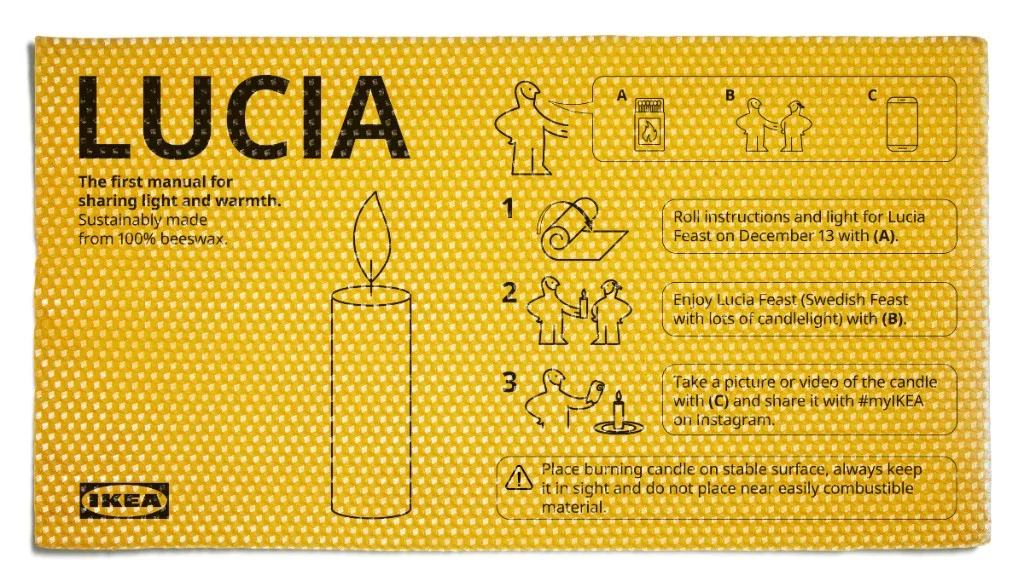
Why it worked: it fused two instantly recognizable IKEA assets, the flat-pack format and the assembly manual, into one product. And that product answered the exact anxiety of the moment: energy costs and a dark winter. The brand voice survived the format change perfectly.
What to steal: tie the mailer to a live moment your audience is feeling, and express it through an asset only your brand could credibly send.
Examples: dimensional brand boxes
6. Jeep "DNA Box"
To launch the new Jeep Cherokee, the brand mailed select customers a wooden box framed as the model's "DNA." Inside were seven sealed tubes of natural elements: sand, soil, stone, water, leaf, ice, and mud. A clock stood for "anytime" and a compass for "anywhere", materializing Jeep's positioning of "adventure, freedom and passion anytime, anywhere." Reportedly, 76% of recipients came to dealers to test-drive the new Cherokee.
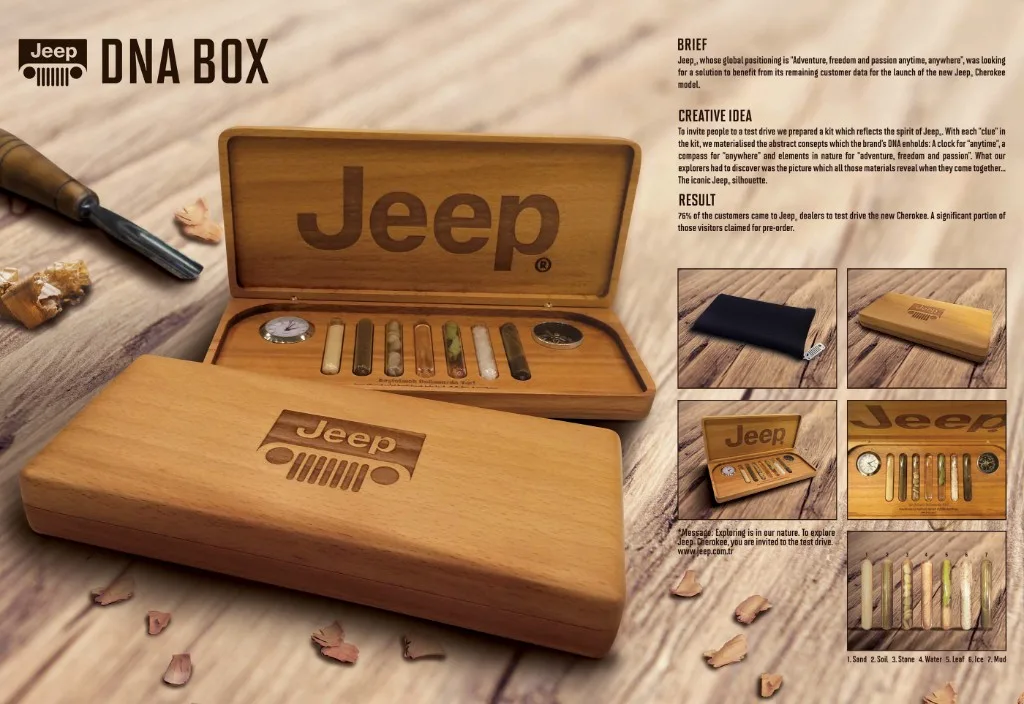
Why it worked: it translated abstract brand claims (rugged, capable) into physical, touchable proof, which is far stickier than a spec sheet.
What to steal: turn intangible attributes into objects. A thing the recipient can hold outlasts a bullet point they'll skim.
7. Nike "Stadium Shoe Box"
Nike designed a shoebox that opens into a miniature football stadium, complete with stands, a pitch, and a sky-and-clouds lid. The goal was to encourage kids into athletics. The packaging itself became a small play environment, not just a container.
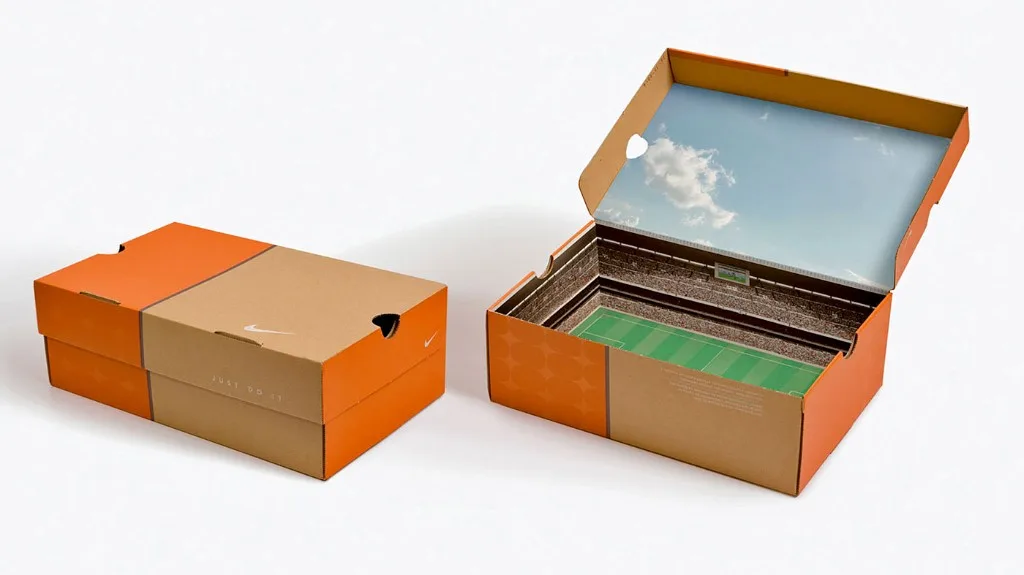
Why it worked: it gave the recipient a reason to keep and interact with the piece. The "ad" had a second life as an object on a shelf.
What to steal: design the container, not just the contents. If the packaging is worth keeping, your brand stays in the room.
8. Google Partners 3D hologram prism
To reach agencies, Google Partners mailed a flat kit with a simple instruction: fold a small clear prism, place it on a smartphone, and watch a "hologram" animation float above the screen. It was a low-tech build with a high-tech payoff, all promoting the partner program.
Why it worked: the recipient had to do something. The small build paid off with a genuinely surprising effect that reinforced Google's "innovative" positioning. Participation creates memory.
What to steal: give the recipient a tiny task with a satisfying payoff. Active engagement beats passive reading, and the reveal should embody your positioning.
Examples: B2B and account-based mail
9. Blue Pillar's mini baseball bat (MarketingSherpa, 2014)
Cold calls and email weren't reaching the C-suite, so Blue Pillar's marketing director Bob Birge built a multichannel sequence anchored by a memorable piece of mail. He sent target executives a mini Louisville Slugger baseball bat, then followed up with coordinated emails and calls. The effort produced 14 executive briefing calls and 21 calls with engineers, and lifted briefing-call response by about 50%. It won a MarketingSherpa Email Award.
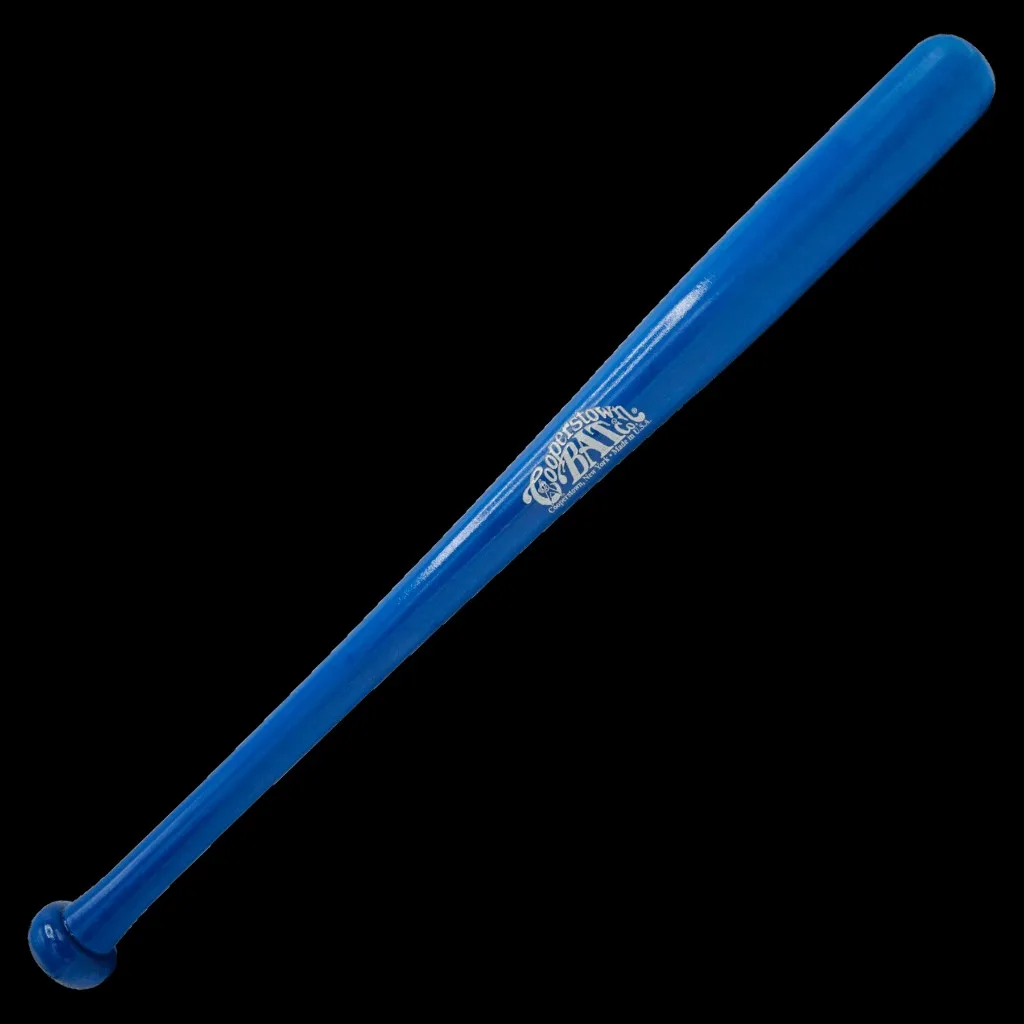
Why it worked: the bat got past gatekeepers and gave the follow-up call a natural hook ("did you get the bat?"). The mail wasn't the campaign, it was the icebreaker for the human touch that closed.
What to steal: in B2B, use mail to earn the follow-up, not to sell. A small, memorable object plus a timed call-and-email sequence beats either channel alone.
10. AWS "Passport to re:Invent" (2023)
Ahead of AWS re:Invent 2023, the team mailed a small group of Indian startup founders a travel-themed kit: a "Passport to re:Invent." It was built around the journey they were about to take to Las Vegas. The kit blended AWS's global brand system with locally relevant cues, and it arrived before the event to create anticipation.
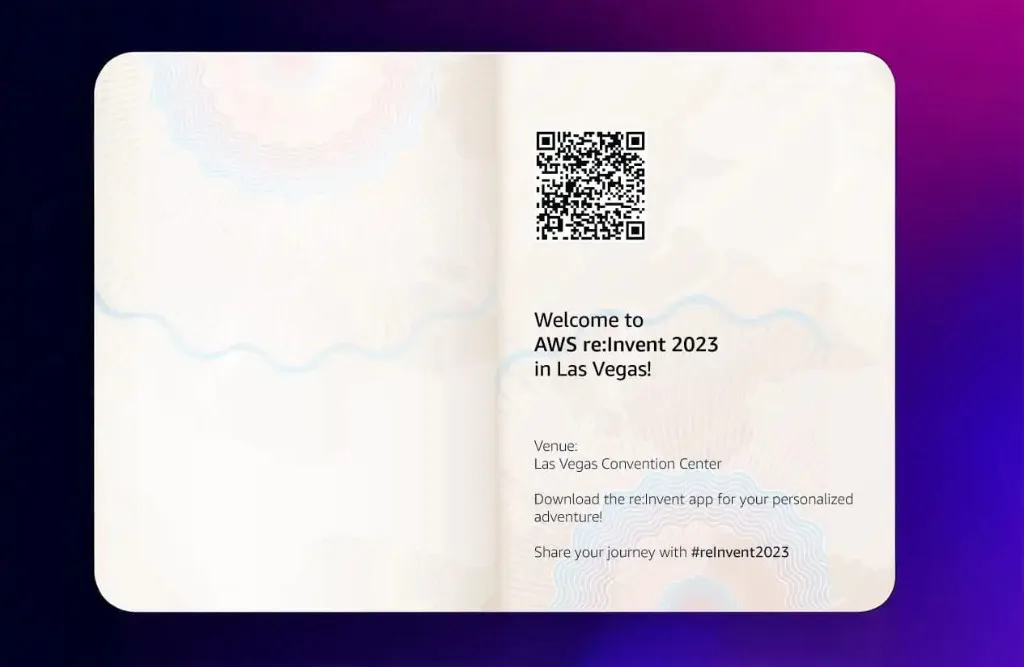
Why it worked: the concept matched a real thing happening in the recipient's life, the trip. The list was small and specific, so the spend per person could be high and the relevance unmistakable.
What to steal: anchor the mailer to an event already on the recipient's calendar, and keep the list small enough that every piece can be genuinely relevant.
11. The B2B flowers-and-PURL play
A software company targeting its top 500 prospects sent each a bouquet of flowers with a handwritten miniature card and a personalized URL (PURL). A wider list got Valentine's-themed cards, and a follow-up email referenced the flowers. The campaign reported 450 responses and seven qualified deals worth more than $370,000.
Why it worked: almost no one ignores a bouquet, so the open rate was effectively guaranteed. The PURL and follow-up email then turned that attention into a trackable path to a conversation.
What to steal: for a small, high-value list, an unignorable gift plus a personalized landing page and a referencing follow-up can convert attention into pipeline. Make the next step measurable.
Examples: nonprofit and cause mail
12. Trócaire's "exceptional ask" ambulances (SOFII, 2017)
The charity Trócaire (with agency Ask Direct) didn't ask donors to "help the East Africa crisis." Instead, it narrowed the appeal to one concrete, urgent thing: funding a field ambulance to get cholera patients to treatment within the critical six-hour window. A highly personalized letter made the high-value ask. They braced for a handful of takers. In the end, 22 ordinary individual donors each funded an ambulance, contributing to ~€270,000 raised at an 8.5% response rate.
Why it worked: the problem was specific and solvable, "a person dies without treatment in six hours", with a single tangible solution. That's far easier to act on than an abstract crisis of unimaginable scale.
What to steal: shrink the ask to one concrete, fundable thing the donor can picture completing. Specific and solvable beats big and overwhelming.
13. Trócaire's "Give Water, Give Life" wells
Trócaire repeated the tangible-ask approach with water. A six-page letter from the country director, complete with handwritten notes and a "field report," asked donors to fund a well. A leaflet unfolded to visualize dry soil turning into a sprouting crop as the water flowed. Donors funded 36 wells, 260% of the target, at an average gift of about €98.
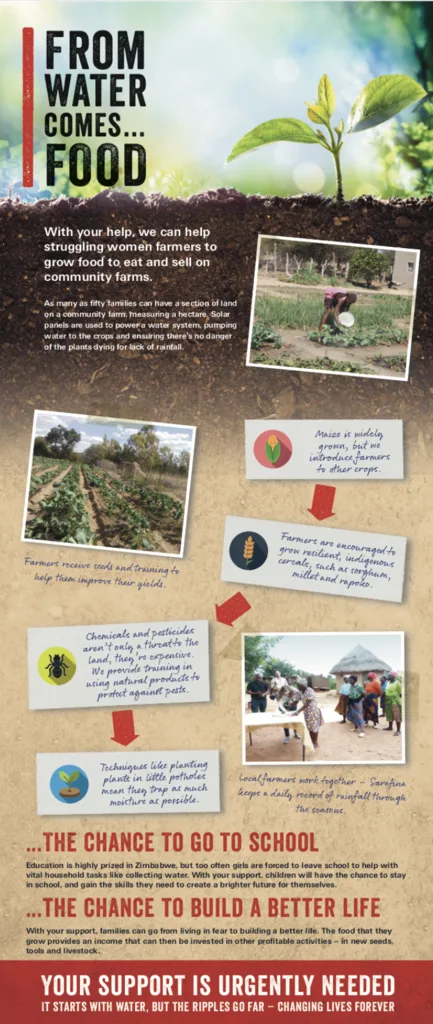
Why it worked: the long, personal, evidence-rich letter built trust, and the unfolding leaflet made the donor's impact literally visible. Length wasn't the enemy; relevance and proof carried it.
What to steal: a long letter works when it's personal and full of proof. Show the outcome the gift produces, ideally in a way the recipient's hands reveal.
14. UN Women × IMPACT BBDO "Child Wedding Cards" (Cannes 2024)
To pressure Pakistani lawmakers to raise the legal marriage age, UN Women and IMPACT BBDO hand-delivered something culturally loaded: wedding invitations for a child's fictional wedding, designed entirely by children aged five to fifteen. In a culture where printed wedding cards are still hand-delivered, the format made the issue impossible to file away. Dozens of lawmakers filmed themselves holding the cards and pledging action. The campaign reached 25 million-plus, cost under $1,500, and contributed to real legislative movement. It won the Cannes Lions Grand Prix for Good.
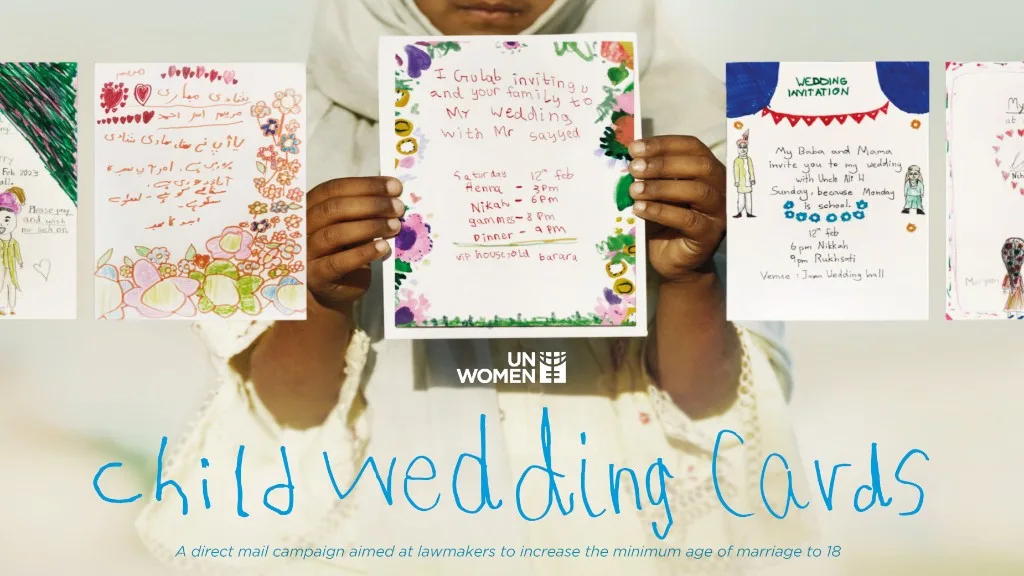
Why it worked: it weaponized a specific cultural ritual, the hand-delivered wedding invite, so the medium delivered the message before a word was read. The child-drawn artwork made the stakes visceral. Tiny budget, enormous emotional voltage.
What to steal: the most powerful direct mail uses a format loaded with meaning for that exact audience. When the medium is the argument, you don't need a big budget.
Examples: small-business and local mail
15. The carpet-cleaning postcard program
A carpet and rug cleaning company in the DC metro area mailed seasonal postcards reminding customers to clean their rugs. The cards carried genuinely useful tips, like how to remove specific stains, which positioned the company as the local expert. One campaign reported spending $13,950 to generate $224,500, a roughly 1,509% return. The owner credits 30 years of consistent postcards for the business's steady growth.
Why it worked: it combined a recurring, natural reminder (seasonal cleaning) with real utility (tips) and, crucially, consistency. The compounding return came from showing up reliably, not from one clever piece.
What to steal: for local and service businesses, a useful, recurring postcard sent consistently can quietly out-earn flashier one-off stunts. Cadence is the strategy.
What these direct mail examples teach: six patterns
Strip away the brands and these 15 pieces reduce to six repeatable strategies:
- Tell a story, don't list specs. The WSJ letter and Trócaire's appeals sold an outcome through narrative, not bullet points.
- Disguise the mail. Halbert's real stamps and the KitKat "missed delivery" card borrowed familiar formats so the piece got opened and read.
- Make the object the message. The Earth Hour candle, IKEA Candual, and Child Wedding Cards delivered the argument through the physical piece itself.
- Use depth to beat the gatekeeper. Dimensional pieces (the bat, the DNA box, the AWS kit) get routed like parcels and opened almost every time.
- Shrink the ask to one tangible thing. A well, an ambulance, a free bar, a single concrete action converts better than a vague one.
- Treat mail as one touch. The B2B winners paired the piece with a timed email and call. Mail opens the door; the follow-up walks through it.
The pieces span 50 years. The mechanics don't, they'll show up in the mailers landing on desks next quarter, wearing different logos.
Conclusion: what to take from these direct mail examples
If you searched for direct mail examples, here's the practical answer. The pieces that worked changed a mechanic: the story, the disguise, the object, or the ask. They didn't just print a nicer flyer. So the useful skill isn't memorizing brand names. It's recognizing which of the six patterns above fits your audience and budget.
You now have 15 explained examples across letters, consumer mailers, dimensional B2B, and nonprofit appeals. Each comes with cited figures, plus a FAQ on related questions. But examples only help if you can find them when you're briefing your own campaign. That's why we recommend saving each piece with its source and a one-line note on why it worked.
How to study and reuse these examples
Here's the uncomfortable part: you've read roundups like this before, nodded, and remembered none of it the next time you planned a mailer.
That's not a memory problem, it's a storage problem. Direct mail examples are only useful at the moment of briefing: a campaign due next month, a pitch, a budget review. If your examples live in screenshots and bookmarked listicles, they're gone when that moment arrives.
The fix is a working swipe file:
- Save the source, not a screenshot. Keep the URL of the case study or award page so you can verify the numbers and cite them later.
- Write the why. One line: "candle box, the object teaches the ask." The note is what makes it reusable.
- Tag by mechanic, not by brand. You'll search for "dimensional" or "tangible ask," not "Trócaire."
This is the workflow Gleanit is built for: highlight the example on the live page, attach the note and tags, and search it when you're planning. For more example libraries, see our roundup of recent innovative marketing examples, and for tooling, our content curation tools guide.
Frequently asked questions
What are some examples of direct mail?
Direct mail examples range from simple sales letters to elaborate dimensional packages. Classics include the Wall Street Journal's "Two Young Men" subscription letter and Gary Halbert's "coat of arms" letter. Creative consumer examples include KitKat Chunky's parody of a missed-delivery card, WWF's Earth Hour candle box, and IKEA Switzerland's beeswax "Candual" that rolls into a candle. B2B examples include dimensional mailers like a mini baseball bat or a branded mug, and nonprofit examples include Trócaire's "exceptional ask" letters and UN Women's "Child Wedding Cards."
What is the most successful direct mail piece ever?
The Wall Street Journal's "Two Young Men" letter, written by Martin Conroy and first mailed in 1974, is widely considered the most successful direct mail piece in history. It ran as the WSJ's control mailing for roughly 28 years (1975–2003) and is credited with an estimated $2 billion in subscription revenue. No copywriter ever beat it in testing.
Does direct mail still work in 2026?
Yes, especially for high-value B2B and nonprofit audiences. Dimensional mail is reported to achieve near-100% open rates, because mailrooms route packages to the addressee instead of screening them as advertising. Trade data cites response rates of roughly 5%–15% on targeted account-based campaigns, versus a fraction of a percent for cold email. It works best as one anchor touch in a multi-channel sequence with email and a phone follow-up.
What is a dimensional mailer?
A dimensional mailer is a three-dimensional direct mail piece, a box, tube, or custom shape, rather than a flat letter or postcard. Because it has physical depth, it gets routed to the recipient like a parcel and is almost always opened. Examples include a mini baseball bat, a branded mug with a meeting offer, or a custom gift box. Dimensional pieces cost more per unit (typically $3–$25+), so they're reserved for high-value accounts.
How do I make my direct mail stand out?
The best direct mail examples change a mechanic rather than just polishing a flyer. Make the piece feel personal with real stamps and handwritten notes. Tie the format to the message, like a candle for an energy appeal. Or use a physical object that demands to be opened. Then pair it with one clear call to action, plus a follow-up email and call, so the attention converts.
Where can I find more direct mail samples to study?
Award databases like Cannes Lions, The One Club, and D&AD publish winning direct mail samples with case studies. Swipe-file archives such as Swiped.co collect classic sales letters, and trade press like Ad Age and Adweek cover new campaigns. The most useful habit is to save each sample you find with its source URL and a one-line note on why it worked.
References and primary sources
We grouped the outbound sources used to research and verify this guide.
Case studies and award archives
- SOFII (Wall Street Journal "Two Young Men" analysis)
- Martin Conroy (WSJ letter authorship and dates)
- SOFII / Ask Direct (Trócaire "exceptional ask")
- Ask Direct (Trócaire "Give Water, Give Life")
- The One Club (IKEA Switzerland "The Candual")
- Little Black Book (UN Women × IMPACT BBDO "Child Wedding Cards")
- MarketingSherpa (Blue Pillar mini-bat campaign)
- Younion (AWS "Passport to re:Invent")
Trade coverage and swipe-file archives
- Swiped.co (WSJ letter swipe-file teardown)
- AdsSpot (KitKat "Chunky Mail," JWT London)
- Red Sq. Design (WWF Earth Hour candle, KitKat Chunky)
- Wizard of Ads (Jeep DNA Box, Nike Stadium Box, Google prism)
- Royal Prints (dimensional mail delivery and response stats)
- AccurateAZ (carpet-cleaning postcards, B2B flowers/PURL)
Corrections: ovannes@hearye.co or our editorial policy.