Most lists of innovative marketing campaigns show the same screenshots. However, few explain the mechanic: the structural choice that made each campaign work, and which you can reuse even if your budget is a rounding error compared to Nike's.
Therefore, this guide is organized as a study reference. For each example you will learn what happened, why it worked, and what to note in your swipe file. In addition, we cover related questions marketers search alongside this topic: what makes a campaign innovative, where to find case studies, and how to track examples over time.
What you'll learn from these marketing examples
- How 28 recent campaigns changed a mechanic instead of just polishing a message
- Which patterns recur across social, collabs, cultural moments, big-stage ads, AI, and crisis response
- Where to verify claims with primary sources, trade press, and award databases
- How to turn examples into reusable notes for briefs, pitches, and strategy decks
How we researched these marketing examples
What we used. Public coverage from trade press (Ad Age, Adweek, The Drum, Marketing Brew), the brands' own social accounts and press rooms, and award announcements from Cannes Lions. Where a brand published the campaign film, we embed the official video so you can judge it yourself.
How we built this list. Over six months (December 2024 through June 2026), we captured more than 40 candidate campaigns in Gleanit as they appeared in trade press and on brand channels. We tagged each capture by mechanic, then filtered to 28 entries that met our criteria below.
Tools we used: Chrome, Gleanit (where this list lived as captures before it became a post), and each brand's primary channels.
How we evaluated. Three filters: the campaign ran between 2024 and early 2026, it changed a mechanic rather than just polishing a message, and there's a lesson that transfers to teams without a Super Bowl budget.
What we think. These are practical teardowns, not engagement-stat worship. Reach is nice; a repeatable pattern is better.
In our experience, the examples you remember are the ones you saved with a note about why. For example, most entries in this guide started as highlights in our own library, captured the week they debuted. Similarly, when we revisited captures months later, the one-line "why" note was what made each example usable in a brief.
Scope of this guide. We did not verify internal campaign metrics beyond what brands and trade press published. Engagement numbers are as reported at the time.
Limitations include a bias toward English-language campaigns from the US and UK, because that's where the coverage and our own captures were concentrated.
Key takeaways from these examples
- The most effective recent innovative marketing examples change the mechanic, not the message: kill the mascot, plant the conspiracy, print the typo, sell the DNA.
- Character-driven social (Duolingo, Nutter Butter) out-performed polished brand content on the same platforms.
- Borrowing an existing cultural moment (KFC × Stranger Things, Dunkin × Sabrina Carpenter, Brat) beats building an audience from zero.
- When attention arrives uninvited, Astronomer's kiss-cam scandal, Jet2's ironic meme, the winning move is self-aware participation, not damage control.
- Cautionary tales count too: Jaguar's rebrand and Apple's "Crush!" show attention without affection is a cost, not a win.
- None of these patterns help if you can't find them when you're writing a brief, save examples with source and a note, not as screenshots.
Marketing examples at a glance: cited facts
Across the 28 entries below, these published figures illustrate the scale some campaigns reached. They are reported by brands or trade press, not independently verified by Gleanit:
- Canva reported 10.5 million estimated online views from its Waterloo billboard takeover (June 2025).
- Dyson's Airbrow April Fools post drew roughly 206,000 Instagram likes versus 540 on its prior reel, according to trade coverage at the time (April 2025).
- Jet2's ad audio appeared in 11.8 million social posts after the meme peaked in summer 2025.
- OpenAI cited 700 million weekly ChatGPT users when scaling its first brand campaign (September 2025).
- Coca-Cola rolled its 2025 Share a Coke relaunch across 120+ countries (April 2025).
Examples: character-driven social campaigns
1. Duolingo kills Duo (February 2025)
Duolingo announced on X that Duo, its owl mascot, had died: "authorities are currently investigating his cause of death and we are cooperating fully." A follow-up video showed him hit by a Cybertruck. The World Health Organization, the European Space Agency, and Dua Lipa ("Til' death duo part") all joined the mourning. Duo was eventually revived after users completed lessons "in his honor."
an important message from Duolingo
— Duolingo (@duolingo) February 11, 2025
Why it worked: Duolingo had spent years building Duo into a character with a personality (passive-aggressive, unhinged, persistent). The death stunt only landed because the audience already had a relationship with the character. It also tied the joke back to the product: do your lessons, bring him back.
What to steal: a long-running character earns the right to a big swing. Stunts without that equity read as random.
2. Nutter Butter goes unhinged (2024)
A 55-year-old cookie brand turned its TikTok into surreal, fever-dream content, distorted images, cryptic lore, recurring characters like "Aidan", and grew its following by an order of magnitude. Comment sections turned into collaborative fan fiction.
Why it worked: it abandoned brand-safe polish entirely and matched the native tone of the platform. The ambiguity ("is the cookie account okay?") was the engagement engine.
What to steal: on creator platforms, acting like a creator beats acting like a brand. Commit to the bit, half-unhinged reads as corporate.
3. McDonald's WcDonald's (2024)
Anime artists have drawn McDonald's as "WcDonald's" for decades to dodge trademark rules. In 2024, McDonald's embraced the fan-made parody: official WcDonald's packaging, anime shorts by studio Pierrot, a manga-style sauce launch, and an immersive WcDonald's pop-up in Los Angeles.
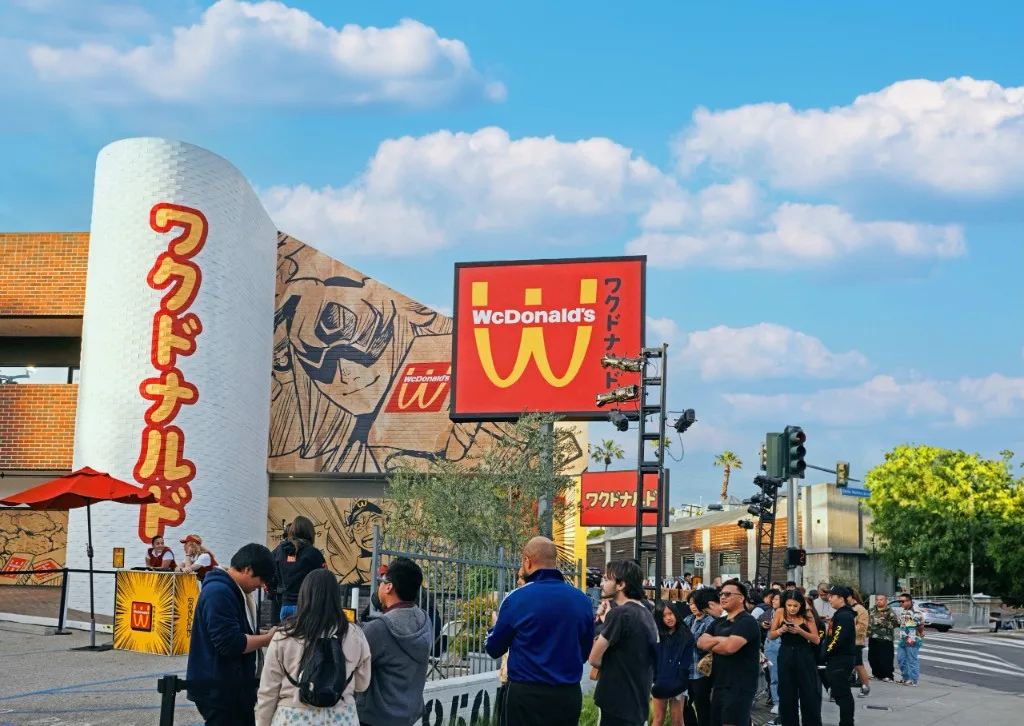
Why it worked: the brand didn't invent a culture, it ratified one that fans had already built. That flips the usual dynamic, instead of asking for attention, it rewarded decades of inside jokes.
What to steal: search for the parody, fan name, or meme your audience already uses for you. Making it official is cheaper and more credible than inventing a campaign world.
Examples: pranks, typos, and fake products
4. CeraVe × Michael Cera (Super Bowl 2024)
Weeks before the Super Bowl, paparazzi shots "leaked" of actor Michael Cera signing CeraVe bottles. Influencers stoked the conspiracy that he founded the brand. The Super Bowl ad then revealed the whole thing as a fake pitch: "CeraVe is developed with dermatologists. Not Michael Cera." The campaign won at Cannes Lions 2024.
Why it worked: it inverted the reveal structure. Instead of announcing, it seeded a mystery and let the internet do the investigating. By game day, the audience was pre-invested in the punchline.
What to steal: the tease-investigate-reveal arc. Even small launches can plant a question a week before answering it.
5. Coors Light "Case of the Mondays" (January 2025)
Coors Light ran ads with the word "Refreshment" misspelled as "Refershment," let the internet dunk on the typo, then revealed it was deliberate, everyone has an off Monday, and sold a "Mondays Light" 12-pack.
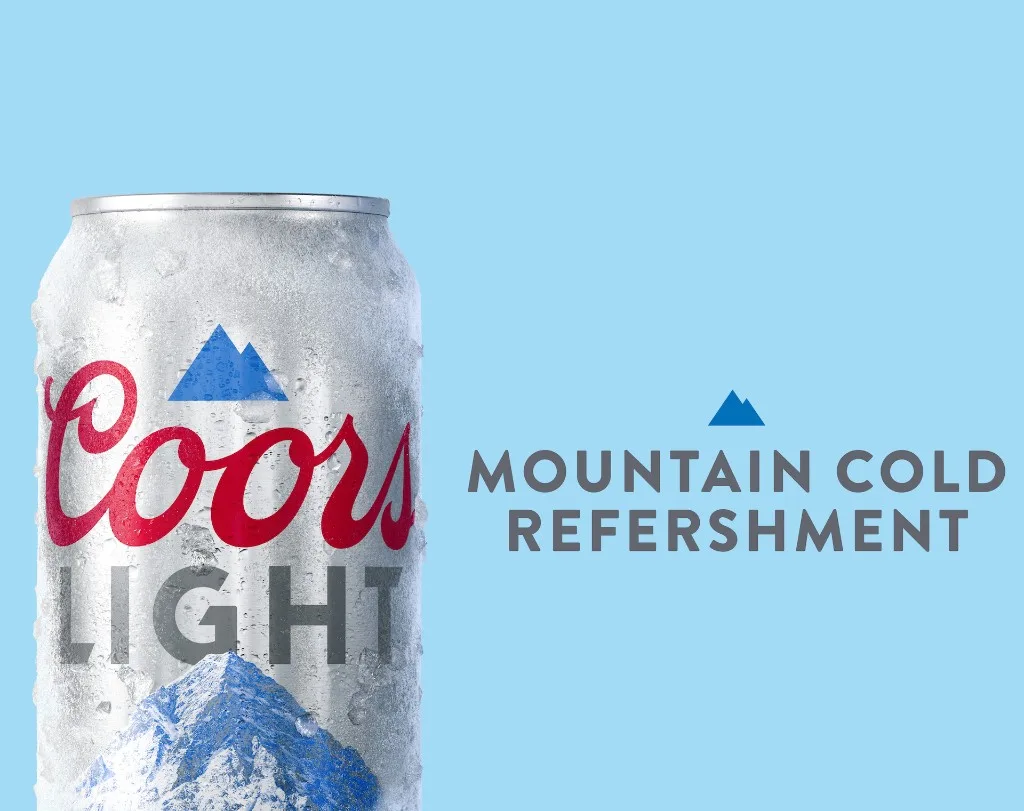
Why it worked: it weaponized the correction reflex. People who would never engage with a beer ad piled in to point out the mistake, which was the campaign.
What to steal: a deliberate, ownable flaw can out-perform polish. The reveal must arrive fast, before the joke goes stale.
6. Dyson "Airbrow" (April 1, 2025)
Dyson announced the Airbrow, a miniaturized Airwrap that sculpts eyebrows with "precision airflow", complete with an influencer demo by Victoria Magrath and a straight-faced product reveal across its social channels. It was an April Fools prank. The post pulled roughly 206,000 likes on Instagram; the brand's previous reel had 540.
@dyson_anz: Dyson Airbrow April Fools reveal
Why it worked: the prank was executed at the same production fidelity as a real Dyson launch, which made being fooled feel like a compliment to the brand rather than an insult to the audience. The comment section filled with people asking Dyson to actually build it.
What to steal: if you do a stunt, commit to launch-level fidelity. A half-built joke reads as a memo; a fully produced one reads as a brand world. Bonus: a fake product is free market research for a real one.
7. Canva "Make the Logo Bigger" (June 2025)
Canva and agency Stink Studios took over all 14 billboards at London Waterloo and turned each into a physical product demo of a designer's recurring nightmare: a Canva logo literally bursting out of its frame ("make the logo bigger"), a billboard squeezed from landscape into portrait for Magic Resize, a real e-bike suspended mid drag-and-drop. The media owner kept the work up for twice the planned run at no extra cost; Canva reported 10.5M online views.
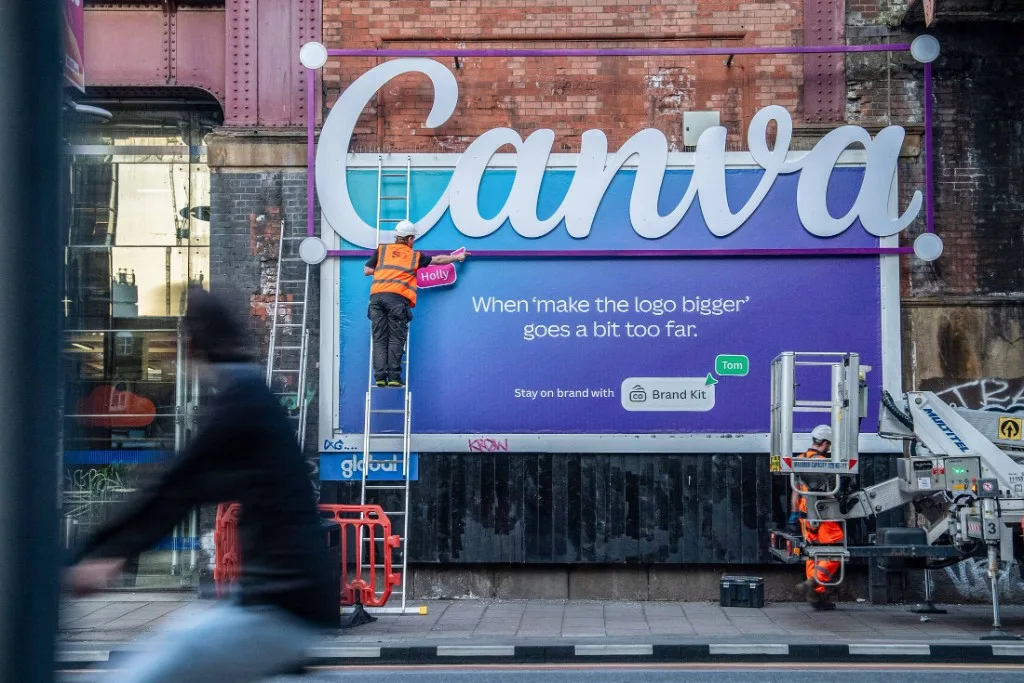
Why it worked: Canva's problem with professional designers was credibility, and the campaign earned it by proving the brand understood designer pain at an inside-joke level. The billboards were screenshots waiting to happen, so the audience distributed them on LinkedIn and design Twitter for free.
What to steal: the fastest way into a skeptical audience is demonstrating you understand their specific pain. Specificity is empathy made visible, and a physical gag earns digital reach.
Examples: collabs and products-as-marketing
8. Liquid Death × e.l.f. "Corpse Paint" (2024)
A canned-water brand styled as a heavy-metal beverage collabed with a drugstore makeup brand on a goth makeup kit. It sold out fast, and the partners kept the bit going with follow-up metal-themed drops.
Why it worked: maximum-contrast partnership. Each brand reached the other's audience precisely because the pairing made no obvious sense, the absurdity was the story.
What to steal: pick a collab partner whose audience overlaps yours by values (irreverence) but not by category. Same-category collabs are invisible. And if the first drop hits, serialize it.
9. Liquid Death sells Ozzy Osbourne's DNA (June 2025)
Liquid Death released "Infinitely Recyclable Ozzy": ten iced-tea cans that Ozzy Osbourne personally drank from and crushed, lab-sealed with trace amounts of his saliva DNA, individually numbered and signed, at $450 each, so fans can "recycle him forever" once cloning is legal. Ozzy's official quote: "Clone me, you bastards." They sold out within hours.
Why it worked: the premise is one sentence, the press coverage wrote itself, and the tone match was perfect, an extreme, theatrical icon for a brand whose entire thesis is that beverage marketing should be entertainment. Scarcity (ten cans) turned a gag into a collector event.
What to steal: the right collab is a tone match, not just an audience match. And a tiny product run can buy national press if the premise is retellable in one sentence.
10. Crocs × LEGO Brick Clog (January–February 2026)
Two of the most recognizable physical designs in consumer goods fused into one object: a clog shaped like an oversized 2×2 LEGO brick, four logo-stamped studs on top, $149.99, sold with a LEGO minifigure wearing its own miniature brick-built Crocs. The February 16 drop nearly sold out on day one, and it's the opening move of a multi-year partnership.
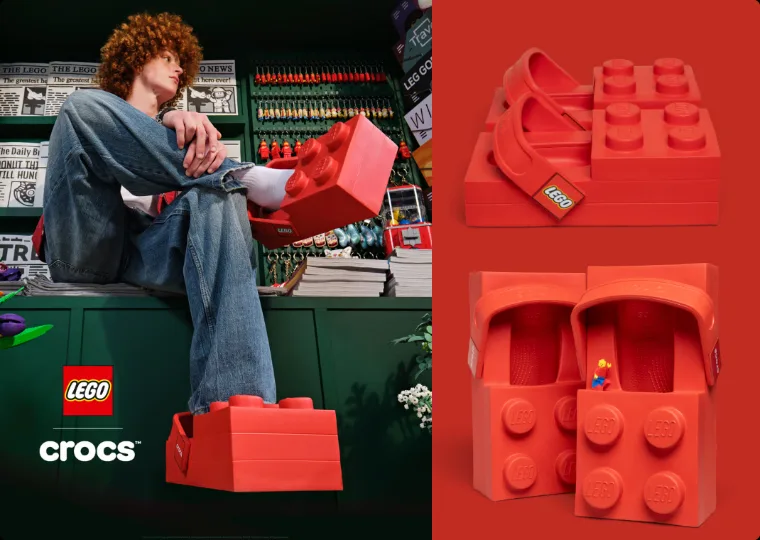
Why it worked: both brands trade on silhouettes you can identify with no logo attached, so the collaboration needed zero explanation. Every photo of the shoe was an ad for both companies, and the absurd price point made owning a pair a flex worth posting.
What to steal: the strongest collabs fuse two distinctive brand assets into a third thing people can't stop photographing. If your collab needs a press release to make sense, it's the wrong collab.
11. Aldi × Lewis Capaldi "Cap-Aldi" rooftop gig (September 2025)
Lewis Capaldi played a surprise set on the roof of an Aldi in Nottingham days after releasing a new single, with the store sign rebranded "Cap-Aldi" via a giant cardboard "Cap." Shoppers filmed from the car park; rival supermarkets piled into the comments. It echoed the Beatles' 1969 rooftop gig, and followed Aldi rebranding a Manchester store "Aldeh" for the Oasis reunion earlier that year.
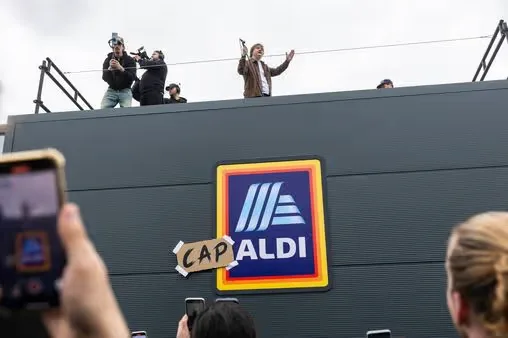
Why it worked: the pun did the distribution work, "Cap-Aldi" is a headline people enjoy saying out loud, and the gap between a major artist and an unglamorous supermarket roof is exactly the cognitive dissonance that travels on TikTok. Aldi has spent years earning permission for cheeky stunts, so it read as in-character, not desperate.
What to steal: a great pun is a distribution mechanism. If the campaign has a name people repeat unprompted, half the reach problem is solved before launch.
Examples: cultural-moment hijacks
12. KFC becomes Hawkins Fried Chicken (November 2025)
For the final season of Stranger Things, KFC didn't run a tie-in spot, it rebranded as "Hawkins Fried Chicken," a believable in-universe 1987 diner. The hero film by Mother London follows HFC staff delivering chicken through a rift-torn town; the real world got a Stranger Things Burger with a rift-red bun, a pop-up hotline in UK cities, and an underground diner built in Sydney's abandoned Wynyard tunnels.
Why it worked: most IP tie-ins look like awkward cosplay. KFC committed to a costume change, period-accurate, canon-plausible, which let fans treat the activation as world-building and share it like an Easter egg rather than an ad.
What to steal: don't slap your logo on someone else's IP. Disappear into it. Tie-ins that feel like world-building outperform tie-ins that feel like sponsorship.
13. Dunkin' × Sabrina Carpenter "Shake That Ess" (December 2024)
At the peak of "Espresso" dominating the charts, Dunkin' launched Sabrina's Brown Sugar Shakin' Espresso with a Dave Meyers–directed spot in which an entire launch party can't stop shaking their drinks. The product name and the ad both riffed directly on the song.
Why it worked: this wasn't a generic celebrity endorsement, it tied the product to a specific cultural artifact that was already everywhere. Every radio play of "Espresso" became ambient advertising for the drink.
What to steal: a celebrity gives you a face; a specific cultural artifact (a song, a meme, a scene) gives you a built-in distribution engine. Tie to the artifact, not just the person.
14. Charli XCX "Brat" (summer 2024)
One lime-green square with low-resolution text became the most recognizable visual of the year. The "Brat" album branding was deliberately ugly, infinitely remixable, and spawned a global meme template, culminating in "brat summer" and adoption by everyone from brands to a US presidential campaign.
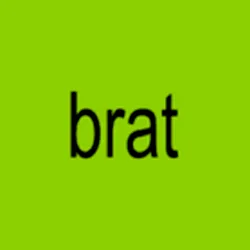
Why it worked: the asset was designed to be copied. Anyone could make their own "brat" cover in ten seconds, so everyone did, each copy advertising the original.
What to steal: make your campaign asset reproducible by the audience. A perfect, locked-down visual can't spread; a template can.
15. Jet2's holiday-ad meme (2024–2025)
A perfectly ordinary Jet2 TV ad, scripted with the tagline Nothing beats a Jet2 holiday, and right now you can save £50 per person
over Jess Glynne's "Hold My Hand", escaped containment on TikTok. Users layered that brand-written line over holiday disasters as ironic commentary. According to Marketing Week, the trend reached 11.8 million social posts at its peak. Jet2 mostly got out of the way, then capitalized with merch drops and a CEO who told investors the meme was "hugely beneficial."
Why it worked: when a brand asset goes viral in a way the brand didn't plan, the instinct is to control it. Jet2 recognized the audio was generating millions of free impressions in a tone it could never buy, and let the audience own it.
What to steal: when your asset escapes containment, your only job is not to kill it. Measure the lift, not the message, and save your heavier-handed participation for merch, not memes.
16. Coca-Cola relaunches "Share a Coke" (April 2025)
Coca-Cola brought back its name-on-the-bottle campaign for a generation that missed it the first time, rolling out across 120+ countries with a digital layer: on-pack QR codes, a customization hub for names that aren't on shelves, and a "Memory Maker" tool for personalized videos.
Why it worked: the original mechanic, your name on the product, was already proven to drive participation. Rather than reinvent, Coca-Cola polished it and added the digital expectations of a new audience. Nostalgia for the 2014 internet had matured into Gen Z buying power.
What to steal: don't always chase the new. A proven campaign refreshed for a generation that missed it can outperform a brand-new idea at lower creative risk.
Examples: big-stage brand campaigns
17. Nike "So Win" (Super Bowl LIX, February 2025)
Nike's first Super Bowl ad in 27 years was also the rare big-game spot built entirely around female athletes: Caitlin Clark, Sha'Carri Richardson, A'ja Wilson, Jordan Chiles, Sabrina Ionescu, and JuJu Watkins, shot in stark black and white, narrated by Doechii over Led Zeppelin. Every "you can't" women athletes get told was answered with a flat "so win."
Why it worked: it wasn't subtle, and it didn't try to be. Nike picked the most-watched ad slot in the world to plant a flag on women's sports exactly as the category's commercial momentum peaked, and "so win" was repeatable, ownable, and meme-ready by the next morning.
What to steal: don't spend premium inventory on nuance. Big-stage spots are remembered for the line you can repeat tomorrow.
18. Nike "Winning Isn't for Everyone" (Paris Olympics, 2024)
Narrated by Willem Dafoe, Nike's Olympic campaign asked "Am I a bad person?" and embraced the ruthlessness of elite athletes, a sharp turn from a decade of inspirational, inclusive sports marketing.
Why it worked: it broke with the category's consensus tone, including Nike's own. When every brand says "sport is for everyone," the contrarian message gets the attention.
What to steal: audit what your whole category is saying, then argue the uncomfortable opposite you can credibly own.
19. Hellmann's "When Sally Met Hellmann's" (Super Bowl 2025)
Meg Ryan and Billy Crystal returned to Katz's Deli to recreate the most famous scene in rom-com history for the film's 35th anniversary, with Hellmann's mayo as the trigger and a Sydney Sweeney cameo delivering "I'll have what she's having."
Why it worked: borrowed memory. The ad didn't have 30 seconds to build an emotional connection, so it rented one the audience already had.
What to steal: nostalgia works when the reference is specific and the brand has a legitimate seat in the scene (the deli table), not when it's pasted on.
20. GoDaddy "Act Like You Know" (Super Bowl 2025)
Walton Goggins plays an actor who can fake being a detective, an astronaut, and a race-car driver, but admits his hardest role is small business owner, until GoDaddy's AI tools build "Walton Goggins Goggle Glasses" for him. The glasses were a real product with a real website, launched months before the game. The campaign won the Cannes Lions Grand Prix for Creative B2B in June 2025.
Why it worked: GoDaddy understood that small business owners don't want to be told they need help, they want tools that make them look like they don't. AI was the punchline, not the lecture, and the functioning fake-real business made the claim verifiable.
What to steal: don't sell competence to people who already feel competent; sell the appearance of competence. And if your ad makes a claim, build the proof where the audience can click it.
21. Pop-Tarts edible mascot (Pop-Tarts Bowl, 2023–2025)
At the Pop-Tarts Bowl, the brand's giant toaster-pastry mascot was lowered into a toaster and "eaten" by the winning team. The bit became an annual tradition with escalating stakes, and one of the most-discussed sponsorships in college football.
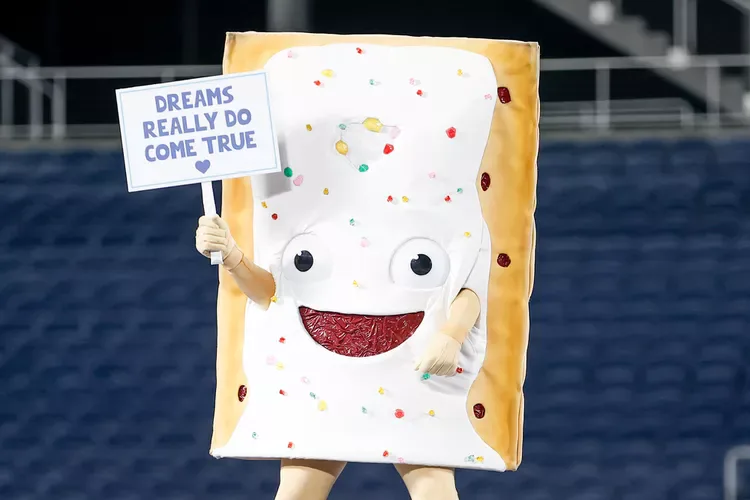
Why it worked: sponsorships usually buy logo placement. Pop-Tarts built a moment that only its brand could own, nobody else's mascot is edible.
What to steal: if you sponsor anything, design one ownable moment instead of buying impressions.
Examples: AI-native campaigns
22. OpenAI's "Everyday Moments" for ChatGPT (September 2025)
ChatGPT's first scaled brand campaign skipped futurism entirely. Spots like "Dish", a man cooks a date dinner from a recipe prompt that says "I like you, but want to play it cool", were shot on 35mm film and framed like the final scene of a movie, with the prompt and answer rolling as end credits.
Why it worked: the AI category's biggest weakness is feeling intimidating or only useful for technical work. OpenAI anchored the product in the most mundane moments imaginable, translating capability into intimacy, with 700 million weekly users' real habits as the source material.
What to steal: when your product is abstract or technical, anchor it in the most ordinary moment your audience already lives through. Familiarity beats spectacle.
23. Spotify Wrapped adds an AI podcast (December 2024)
Wrapped is the most-copied campaign format of the decade. In 2024, Spotify added an AI-generated "podcast", two synthetic hosts discussing your personal listening year, built with Google's NotebookLM.
Why it worked (and didn't): the personalization engine of Wrapped stayed the draw; the AI layer got mixed reviews. The lesson is that Spotify keeps shipping experiments inside a proven format instead of betting the whole campaign on the new thing.
What to steal: attach experiments to your already-working ritual, so a flop costs a feature, not the franchise.
24. Coca-Cola's AI-generated holiday ad (November 2024)
Coca-Cola remade its classic "Holidays Are Coming" truck ad using generative AI. The result was technically impressive, widely covered, and heavily criticized by creatives and audiences as soulless.
Why it matters: the backlash itself is the case study. The ad bought enormous earned media, but spent brand warmth to get it. Whether that trade was worth it is the debate every marketing team had that month.
What to steal: if you use AI visibly, expect the production method to become the story. Decide in advance whether that story helps you.
Examples: crisis plays and cautionary tales
25. Astronomer hires Gwyneth Paltrow (July 2025)
After its CEO and chief people officer were caught embracing on a Coldplay concert kiss cam, a clip with tens of millions of views, followed by both resignations, data company Astronomer hired Gwyneth Paltrow, Chris Martin's ex-wife, as a "very temporary spokesperson." In a video made with Ryan Reynolds' Maximum Effort, she cheerfully ignores the on-screen questions ("OMG what the actual f, ") and pivots to data workflow automation.
Thank you for your interest in Astronomer.
— Astronomer (@astronomerio) July 25, 2025
Why it worked: the casting was a meta-joke the internet was uniquely positioned to appreciate, and the self-awareness signaled the company could handle scrutiny without melting down. It converted a reputational crisis into more earned media than any B2B data company has ever generated.
What to steal: when a crisis is already public, denial is the worst option. Acknowledge the moment with self-aware humor that proves you're in on the joke, it converts attention you can't control into attention you can.
26. Mattel's Barbie with type 1 diabetes (July 2025)
Mattel released the first Barbie with type 1 diabetes, continuous glucose monitor on her arm, insulin pump at her waist, designed with research organization Breakthrough T1D and debuted at its Children's Congress. Crucially, she joined the permanent Fashionistas line at the standard price, not a limited PR edition. She sold out almost immediately.
Why it worked: inclusion campaigns usually live for one news cycle. By making the doll a permanent SKU, Mattel turned representation into a product decision rather than a marketing one, and parents of T1D kids shared the launch as a personal milestone, not a brand moment.
What to steal: if your purpose campaign requires a press release to make sense, it's PR, not purpose. The version that lasts is embedded in the product itself.
27. Jaguar "Copy Nothing" rebrand (November 2024)
Jaguar dropped its iconic leaping-cat mark for a geometric wordmark and launched with a fashion-film teaser containing no cars, followed by the Type 00 concept reveal at Miami Art Week. The internet response was brutal; the discussion was unavoidable for weeks.
Why it matters: it's the sharpest recent test of "all attention is good attention." The rebrand reached everyone and persuaded few, a reminder that distinctiveness without affection from your actual buyers is just expensive noise.
What to steal: before a radical repositioning, know which audience you're firing and confirm the new one actually exists.
28. Apple "Crush!" (May 2024)
To launch the thinnest iPad ever, Apple showed a hydraulic press crushing pianos, paint cans, arcade machines, and instruments into a tablet. The backlash from artists and creators was immediate and global; Apple apologized and pulled the TV run.
Why it matters: the craft was flawless and the metaphor was honest, that was the problem. The ad accidentally said the quiet part out loud: technology flattening creative tools into a slab. Even the world's most valuable brand can't out-produce a bad read of the room.
What to steal: pressure-test your metaphor with the people it's about. The audience hears the subtext, not the storyboard.
What these marketing examples teach: seven patterns
Strip the logos and these 28 case studies reduce to seven repeatable strategies:
- Character over content. Duolingo and Nutter Butter built personalities, then let the personality generate the content.
- Ratify, don't invent. WcDonald's, Brat, and Jet2 worked because the audience already owned the material.
- Engineer the flaw. CeraVe's fake conspiracy, Coors Light's typo, and Dyson's fake product gave the internet something to "catch."
- One ownable moment. Pop-Tarts built the only edible-mascot ritual in sports; Aldi got a chart-topping artist onto a supermarket roof.
- Contrast is the message. Nike against its own category tone; Liquid Death against e.l.f.; a major artist against a discount supermarket.
- Disappear into the moment. KFC became canon inside Stranger Things; Dunkin' fused with a No. 1 song; Hellmann's rented a 35-year-old memory.
- Self-awareness beats damage control. Astronomer leaned into its scandal; Jet2 let the meme run. Jaguar and Apple show the cost of misreading the room instead.
The campaigns are recent. The mechanics aren't, they'll recur in the campaigns currently in production for late 2026, wearing new logos.
Conclusion: what to take from these marketing examples
If you searched for recent innovative marketing examples, the practical answer is this: innovation, in these 28 campaigns, means changing the mechanic (the stunt, collab, flaw, or cultural borrow) rather than polishing the same message louder. Therefore, the useful output is not memorizing brand names but recognizing which pattern fits your brief.
In summary, you now have 28 explained examples across seven pattern groups, cited facts where trade press published them, and a FAQ covering related searches such as innovative marketing strategies, 2025 standouts, and where to find case studies. However, examples only help if you can find them when you write. That is why we recommend saving each campaign with its source URL and a one-line note about why it worked.
How to study and reuse these examples
Here's the uncomfortable part: you've read lists like this before, nodded, and remembered none of it the next time you wrote a brief.
That's not a memory problem, it's a storage problem. Marketing examples are only useful at the moment of writing: a headline due Friday, a pitch deck, or a strategy review. If your examples live in screenshots and bookmarked listicles, they're gone when that moment arrives.
The fix is a working swipe file:
- Save the source, not a screenshot. Keep the URL of the campaign coverage or the ad itself, so you can verify and cite it later.
- Write the why. One line: "typo as engagement bait, reveal within 48h." The note is what makes it reusable.
- Tag by mechanic, not by brand. You'll search for "nostalgia" or "collab," not "Hellmann's."
This is the workflow Gleanit is built for: highlight the example on the live page, attach the note and tags, and search it when you're drafting. For more example libraries, see our roundup of direct mail examples, and for tooling comparisons, our content curation tools roundup.
Frequently asked questions
What are some recent innovative marketing examples?
Recent standouts include Duolingo killing off Duo the owl (February 2025), KFC rebranding as Hawkins Fried Chicken for the Stranger Things finale (November 2025), Astronomer hiring Gwyneth Paltrow after its kiss-cam scandal (July 2025), the Crocs × LEGO Brick Clog (February 2026), CeraVe's Michael Cera conspiracy campaign (Super Bowl 2024), and the Jet2 holiday audio meme. Each paired one surprising mechanic with disciplined execution.
What are the most innovative marketing campaigns of 2025?
2025's standouts, month by month: Duolingo's Death of Duo and Nike's "So Win" (February), Coca-Cola's Share a Coke relaunch and Dyson's Airbrow prank (April), Canva's "Make the Logo Bigger" takeover and Liquid Death's Ozzy DNA cans (June), Astronomer's Paltrow video and the Barbie with type 1 diabetes (July), Aldi's Cap-Aldi rooftop gig and OpenAI's first ChatGPT brand campaign (September), and KFC's Hawkins Fried Chicken (November).
What makes a marketing campaign innovative?
Innovative campaigns change the mechanic, not just the message. Instead of saying something louder, they break a convention: pretend the mascot died, hire an actor who shares the brand's name, print the typo on purpose, turn a corporate scandal into a celebrity cameo. The test is structural: did the campaign do something the audience hadn't seen, in a way only that brand could pull off?
What are examples of innovative marketing strategies?
The strategies behind these campaigns include character-driven social media (Duolingo, Nutter Butter), fan-culture ratification (WcDonald's), maximum-contrast collabs (Liquid Death × e.l.f., Crocs × LEGO), planted-conspiracy seeding (CeraVe), engineered flaws (Coors Light, Dyson), cultural-moment hijacks (KFC × Stranger Things, Dunkin' × Sabrina Carpenter), and self-aware crisis response (Astronomer). A strategy is the repeatable pattern; the campaign is one execution of it.
Where can I find marketing case studies for these campaigns?
Cannes Lions publishes its winners (CeraVe won in 2024; GoDaddy took the Creative B2B Grand Prix in 2025), and trade press, Ad Age, Adweek, The Drum, Marketing Brew, covered each of these launches in detail. The brands' own social accounts and press rooms are primary sources. When you find a good breakdown, save it with the source URL attached so you can cite the numbers later.
How do I keep track of marketing examples I find?
Keep a swipe file: a searchable collection of campaigns, hooks, and ads with a note on why each worked. Screenshots fail because they carry no source or context. A capture tool like Gleanit saves the example on the live page with the source URL, your note, and tags, findable when you're writing, not just when you saved it.
References and primary sources
We grouped the outbound sources used to research and verify this guide. For campaign-specific films, see the embedded videos in each entry above.
Trade press and industry coverage
- Ad Age
- Adweek
- The Drum
- Marketing Brew
- Marketing Week (Jet2 TikTok trend analysis)
- Little Black Book (Canva Waterloo takeover)
Awards and case-study databases
- Cannes Lions archive
- The One Club (Canva case metrics)
Brand and platform primary sources
- OpenAI (ChatGPT brand campaign)
- The Coca-Cola Company (Share a Coke relaunch)
- Official YouTube, X, and TikTok accounts cited in each campaign entry
Corrections: ovannes@hearye.co or our editorial policy.